⏱ 19 min read
Most enterprise decisions are not ruined by lack of intelligence. They’re ruined by fog.
Not technical fog, exactly. Organizational fog. Too many diagrams, too many PowerPoints, too many “strategic” conversations where everyone uses the same words to mean different things. One team says capability, another says service, security says control, cloud says landing zone, and the business just wants to know why customer onboarding still takes nine days.
That’s the real problem ArchiMate helps solve.
Not because ArchiMate is magical. It isn’t. In fact, in the wrong hands, it becomes just another modeling hobby for architects who like boxes more than outcomes. I’ve seen that too many times. But when used properly, ArchiMate gives enterprises something they usually lack: a shared, structured way to connect strategy, business operations, applications, data, technology, and risk so decisions stop being based on whoever talks loudest in the meeting. ArchiMate modeling guide
So let’s say it simply, early, and clearly.
What is ArchiMate, in plain English?
ArchiMate is an enterprise architecture modeling language. It helps you describe how the business works, what applications support it, what technology runs it, and how those pieces relate to each other.
That matters because enterprise decisions are rarely isolated. If a bank wants to modernize customer identity and access management, that is not just an IAM project. It affects onboarding journeys, fraud controls, APIs, Kafka event flows, cloud infrastructure, compliance evidence, support processes, and cost models. ArchiMate lets you model those relationships in one coherent structure. ArchiMate tutorial
That’s the clean explanation.
Now the stronger opinion: ArchiMate is valuable not because it creates prettier architecture diagrams, but because it forces architectural honesty. It exposes dependencies, ownership gaps, duplicated capabilities, and fake transformation narratives. It makes it harder to wave your hands and say, “We’re becoming event-driven,” when in reality you’ve just installed Kafka and left every core process unchanged.
That’s where decision-making improves.
The actual decision problem in enterprises
Most enterprise architecture problems are not really design problems. They are decision problems:
- Which systems should we retire first?
- Where should IAM controls sit in the customer journey?
- Should we build one shared event platform on Kafka, or let domains run their own?
- What moves to cloud, what stays on-prem, and why?
- Which business capabilities are genuinely strategic?
- Where are the real operational bottlenecks?
- What is the impact of a regulatory change across processes, applications, and infrastructure?
Without a good architectural language, these decisions get fragmented.
Business architecture gets drawn in one notation.
Application landscapes in another.
Cloud environments in vendor diagrams.
Security controls in spreadsheets.
Kafka topics in Confluence pages.
IAM roles in another tool nobody maintains.
Then executives ask for a single view and everyone panics.
ArchiMate’s real strength is not that it models everything perfectly. Nothing does. Its strength is that it gives enough precision to link the important parts together without collapsing into chaos.
That’s a big difference.
Why ArchiMate improves decision-making
1. It connects strategy to implementation
This is the part many architects claim to do, but don’t.
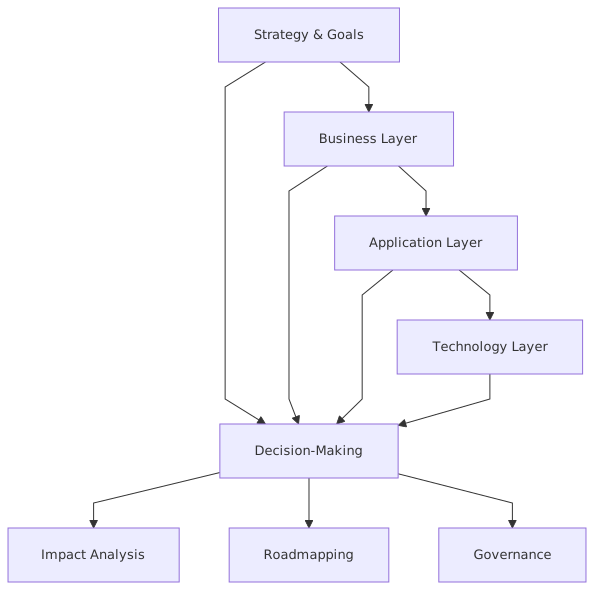
A lot of architecture work sits in the middle: not strategic enough for executives, not technical enough for engineers. ArchiMate helps because it provides a traceable chain from high-level intent to operational reality.
For example, a bank may define a strategic goal:
- Reduce customer onboarding time from 9 days to 30 minutes
That goal relates to outcomes and value.
Those outcomes depend on business capabilities like:
- Customer onboarding
- Identity verification
- Fraud assessment
- Consent management
Those capabilities are realized by business processes and application services.
Those application services depend on systems:
- IAM platform
- CRM
- KYC engine
- Kafka event platform
- Case management
- API gateway
Those systems run on technology:
- cloud Kubernetes clusters
- managed Kafka
- identity federation services
- encrypted storage
- observability stack
Now the decision becomes concrete. If the onboarding target is failing, where exactly is the friction? Is it process design? IAM integration? batch-based fraud checks? poor event choreography? legacy case-routing? cloud latency? duplicated identity stores?
ArchiMate gives a structure for asking those questions with discipline.
2. It exposes impact before people commit to bad ideas
A very common enterprise disease: approving initiatives based on a local optimization.
Example:
A security team decides to centralize IAM policy enforcement for consistency. Good intention. But if they don’t model the business and application impacts, they may introduce latency and failure dependency into every customer login, partner API call, and internal workflow. Suddenly a “security improvement” becomes a resilience problem and a customer experience problem.
With ArchiMate, you can model:
- the business services affected
- the applications consuming IAM
- the interfaces involved
- the technology services hosting policy decision points
- the dependencies on cloud regions or network paths
- the operational consequences if central components fail
This is where architecture earns its keep. Not by saying “it depends,” but by making dependencies visible enough that leaders can choose knowingly.
3. It reduces political ambiguity
A lot of enterprise decisions are political, not technical. Let’s stop pretending otherwise.
ArchiMate helps because it separates claims from structure. If one division says, “We need our own Kafka cluster for autonomy,” and another says, “No, everything must be centralized,” ArchiMate can frame the discussion around operating model, platform services, ownership, interfaces, and constraints rather than tribal preference.
That doesn’t eliminate politics. Nothing does. But it makes weak arguments easier to spot.
4. It supports multiple views for different audiences
This is one of the most practical reasons ArchiMate works in real architecture work.
Executives do not want a deployment view of Kafka brokers, IAM policy stores, and subnet segmentation.
Engineers do not want a strategy map with vague arrows saying “enables digital trust.”
Risk and audit teams need control traceability.
Product teams need service dependency views.
Cloud platform teams need environment and technology relationships.
ArchiMate allows different viewpoints from the same underlying model. That’s crucial. If your architecture story changes every time you redraw it for a new audience, your architecture is probably not stable enough to guide decisions.
Real architecture work: where ArchiMate actually helps
Let’s get away from theory.
In real enterprise architecture work, ArchiMate helps in five routine but painful areas.
Portfolio rationalization
Every large enterprise says it wants to simplify. Very few know how.
You can’t rationalize applications just by listing them. You need to understand:
- which business capabilities they support
- what processes depend on them
- what data they own or use
- what integrations they carry
- what technology dependencies make migration hard
- what risks emerge if they are removed
ArchiMate is useful here because it ties application components to business services and underlying technology. You can see that two onboarding systems might look redundant at the app level, but one still supports a critical regulatory workflow in a specific country. Or the opposite: five different systems all claim to support identity proofing, but only one is actually authoritative.
That changes investment decisions.
Cloud migration planning
Cloud migration is where architecture language often collapses into vendor marketing.
The decision is not “move to cloud or not.”
The decision is:
- which workloads move
- for what business reason
- with what risk
- with what dependency changes
- with what operating model impact
ArchiMate helps map business services to applications and technology nodes, so you can show whether migrating a service actually improves resilience, agility, cost, or compliance—or just shifts pain into a different billing model.
A lot of cloud programs fail because they model infrastructure movement but not service dependency. They move a customer-facing onboarding app to cloud while the KYC engine, IAM master store, and document archive remain tied to on-prem systems over brittle network links. On paper it looks modern. Operationally it’s a distributed mess.
ArchiMate makes that visible early.
IAM transformation
IAM is usually treated as a security domain. That’s too narrow.
Identity and access management is deeply architectural because it sits across customer journeys, workforce operations, partner integration, compliance, and platform controls. If you model IAM only as a technical stack, you miss the business consequences.
With ArchiMate, IAM can be linked to:
- business roles
- processes like customer onboarding or employee joiner-mover-leaver
- application services requiring authentication and authorization
- data objects like identity profiles and consent records
- technology services such as federation, policy enforcement, secrets management, and directory services
This helps answer better questions:
- Where is access policy duplicated?
- Which applications depend on legacy directories?
- What customer journeys break if federation fails?
- Which controls are compensating for poor application design?
- Should authorization be centralized, federated, or domain-owned?
These are enterprise decisions, not just security decisions.
Event-driven architecture with Kafka
Here’s a contrarian thought: buying or deploying Kafka does not mean you have an event-driven architecture. It often means you have a new place to hide integration complexity.
ArchiMate can help distinguish between:
- business events
- application interactions
- integration services
- data flows
- platform dependencies
That matters because many enterprises implement Kafka as a technical utility, not an architectural pattern. They create topics everywhere, no clear ownership, no event contracts, no retention governance, no domain boundaries, and then call it modernization. ArchiMate for governance
When modeled properly, you can see:
- which business processes are triggered by events
- which application services publish and consume them
- which data objects are represented in those events
- what technology services and platform components support the flow
- where failure or replay has business consequences
That is much better decision support than a slide with arrows and the word “real-time.”
Regulatory impact analysis
In banking especially, regulation cuts across everything.
A new requirement about customer consent, auditability, privileged access, or data residency is never isolated. It touches business products, channels, IAM controls, process steps, application logging, event retention, cloud deployment patterns, and operational governance. EA governance checklist
ArchiMate is useful because you can trace a regulatory driver through requirements to capabilities, processes, applications, and infrastructure. That traceability is gold when leaders ask, “What exactly do we need to change, and what happens if we don’t?”
A real enterprise example: retail banking onboarding modernization
Let’s use a realistic case.
A mid-sized retail bank wanted to improve digital account opening. New customers were dropping out at high rates. Manual review queues were huge. Fraud losses were rising. The CIO wanted cloud modernization. Security wanted stronger IAM and MFA. Integration teams wanted Kafka as a strategic event backbone. Everyone was right, and that was the problem.
At the start, each team had a valid but partial view:
- Business: onboarding is too slow and inconsistent
- Security: identity proofing and access controls are weak
- Operations: manual exception handling is overwhelming staff
- Data: customer data is duplicated and unreliable
- Integration: point-to-point APIs are brittle
- Cloud team: legacy hosting slows change and scaling
- Risk: audit evidence is incomplete
Classic enterprise situation. Lots of truth, no single frame.
What the architects did
The architecture team used ArchiMate to create a set of linked views.
They modeled:
- the strategic goal of reducing onboarding time and improving conversion
- business capabilities including onboarding, identity verification, fraud assessment, consent management, and case handling
- the current business process from application submission to account activation
- application services delivered by CRM, IAM, KYC, fraud, case management, API gateway, and notification platforms
- event flows over Kafka for application submitted, identity verified, fraud flagged, consent captured, and account activated
- technology services in cloud and on-prem environments
- security and compliance relationships around IAM, logging, and access controls
This was not a giant “model the universe” exercise. It was scoped tightly around one value stream and its supporting architecture.
That’s another strong opinion: ArchiMate works best when tied to decisions, not when treated like a corporate encyclopedia.
What they discovered
The model surfaced several issues quickly:
- Identity proofing was embedded in multiple channels
Mobile onboarding, branch onboarding, and partner onboarding all had different identity verification logic. The business thought it was one capability. It was actually fragmented.
- Authorization decisions were spread inconsistently
Some applications relied on central IAM roles, some had local entitlements, and some used crude network-based trust. Audit pain was inevitable.
- Kafka was being introduced without event ownership
Teams wanted to publish customer events, but there was no agreed source of truth for customer identity lifecycle events.
- Cloud migration plans ignored a critical legacy dependency
The new onboarding UI was moving to cloud, but document validation still depended on an on-prem imaging service through a fragile integration path.
- Manual case handling was not just an operations issue
It was triggered by poor event correlation and weak exception routing between fraud and KYC systems.
This changed the conversation.
Instead of approving separate initiatives—cloud migration, IAM uplift, Kafka rollout, onboarding redesign—the bank could make one integrated set of decisions:
- centralize identity proofing as a reusable application service
- define ownership for customer lifecycle events on Kafka
- standardize authorization patterns for customer-facing channels
- delay part of the cloud migration until the imaging dependency was addressed
- redesign exception handling as part of the onboarding process, not as an afterthought
That is enterprise decision-making improved by architecture.
Not because the notation was elegant. Because the relationships were visible.
A practical table: how ArchiMate changes decisions
Common mistakes architects make with ArchiMate
This part matters, because a lot of ArchiMate disappointment is self-inflicted.

Mistake 1: Modeling too much, too early
Architects love completeness. Enterprises pay for usefulness.
If you try to model the whole enterprise in one pass, you’ll create a stale repository that nobody trusts. Start from a decision or value stream. Model just enough to answer real questions.
The right scope is usually:
- a business outcome
- a capability slice
- a transformation initiative
- a risk or regulatory concern
- a platform decision with clear enterprise impact
Not the whole planet.
Mistake 2: Treating ArchiMate as an end in itself
This is probably the most common failure.
The goal is not to produce “an ArchiMate model.”
The goal is to improve a decision.
If the model doesn’t help answer:
- what should we invest in?
- what should we retire?
- what is impacted?
- where is the risk?
- who owns what?
then it’s probably architecture theater.
Mistake 3: Staying too abstract
Some architects hide in abstraction because detail is messy.
They create capability maps and strategic views that sound intelligent but don’t connect to systems, interfaces, events, controls, or deployment realities. Then engineering ignores them, and honestly, engineering is often right to do so.
Good ArchiMate work moves between levels:
- strategic enough for business leaders
- concrete enough for delivery teams
If you can’t connect “improve customer trust” to actual IAM services, access policies, application behavior, and operating constraints, you’re not doing architecture. You’re doing mood boards.
Mistake 4: Confusing the metamodel with reality
ArchiMate gives structure, but enterprises are messy. Not every relationship is clean. Not every ownership line is stable. Sometimes the right answer is “this is a temporary hybrid and we should model that honestly.”
I’ve seen architects force reality into the notation instead of using notation to clarify reality. That leads to brittle models and fake precision.
Use the language rigorously, yes. Worship it, no.
Mistake 5: Ignoring operating model and governance
Architecture decisions don’t live only in diagrams. They live in funding, ownership, support models, controls, and team boundaries.
For example, you can model a beautifully centralized Kafka platform, but if no team owns topic governance, schema standards, tenant isolation, and support SLAs, the platform will decay. Same for IAM. Same for cloud landing zones.
ArchiMate can represent structural relationships, but the architect still has to bring organizational judgment. This is where experience matters more than notation.
Contrarian view: ArchiMate is not always the answer
It’s worth saying this out loud.
Sometimes ArchiMate is overkill.
If a team is making a narrow technical decision inside a bounded product context, they may not need enterprise modeling. A lightweight C4 diagram, sequence diagram, or decision record may be better. Not every problem deserves enterprise architecture treatment.
Also, some organizations adopt ArchiMate before they have any architectural discipline. That’s backwards. If there is no agreed vocabulary, no governance rhythm, no repository ownership, no stakeholder engagement, and no decision process, ArchiMate will not rescue you. It will just formalize confusion.
And one more contrarian point: many executives do not care about ArchiMate at all. They care about clarity, trade-offs, cost, risk, and speed. Good. They should. The architect’s job is not to sell the notation. The job is to use it behind the scenes, and sometimes visibly, to make those trade-offs sharper.
That’s the mature stance.
How to use ArchiMate well in real enterprise architecture practice
Here’s the practical pattern I’ve seen work.
1. Start from a business decision, not a modeling ambition
Pick a live issue:
- modernize onboarding
- reduce IAM risk
- rationalize integration platforms
- sequence cloud migration
- respond to a regulatory change
Then define the key questions decision-makers need answered.
2. Build a small core model
Model only the essential elements:
- goals and outcomes
- business capabilities and processes
- application services and major systems
- key data objects
- technology services and environments
- critical dependencies and constraints
Don’t boil the ocean.
3. Create stakeholder-specific views
Use the same model to generate different conversations:
- executive investment view
- dependency/risk view
- platform impact view
- security/control traceability view
- delivery transition view
This is where ArchiMate shines.
4. Keep the model tied to change
Architecture repositories die when they become archives.
Link the model to:
- initiatives
- transition states
- standards
- risk items
- target-state roadmaps
If the model doesn’t move with the change portfolio, people stop believing it.
5. Use it to challenge assumptions
This is the real architect move.
Not “here is the approved diagram.”
But:
- Why are we centralizing this service?
- Why is this capability fragmented?
- Why does this cloud move increase dependency risk?
- Why is IAM solving for policy consistency but harming resilience?
- Why are Kafka events modeled around systems instead of business facts?
ArchiMate gives a language for those challenges. The architect still needs courage.
Why this matters more now
Enterprise decision-making has become harder, not easier.
Cloud has increased deployment options but also complexity.
Kafka and event-driven patterns have improved decoupling but also multiplied integration sprawl when unmanaged.
IAM has become central to zero trust, customer identity, and compliance, but many enterprises still treat it as a side domain.
Banking and other regulated sectors face constant pressure to modernize without losing control.
In that environment, leaders need more than technical recommendations. They need architectural truth that crosses silos.
That’s the promise of ArchiMate when used well.
Not exhaustive truth. Not perfect truth. But enough structured truth to make better enterprise decisions.
And frankly, that’s already rare.
Final take
ArchiMate improves enterprise decision-making because it helps organizations see cause and effect across business, application, technology, and risk. It reduces ambiguity. It makes impact visible. It supports meaningful conversations between executives, architects, engineers, and control functions.
But—and this is important—it only works when architects use it as a decision instrument, not a diagramming religion.
The best ArchiMate practitioners I know are not obsessed with notation. They are obsessed with clarity. They use the language to expose dependencies, challenge lazy assumptions, and make trade-offs explicit. They know when to go deep, when to keep it simple, and when not to use ArchiMate at all.
That’s real architecture work.
If your enterprise keeps making expensive decisions in fragments—one cloud program here, one IAM initiative there, one Kafka platform somewhere else—then ArchiMate can help stitch reality back together.
And if it doesn’t change decisions, don’t blame the language too quickly. Blame the architecture practice.
FAQ
1. Is ArchiMate only useful for large enterprises?
Mostly, yes. Smaller organizations can use it, but the payoff is highest when complexity crosses business units, applications, platforms, and governance domains. In a bank with multiple channels, IAM dependencies, Kafka-based integration, and hybrid cloud, it becomes much more valuable.
2. How is ArchiMate different from UML or C4?
UML is stronger for software design detail. C4 is great for communicating software architecture simply. ArchiMate is better for enterprise-level relationships across strategy, business, applications, technology, and change. Different tools, different jobs.
3. Can ArchiMate help with cloud and platform architecture decisions?
Yes, if used properly. It helps show how cloud choices affect business services, application dependencies, resilience, security controls, and operating models. It is far more useful than a cloud vendor reference diagram when you need enterprise trade-off decisions.
4. How does ArchiMate help with Kafka and event-driven architecture?
It helps distinguish business events, application interactions, services, and platform dependencies. That makes event ownership, impact analysis, and governance much clearer. It stops Kafka from becoming just another integration black box.
5. What is the biggest mistake teams make when adopting ArchiMate?
Treating it as a modeling exercise instead of a decision-support capability. If the model is not helping leaders decide what to change, invest in, simplify, or control, then it’s just a polished artifact with no operational value.
Frequently Asked Questions
What is enterprise architecture?
Enterprise architecture is a discipline that aligns an organisation's strategy, business processes, information systems, and technology. Using frameworks like TOGAF and modeling languages like ArchiMate, it provides a structured view of how the enterprise operates and how it needs to change.
How does ArchiMate support enterprise architecture practice?
ArchiMate provides a standard modeling language that connects strategy, business operations, applications, data, and technology in one coherent model. It enables traceability from strategic goals through business capabilities and application services to the technology platforms that support them.
What tools are used for enterprise architecture modeling?
The main tools are Sparx Enterprise Architect (ArchiMate, UML, BPMN, SysML), Archi (free, ArchiMate-only), and BiZZdesign Enterprise Studio. Sparx EA is the most feature-rich option, supporting concurrent repositories, automation, scripting, and integration with delivery tools like Jira and Azure DevOps.