⏱ 20 min read
Most data platforms don’t fail because the technology is weak. They fail because nobody can answer a simple question with confidence: what, exactly, is this data and who is responsible for it after the dashboard goes live? That is the quiet scandal at the heart of enterprise analytics. We spend millions building pipelines, lakes, warehouses, semantic layers, Kafka backbones, machine learning platforms—and then treat data like exhaust fumes from operational systems rather than as products with a lifecycle.
A data mesh changes the conversation. It says data should be owned close to the business domains that create and understand it. It says analytical data is not a side effect. It is a product. But the phrase “data product” is often used like a slogan. Nice on slides. Dangerous in implementation. If everything is a data product, nothing is. If every table with a README is a product, we have not built a mesh; we have rebranded our mess.
The useful question is not whether a data product exists. The useful question is how it lives: how it is conceived, designed, implemented, governed, evolved, reconciled with reality, and eventually retired without leaving broken consumers behind. That is the data product lifecycle. And in a serious enterprise, lifecycle is where architecture stops being theory and starts costing money.
This article looks at the lifecycle of data products in a data mesh through an enterprise architecture lens: domain-driven design, migration from legacy platforms, Kafka and microservices where they matter, reconciliation patterns, operational concerns, and the hard edges—the tradeoffs, the failure modes, and when not to use this approach at all. event-driven architecture patterns
Context
Data mesh emerged as a reaction to a familiar enterprise pattern: a centralized data team becomes a bottleneck, detached from domain knowledge yet accountable for every downstream report, model, and integration. Business teams complain that the platform is slow. The platform team complains that source systems are inconsistent. Everybody is correct, and nothing improves.
The traditional central lake-and-warehouse model assumes scale comes from consolidation. In practice, consolidation often creates distance. The people who understand customer orders, claims adjudication, card authorizations, inventory positions, or patient encounters are not the people managing generic ingestion pipelines in a central team. As a result, the most important thing in data architecture—meaning—gets diluted.
This is where domain-driven design matters. A data mesh is not just decentralized storage plus catalogs. It is domain ownership applied to analytical data. A domain should publish data products that reflect its bounded context, use its language correctly, and expose stable contracts to consumers. “Order” means something in commerce. “Shipment” means something in logistics. “Customer” means something different in CRM, billing, fraud, and support. A mature architecture does not pretend those differences vanish. It makes them explicit.
The lifecycle of a data product therefore has to respect domain semantics from day one. Otherwise, teams end up publishing technically polished nonsense.
Problem
Enterprises are full of accidental data products.
A team exposes a curated table because a report needs it. Another adds a Kafka topic because a downstream machine learning model wants more timely events. A third publishes an API-backed extract because finance needs month-end adjustments. None of these are inherently bad. The problem is they are usually born as implementation artifacts rather than intentional products.
That creates predictable trouble:
- nobody agrees on the business meaning of the data
- schema changes break consumers unexpectedly
- quality issues are detected too late
- event streams drift from transactional truth
- ownership is ambiguous across source teams, platform teams, and analytics teams
- duplicate “gold” datasets emerge for the same concept
- deprecation never happens, so every legacy output becomes immortal
The result is a platform that looks decentralized but behaves chaotically. Data mesh without lifecycle discipline is just distributed confusion.
A real enterprise architecture must answer a tougher set of questions:
- When does a domain dataset deserve to become a data product?
- How are semantic boundaries defined?
- What is the contract: schema, SLAs, lineage, retention, access, and quality expectations?
- How do event streams reconcile with source-of-record systems?
- How do we evolve products without causing organizational whiplash?
- How do we migrate from centralized legacy estates without a reckless rewrite?
Those are lifecycle questions, not tooling questions.
Forces
Several forces shape the lifecycle of data products in a mesh.
1. Domain semantics versus enterprise standardization
Domain teams know the business meaning best. But enterprises also need cross-domain interoperability. Left alone, domains optimize for local language and speed. Centrally controlled, they lose nuance. Good architecture does not choose one side blindly. It creates local autonomy with explicit interoperability mechanisms.
2. Event timeliness versus correctness
Kafka and event-driven architectures make data products more timely, but timeliness is not truth. Streams often represent business activity before reconciliation, enrichment, cancellation, reversal, or settlement. If architects ignore this, consumers trust data that is fast but wrong.
3. Product ownership versus platform leverage
If every domain must independently solve storage, observability, quality monitoring, schema management, and access control, costs explode. If the platform does everything, domains are merely ticket submitters again. The platform must be a paved road, not a central factory.
4. Evolution versus stability
Data products must evolve as businesses change. But consumers need stable contracts. This is the old API versioning problem wearing data clothes. Schema evolution, deprecation windows, backward compatibility, and communication rituals matter more than most teams expect.
5. Decentralized accountability versus regulatory control
In regulated sectors—banking, healthcare, insurance, telecom—data products cannot be published with casual governance. Privacy, retention, residency, model risk, auditability, and access control have to be built into the lifecycle, not taped on at the end. EA governance checklist
6. Legacy gravity
No enterprise starts greenfield. There is always a warehouse with 5,000 reports, an MDM platform nobody loves but everybody depends on, nightly batch jobs, and downstream finance processes that can’t fail. Migration strategy is not a side chapter. It is the story.
Solution
The pragmatic solution is to define the data product lifecycle as a managed progression through a set of states, each with explicit responsibilities, controls, and exit criteria. A data product should move from idea to retirement with the same seriousness we apply to service lifecycle management.
At a high level, the lifecycle looks like this:
- Discover — identify a domain need, consumer need, or reuse opportunity
- Define — shape domain semantics, ownership, contract, and success measures
- Design — select data model, publication mechanisms, quality rules, and governance controls
- Build — implement pipelines, transformations, topics, APIs, storage, tests, and metadata
- Validate — prove data quality, semantic correctness, operability, and consumer fitness
- Publish — make the product discoverable and consumable with clear SLAs and access paths
- Operate — monitor freshness, quality, schema drift, usage, incidents, and cost
- Evolve — version safely, add fields, split products, merge semantics, refine quality
- Deprecate — announce retirement, support migration, reconcile remaining consumers
- Retire — remove operational burden while preserving required lineage and audit history
That sequence is simple enough to explain, but in enterprise work the devil lives in the transitions. The transition from define to design is where semantics become architecture. The transition from validate to publish is where wishful thinking meets production. And the transition from evolve to deprecate is where organizational courage is tested.
Here is a simple lifecycle view.

This is not just process choreography. Each stage should produce artifacts:
- business definition and bounded context
- domain owner and product owner assignment
- schema and event contract
- data quality rules and acceptance thresholds
- lineage and classification metadata
- access policy
- service objectives for freshness, availability, and support
- migration and reconciliation plans
- deprecation policy
Without those artifacts, the “product” is really just a dataset with better branding.
Architecture
A workable mesh architecture separates concerns cleanly:
- Domain teams own the semantics and lifecycle of their data products.
- Platform teams provide self-serve capabilities: storage, stream infrastructure, compute, catalog, policy enforcement, observability, CI/CD, quality tooling.
- Federated governance defines enterprise guardrails: naming conventions, classification, policy-as-code, interoperability standards, data contract rules.
- Consumers use products through discoverable interfaces: tables, topics, APIs, semantic views, feature stores, or reverse ETL outputs.
The architectural trick is to treat a data product as more than one thing at once:
- A semantic asset — it encodes domain meaning
- A technical asset — it is implemented in pipelines, topics, storage, and schemas
- An operational asset — it has SLAs, incidents, runbooks, and support
- A governance asset — it has classification, lineage, retention, and access controls
That means architecture decisions have to reflect use cases, not dogma. Some data products are best published as immutable event streams on Kafka. Others are better as curated analytical tables in a warehouse or lakehouse. Some need both: an operational event stream and a reconciled analytical projection.
Domain semantics and bounded contexts
This is where DDD earns its keep.
A domain should not publish an “enterprise customer master” unless it genuinely owns that concept. More often, domains publish their view of a concept:
- Sales publishes Prospect and Account
- Billing publishes Billable Party
- Service publishes Subscriber
- Identity publishes Verified Individual
Trying to collapse these into one canonical definition too early usually creates political fiction rather than useful architecture. Better to expose them as distinct bounded contexts and create explicit mappings where needed.
A good data product description answers:
- What business decision does this support?
- What terms does this use, and what do they mean?
- What does it exclude?
- What is the authoritative source for each attribute?
- Is it event data, state data, or derived analytical data?
- What should consumers never assume?
Those are semantic contracts, not just schema comments.
Event-driven and batch coexistence
In many enterprises, the cleanest lifecycle uses both microservices and Kafka for operational capture, plus batch or streaming transformations for analytical serving. The mistake is assuming raw events are automatically fit for analytics. They are not. They often carry operational concerns, retries, duplicate emissions, partial states, or service-specific identifiers.
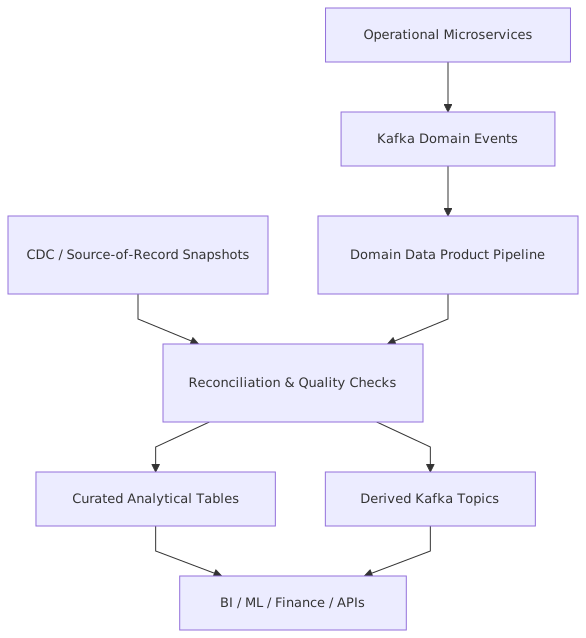
A common pattern is:
- microservices emit domain events to Kafka
- a domain data product pipeline consumes and validates them
- reconciliation jobs compare stream-derived state to source-of-record snapshots or CDC feeds
- curated, consumer-friendly outputs are published as tables, views, or derived topics
That architecture acknowledges reality: event streams are powerful, but reconciliation is non-negotiable.
Reconciliation as a first-class lifecycle concern
Reconciliation deserves special emphasis because it is routinely neglected.
In a distributed enterprise, event loss, duplicate messages, delayed processing, out-of-order delivery, code defects, source corrections, and late business adjustments all happen. If a data product is built from streams, somebody must prove that the product still aligns with reality.
Reconciliation can take several forms:
- record-level reconciliation against source systems
- aggregate balancing by count, amount, status, and time window
- business rule reconciliation such as “all shipped orders must have an invoice within X hours”
- financial reconciliation where totals must match ledger or settlement systems
- temporal reconciliation to handle late-arriving events and backdated corrections
This is especially important in domains like payments, claims, and inventory. In those domains, “near real-time” without reconciliation is just a faster way to be wrong.
Migration Strategy
A data mesh is not introduced by proclamation. It is grown by strangling the old center of gravity.
The right migration strategy is almost always progressive strangler migration. Start with one or two high-value domain data products, build the platform capabilities needed to support them, and gradually route new consumers to the new products while leaving legacy systems running until confidence is earned.
A sensible migration path often looks like this:
Step 1: Identify domains and candidate products
Choose domains with:
- clear business ownership
- strong demand from multiple consumers
- manageable semantic boundaries
- enough pain in the current centralized model to justify change
Avoid starting with the most politically tangled, enterprise-wide “customer 360” problem. That is not courage; it is vanity.
Step 2: Establish the platform baseline
Before decentralizing publication, provide the basics:
- data catalog and discoverability
- access management and policy enforcement
- schema registry for event contracts
- observability and quality monitoring
- CI/CD templates
- standard storage and compute paths
- lineage capture
Without this paved road, domain teams will improvise and entropy will win.
Step 3: Create parallel products
Publish the new domain data product alongside legacy warehouse outputs. Do not cut over immediately. Compare outputs, validate consumer fitness, and run reconciliation over time.
Step 4: Migrate consumers incrementally
Move a subset of reports, downstream pipelines, APIs, and models to the new product. Learn from actual usage. Fix semantic gaps. Tighten operational controls.
Step 5: Deprecate central transformations selectively
Once consumer adoption and trust are established, retire corresponding central ETL logic. Not all at once. Product by product.
Step 6: Expand by domain, not by platform ambition
Scale through repeated wins, not a grand redesign of the entire enterprise information landscape.
A migration diagram makes the point.

Why strangler works
Because enterprise data estates are not software katas. They are living systems with finance deadlines, audit requirements, contractual reporting obligations, and operational dependencies nobody fully remembers until they break. A strangler approach buys learning, trust, and reversibility.
What to watch in migration
- duplicated logic between old and new paths
- semantic mismatches hidden by familiar field names
- old consumers depending on undocumented quirks
- reconciliation gaps between event-driven and batch-driven outputs
- platform immaturity causing teams to bypass standards
- rising cost due to prolonged parallel runs
Migration is not free. Parallel worlds are expensive. But the alternative—a big-bang data replatform—is usually a polished route to organizational trauma.
Enterprise Example
Consider a large retail bank modernizing its data estate.
For years, the bank ran a centralized enterprise data warehouse fed by nightly ETL from core banking, card processing, CRM, collections, and digital channels. Every team depended on the warehouse. Every change request joined a queue. Fraud wanted near real-time card transaction data. Finance wanted reconciled ledger views. Marketing wanted customer interaction history. Risk wanted explainable data lineage for models. Nobody got what they wanted at the speed they needed.
The bank adopted a data mesh model with initial domains:
- Cards
- Current Accounts
- Customer Interaction
- Collections
- Finance
The first serious data product came from the Cards domain: Card Authorization Events and Settlement View.
This was deliberately split into two related products:
- Authorization Event Stream on Kafka
Used for fraud analytics and real-time monitoring. Timely, event-oriented, operationally shaped.
- Reconciled Card Transaction Ledger View in the lakehouse/warehouse
Used for finance, dispute handling, and regulatory reporting. Slower, corrected, settled, and balanced against processor and ledger systems.
That split mattered. One product served rapid decisioning; the other served truth after adjustment. Calling them the same thing would have been architecturally dishonest.
The lifecycle played out like this:
- Discover: fraud and finance both needed card data, but with different latency and correctness expectations.
- Define: the Cards domain defined business terms such as authorization, clearing, reversal, settlement, merchant category, and dispute state. They documented what each product represented and what it did not.
- Design: Kafka topics were registered with versioned schemas; reconciliation rules compared event-derived aggregates to processor files and general ledger totals.
- Build: microservices emitted authorization events; CDC from card processor tables fed balancing logic; platform tooling enforced metadata and access policies.
- Validate: the bank ran the new products in parallel with warehouse feeds for two statement cycles.
- Publish: fraud and operations consumed the stream first; finance adopted the reconciled ledger view after controls passed audit review.
- Operate: freshness, duplicate rate, balancing breaks, and late event percentages were monitored daily.
- Evolve: new fields for tokenized wallet transactions were added under backward-compatible schema rules.
- Deprecate: legacy ETL marts for card authorization reporting were retired after consumer migration.
- Retire: obsolete extracts to old reporting tools were removed, but lineage and historical schema documentation were preserved.
This is what good enterprise architecture looks like: not ideology, but shaped decisions under real constraints.
Operational Considerations
A data product becomes real in operations.
Ownership and support
Every product needs named owners:
- domain product owner
- technical owner
- platform support contact
- governance steward where required
If nobody is on the hook for incidents, the ownership model is fiction.
Observability
You need more than pipeline success metrics. Useful signals include:
- freshness lag
- schema drift
- null or default spikes
- duplicate event rate
- reconciliation breaks
- volume anomalies
- consumer usage patterns
- cost per query or per pipeline run
Data quality
Quality rules should be explicit and automated:
- validity checks
- referential consistency
- completeness
- timeliness
- uniqueness
- domain-specific invariants
The important point is that quality is contextual. A marketing propensity feature store and a financial ledger view do not require the same thresholds.
Metadata and discoverability
A data product that cannot be found, understood, or trusted is not a product. Catalog entries should include:
- business description
- owner
- schema
- sample usage
- SLA/SLOs
- classification
- lineage
- quality scores
- deprecation status
Security and governance
Federated governance should enforce:
- data classification
- access approval workflows
- masking and tokenization
- residency controls
- retention and deletion policy
- audit trails
In highly regulated enterprises, policy-as-code is not optional. Manual governance does not scale. ArchiMate for governance
Cost management
Mesh advocates sometimes underplay the cost side. Decentralized products create duplicated storage, compute, and support overhead. Without FinOps discipline, data mesh becomes a tax on enthusiasm.
Tradeoffs
Let’s be blunt: data mesh is not free decentralization magic.
Benefits
- semantics stay closer to domain expertise
- product ownership improves quality and responsiveness
- consumers get clearer contracts
- platform capabilities become reusable rather than bespoke
- event-driven products can support near real-time use cases
- architecture aligns better with microservice-oriented organizations
Costs
- governance is harder, not easier
- domain maturity varies widely
- duplicated effort appears across teams
- interoperability requires disciplined standards
- lifecycle management introduces overhead
- reconciliation and parallel migration add significant complexity
The central tradeoff is simple: you trade centralized bottlenecks for decentralized coordination. That is often a good deal. But it is still a trade.
A mesh works when domains are capable and motivated to own data as a product. It struggles when decentralization is merely an org-chart aspiration unsupported by skills, incentives, or platform investment.
Failure Modes
Most failed data mesh programs fail in familiar ways.
1. Data products without real product management
Teams publish datasets but do not define consumers, quality goals, or support expectations. The result is abandoned outputs.
2. Platform vacuum
The organization declares domain ownership but does not provide self-serve tooling. Each domain invents its own stack. Chaos arrives wearing the badge of autonomy.
3. Semantic collapse
Everybody publishes “customer,” “order,” and “revenue” with slightly different meanings and no explicit context mapping. Consumers quietly revert to spreadsheets and tribal knowledge.
4. Raw-event worship
Architects assume Kafka topics are sufficient data products. Downstream teams inherit operational complexity, duplicates, late events, and source-specific quirks. Trust drops.
5. No reconciliation discipline
Stream-derived data diverges from source systems and nobody notices until finance or regulators do.
6. Infinite parallel run
Legacy and new products both survive because deprecation is politically uncomfortable. Costs rise, confusion deepens, and the migration story never ends.
7. Governance backlash
Early decentralization creates compliance incidents. Leadership responds by recentralizing everything. Often the issue was not mesh itself, but lack of federated controls.
The common thread is that data mesh punishes half-measures. It is less forgiving than people think.
When Not To Use
Data mesh is not the default answer for every data architecture.
Do not use it when:
The organization is small and centralized by nature
If one capable team can manage the platform and understands most business semantics, mesh may add more coordination than value.
Domains are weak or unstable
If business ownership is unclear, processes change weekly, or teams cannot support production products, decentralization simply exposes the weakness.
The main problem is basic data platform immaturity
If the enterprise lacks cataloging, quality monitoring, reliable storage, access control, or metadata, solve those first. Mesh on top of disorder is ornamental architecture.
Use cases are narrow and mostly reporting-oriented
For a relatively stable reporting estate, a well-run centralized warehouse can be perfectly sensible.
Regulatory requirements demand extreme central control and the organization cannot implement federated governance
In some contexts, central stewardship remains the safer operating model.
Architecture is not a morality play. Centralized data platforms are not obsolete. They are just often overused.
Related Patterns
Several patterns work well alongside the data product lifecycle in a mesh.
Data contracts
Versioned agreements on schema, semantics, and compatibility between producers and consumers.
Event sourcing and CDC
Useful for capturing domain changes, but they should feed curated products rather than be mistaken for final truth.
Medallion or layered transformations
Bronze, silver, gold can still exist within a product implementation, provided the product contract is clear and not confused with internal pipeline stages.
Semantic models
Cross-domain consumption often benefits from semantic layers that map multiple bounded contexts into business-facing measures and dimensions.
Master/reference data patterns
Some cross-domain entities require stewardship and harmonization. That does not eliminate bounded contexts; it complements them.
Strangler fig migration
Essential for moving from legacy warehouses and ETL estates to domain-owned products incrementally.
Data observability
Not a luxury. It is the operating system for trust in decentralized data architectures.
Summary
A data mesh becomes credible when data products have a disciplined lifecycle.
That lifecycle starts with domain semantics, not storage. It turns ownership into something operationally real. It forces teams to define contracts, quality rules, and governance controls before publication. It makes reconciliation a first-class concern, especially when Kafka, microservices, and event-driven pipelines are involved. And it gives enterprises a practical migration path through progressive strangler patterns rather than heroic rewrites. microservices architecture diagrams
The sharpest lesson is this: a data product is not just data made available. It is data made accountable.
That accountability has to survive design changes, schema evolution, consumer growth, audit scrutiny, operational incidents, and retirement. Without lifecycle discipline, data mesh collapses into distributed ETL with better marketing. With it, organizations can finally align analytical data with the domains that understand it best while still operating at enterprise scale.
If you remember one line, remember this one: decentralize meaning, standardize the road, and never confuse fast data with true data. That is the heart of the data product lifecycle in a serious data mesh.
Frequently Asked Questions
What is a data mesh?
A data mesh is a decentralised data architecture where domain teams own and serve their data as products. Instead of a central data team, each domain is responsible for data quality, contracts, and discoverability.
What is a data product in architecture terms?
A data product is a self-contained, discoverable, trustworthy dataset exposed by a domain team. It has defined ownership, SLAs, documentation, and versioning — treated like a software product rather than an ETL output.
How does data mesh relate to enterprise architecture?
Data mesh aligns data ownership with business domain boundaries — the same boundaries used in domain-driven design and ArchiMate capability maps. Enterprise architects play a key role in defining the federated governance model that prevents data mesh from becoming data chaos.