⏱ 18 min read
Most enterprise integration landscapes don’t fail because the technology is weak. They fail because the business changes faster than the plumbing. A pricing rule shifts. A fraud model evolves. A customer event arrives out of order. Then the neat little request-response world starts to creak, and teams discover they have built a system optimized for yesterday’s certainty.
Reactive pipeline architecture is what happens when we stop pretending the world is tidy.
It is not just “using Kafka” or “adding asynchronous messaging.” That’s cargo cult architecture. A reactive pipeline is an architectural style for systems that continuously ingest, transform, enrich, route, and react to streams of domain events. It treats change as normal, latency as variable, and failure as unavoidable. Done well, it gives you a platform that bends under pressure instead of snapping. Done badly, it becomes an expensive event-shaped mess.
This article is about the real thing: how reactive pipeline architecture works in streaming systems, where it belongs, where it goes wrong, and how to migrate toward it without setting your enterprise on fire.
Context
Large organizations accumulate processing logic the way old cities accumulate alleyways. There’s an order system over here, a risk engine there, a CRM with its own view of the customer, and a nightly batch process trying heroically to reconcile the lot. For years, this is tolerable. Then the business asks for real-time personalization, sub-second fraud checks, event-driven order orchestration, operational analytics, and cross-channel consistency.
That’s when the old model starts fighting back.
Traditional integration patterns tend to assume one of two worlds:
- Synchronous request-response, where one system asks another for an answer now.
- Batch-oriented data movement, where systems dump files or tables on schedules and hope tomorrow is good enough.
Reactive pipeline architecture occupies the ground between them and beyond them. It is built for continuous flows of facts: orders created, payments authorized, inventory reserved, shipments delayed, claims reopened, sensors reporting, customers updating preferences. These are not mere messages. They are business signals. The architecture only works if we respect that distinction.
And this is where domain-driven design matters. In streaming systems, the shape of your events is not just a technical contract. It is a statement about the business. “OrderPlaced” is meaningful. “OrderRowInserted” is laziness with serialization.
Reactive systems live or die by domain semantics.
Problem
Enterprises increasingly need to process high-volume, low-latency streams while preserving business correctness across distributed services. That sounds respectable in a slide deck. In production, it means problems like these:
- A payment authorization arrives before the order service has emitted the order creation event.
- Inventory is allocated twice because two consumers interpret the same event differently.
- One service sees “customer premium status” as immediate, another sees it after a delay, and now pricing disputes appear.
- Teams create topic forests with no shared language, no ownership model, and no reconciliation strategy.
- A legacy core system remains the system of record, but downstream services start behaving as if Kafka is the truth.
The challenge is not simply moving data quickly. It is maintaining coherent business behavior when processing becomes asynchronous, distributed, replayable, and eventually consistent.
That combination changes the architecture game.
In a request-response world, control is explicit. In a reactive pipeline, control is inferred from event flow, buffering, partitioning, subscription, retries, offsets, and state stores. The pipeline becomes the execution path. And that means architecture must address not only throughput and latency, but also meaning, accountability, and recovery.
Forces
Reactive pipeline architecture exists because several forces pull in different directions at once.
1. The business wants immediacy
Fraud scoring, dynamic fulfillment, usage-based billing, customer notifications, and real-time analytics all depend on reacting to events as they happen. Waiting for nightly ETL is often not acceptable.
2. The enterprise landscape is fragmented
Different bounded contexts own different parts of the truth. Sales owns opportunities. Fulfillment owns shipments. Finance owns settlement. Customer service owns cases. There is no single monolithic model that should dominate all streams.
That is not a flaw. That is reality.
3. Scale is uneven
Some event streams are tiny but critical. Others are huge and mundane. A support case reopened might matter more than a million clickstream events. Architecture must support both without flattening them into the same operational posture.
4. Failures are normal
Consumers go down. Partitions rebalance. Network links flap. Schema evolution gets botched. Duplicate delivery happens. Delays happen. If your architecture assumes perfect ordering and exactly-once business outcomes by magic, you are writing fiction.
5. Domain semantics must survive technical abstraction
The more generic the pipeline becomes, the less useful it is. Teams that build a “universal event bus” without domain boundaries end up with what I call semantic bankruptcy: lots of movement, very little meaning.
6. Legacy systems cannot be replaced overnight
No serious enterprise gets to redraw the landscape from scratch. The architecture must support progressive migration, anti-corruption layers, coexistence, and reconciliation with systems that remain authoritative for years.
These forces create the need for a style that is reactive, domain-aware, and operationally disciplined.
Solution
Reactive pipeline architecture structures streaming systems as a set of event-driven processing stages, each responsible for a meaningful domain transformation or reaction. Events are emitted by producers, persisted in a durable stream platform such as Kafka, processed by specialized services or stream processors, and consumed by downstream services that maintain local state, trigger actions, or publish new domain events. event-driven architecture patterns
The idea sounds simple because the boxes in the diagram are simple. The hard part is deciding what each box means.
A good reactive pipeline has a few essential characteristics:
- Domain events, not technical change logs, are the primary language
- Bounded contexts own their streams and event contracts
- Processing stages are small enough to reason about but rich enough to encapsulate domain logic
- State is local, derived, replayable where possible, and reconciled where necessary
- Backpressure, retries, dead-letter handling, and replay are deliberate design choices, not afterthoughts
- The system tolerates out-of-order, duplicate, and delayed events without corrupting business outcomes
This is not merely event-driven architecture with better branding. The “pipeline” matters. Events do not just bounce around. They flow through purposeful stages of validation, enrichment, correlation, decisioning, and action.
Here is a canonical shape.

Notice a few things.
First, Kafka is not the architecture. It is the transport and persistence backbone. The architecture lies in the decomposition of responsibilities and the semantics of events.
Second, some stages are transformative and others are reactive. Validation and canonicalization make events usable. Enrichment adds context. Decision services apply policy. Action services interact with external systems or mutate domain state. Read models provide query-optimized views.
Third, feedback loops are normal. Action services publish subsequent domain events. This means the pipeline is not linear in the simplistic sense. It is a graph with a directed flow and local feedback cycles.
That graph must still honor domain boundaries.
Architecture
Let’s get concrete.
Event backbone
Kafka is a common fit because it offers durable logs, partitioning, replay, and consumer groups. Those are valuable traits for reactive pipelines. But Kafka should be organized by domain ownership, not by infrastructure vanity. Topics should reflect bounded contexts and event types that the business understands.
Examples:
orders.order-placedpayments.payment-authorizedinventory.stock-reservedcustomer.profile-amended
That naming discipline is not pedantry. It affects discoverability, governance, and contract evolution. EA governance checklist
Processing layers
A reactive pipeline often includes several kinds of processing:
- Ingress adapters
These accept input from external systems, APIs, CDC feeds, or partner channels. Their job is translation, authentication, coarse validation, and publication into the event backbone.
- Canonicalization and anti-corruption layers
Especially during migration, raw legacy events or table-change feeds are rarely suitable domain events. An anti-corruption layer converts legacy semantics into domain language that downstream services can trust.
- Stateful stream processors
These perform correlation, joins, deduplication, temporal logic, sliding window calculations, and lightweight business decisions. Kafka Streams, Flink, or similar technologies often fit here.
- Domain microservices
These own business capabilities and local state. They consume domain events, apply rules, persist decisions, and emit new events. They are not generic handlers; they are domain actors.
- Materialized views and projections
These create read-optimized models for APIs, dashboards, and operational support.
Domain semantics discussion
Here is where too many designs go soft. In a reactive pipeline, event design has to reflect business facts and business decisions.
A useful distinction:
- Fact events: something that happened in the domain
Example: PaymentAuthorized
- Decision events: a policy or conclusion was reached
Example: OrderFlaggedForReview
- Command-like intent events: a request to perform an action
Example: ReserveStockRequested
If everything is modeled as a fact, the system becomes vague. If everything is modeled as a command, it becomes tightly coupled. A healthy pipeline uses all three sparingly and deliberately.
DDD helps here. Each bounded context should define its own ubiquitous language and publish events from that language. Downstream consumers may translate those events into their own terms rather than forcing a single enterprise-wide canonical model on everyone. A little translation is cheaper than a giant semantic compromise.
Control and state
Reactive pipelines are stateful whether architects admit it or not. Deduplication requires state. Correlation requires state. Windowing requires state. Idempotency requires state. Reconciliation certainly requires state.
The practical rule is this: put state near the logic that needs it, but be explicit about source-of-truth boundaries.
You may have:
- local state stores in stream processors
- service-owned databases in microservices
- compacted Kafka topics for current entity state
- read models derived from event streams
- a legacy system that remains authoritative for settlement or regulatory reporting
The trick is not to eliminate multiple states. The trick is to know which one is authoritative for which decision.
Here is a more detailed architecture view.
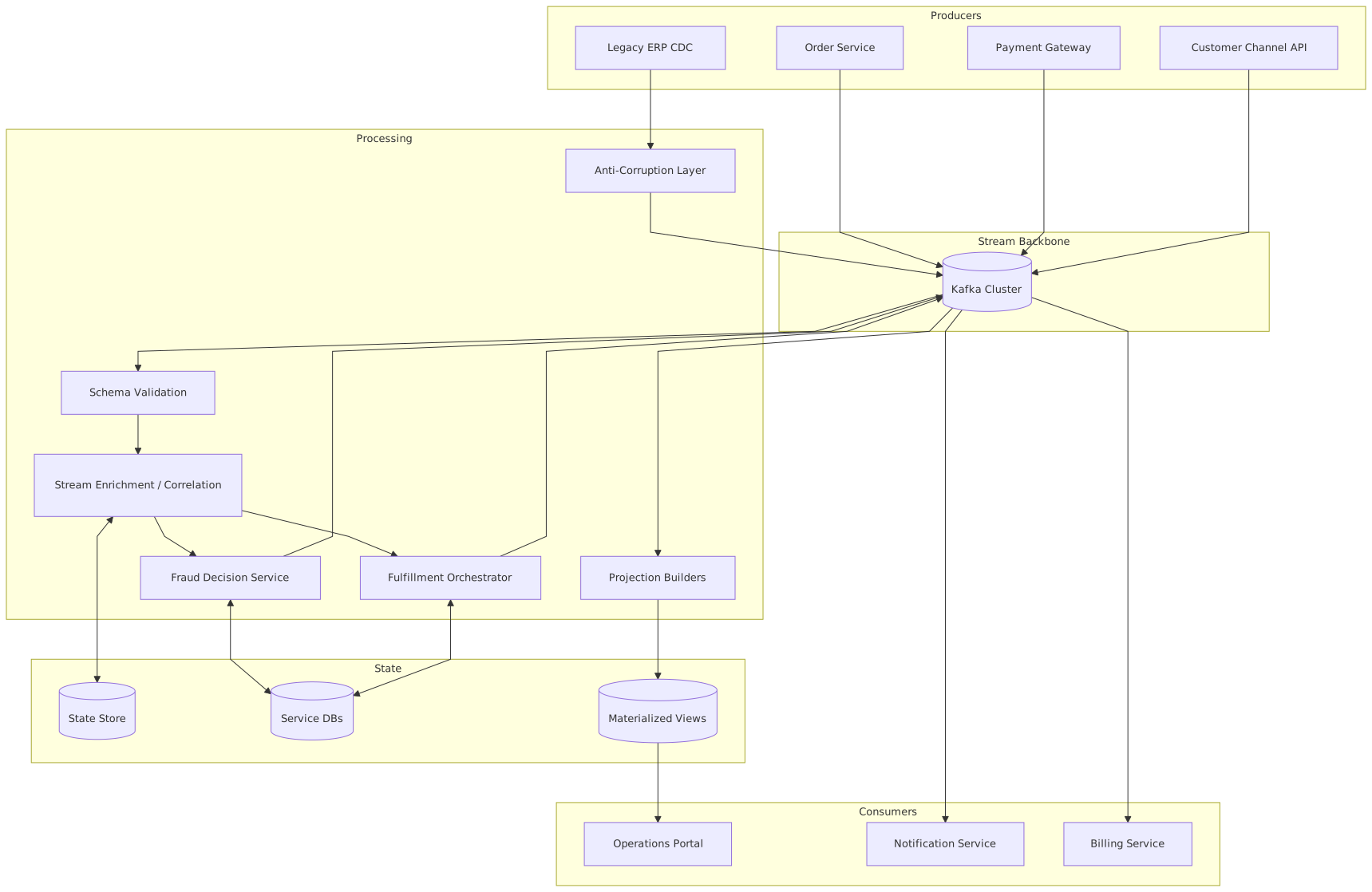
This architecture is reactive because changes propagate as events. It is pipeline-based because processing is staged. And it is enterprise-worthy only if ownership, semantics, and operational controls are explicit.
Migration Strategy
No one sensible replaces a mature core platform with a fully reactive pipeline in one move. That kind of ambition usually ends up as a multi-year apology.
The right strategy is progressive strangler migration.
Start with one flow. One painful, high-value, delay-sensitive flow. Claims triage. Order fraud screening. Inventory visibility. Pick something where event-driven reaction creates real business leverage and where consistency constraints are understood.
Then build a seam around the legacy system.
Progressive strangler migration
A common sequence looks like this:
- Capture legacy changes
Use CDC, outbound integration hooks, or application events to observe the existing world without disrupting it.
- Introduce an anti-corruption layer
Translate technical changes into meaningful domain events. This is vital. Raw database mutations are not a domain contract.
- Build downstream reactive capabilities
Materialized views, alerts, enrichment, routing, and low-risk decisions can often be introduced first.
- Shift selected decisions to the reactive path
Once trust increases, move business decisions such as fraud routing or notification triggers to stream-driven services.
- Reconcile continuously
Compare legacy authoritative records with derived reactive state. Measure drift. Fix mismatches before broadening scope.
- Gradually reassign system of record responsibilities
Only after operational confidence should source-of-truth boundaries move.
This is not glamorous. It is how serious migration survives contact with finance, audit, and customer support.

Reconciliation discussion
Reconciliation is the grown-up part of event-driven migration. Everyone likes drawing event flows. Fewer enjoy discussing how to detect and repair divergence between a derived reactive state and an authoritative legacy ledger.
But they must.
In enterprise systems, eventual consistency is acceptable only when eventual correctness is engineered.
Reconciliation patterns include:
- Periodic state comparison between authoritative records and derived projections
- Compensating events when discrepancies are discovered
- Replay-based rebuilds for projections and state stores
- Audit topics that preserve key transitions for traceability
- Human exception workflows for business cases automation cannot safely resolve
The right question is not “How do we avoid inconsistencies entirely?” You won’t. The right question is “How do we surface, classify, and repair them before the business bleeds?”
Enterprise Example
Consider a global retailer with stores, e-commerce, and marketplace channels. The company wants near-real-time order promising: when a customer places an order, the business needs to determine whether to fulfill from a local store, a regional warehouse, or a partner inventory source. Fraud scoring and payment status also influence the path. The legacy ERP remains authoritative for financial settlement and final inventory ledger updates.
In the old world, this was stitched together with synchronous calls and delayed batch updates. The website called an inventory API that was often stale. Fraud checks happened via a blocking service. Store stock adjustments arrived in batches. Customer support saw a different order status from the mobile app. Every peak season exposed the cracks.
A reactive pipeline changed the posture.
Domain decomposition
The retailer identified key bounded contexts:
- Ordering
- Payments
- Inventory
- Fulfillment
- Customer communications
- Finance settlement
Each context published domain events in its own language. Ordering emitted OrderPlaced. Payments emitted PaymentAuthorized or PaymentDeclined. Inventory emitted StockReserved and StockReleased. Fulfillment emitted ShipmentPlanned and ShipmentDispatched.
The company did not impose one giant canonical event model. That was wise. Instead, an anti-corruption and enrichment layer mapped legacy ERP and warehouse signals into context-appropriate domain events.
Pipeline behavior
When an order was placed, a pipeline correlated:
- customer profile and loyalty status
- payment authorization state
- fraud score
- current inventory position
- shipping constraints
- store capacity signals
A fulfillment orchestrator then chose a route and emitted a decision event. Downstream services reserved stock, initiated shipment planning, and notified the customer. Materialized views updated support dashboards in seconds.
The ERP still received authoritative updates for financial booking and ledger inventory. A reconciliation service compared reactive reservation state with ERP-confirmed allocations. Any drift beyond threshold generated compensating workflows or support cases.
Why this worked
Because the retailer did not confuse speed with truth.
The reactive pipeline owned operational responsiveness. The ERP continued to own regulated settlement and final ledger integrity. Over time, some inventory decisioning moved fully into the reactive domain, but only after reconciliation metrics showed low drift and support teams trusted the new process.
That is how migration becomes credible in an enterprise.
Operational Considerations
Reactive pipelines are operational systems first and elegant diagrams second.
Observability
You need more than CPU and broker metrics. You need business observability:
- event lag by critical topic
- end-to-end processing latency by business flow
- dead-letter rate by event type
- reconciliation drift by domain entity
- duplicate event detection counts
- schema compatibility violations
- consumer retry saturation
A system can be green from an infrastructure perspective and still be failing the business quietly.
Schema evolution
Streaming systems age through contracts. Use schema management with compatibility rules. Breaking event schemas casually is one of the fastest ways to create silent downstream corruption.
Even with Avro, Protobuf, or JSON Schema, governance must stay domain-aware. Technical schema compatibility does not guarantee semantic compatibility. Renaming orderTotal to grossOrderAmount may compile while changing business meaning.
Backpressure and flow control
If downstream consumers cannot keep up, the pipeline must degrade predictably. Buffering, pausing, rate limiting, consumer scaling, and prioritization matter. Not all events are equal. A fraud review signal may deserve a different processing policy than clickstream enrichment.
Idempotency and duplicates
At-least-once delivery is common and usually fine if consumers are idempotent. Teams who promise exactly-once business semantics too early often create complexity out of proportion to value. Aim for idempotent handlers, deterministic state transitions, and duplicate-tolerant downstream effects.
Security and governance
Events often contain sensitive business and personal data. Encrypt where required, segment topics by trust boundaries, and govern retention deliberately. Reactive does not mean reckless.
Tradeoffs
Reactive pipeline architecture is powerful, but power always invoices later.
What you gain
- low-latency domain reaction
- decoupled producers and consumers
- replay and reprocessing capability
- scalable stream handling
- improved operational visibility through event trails
- flexible addition of new consumers and projections
What you pay
- higher conceptual complexity
- eventual consistency management
- distributed ownership and governance overhead
- harder debugging across asynchronous flows
- increased need for contract discipline
- reconciliation engineering
The biggest tradeoff is psychological. Teams lose the comfort of immediate, linear control flow. They must think in terms of time, causality, partial information, and asynchronous correction.
Some teams are not ready for that. Better to admit it than to cover confusion with platform jargon.
Failure Modes
There are some classic ways this architecture goes wrong.
Event soup
Everything is published. Nothing is owned. Topics proliferate. Naming drifts. Consumers depend on accidental fields. No one can answer which event is authoritative. This is the natural endpoint of weak domain modeling.
CDC masquerading as domain design
A team streams table changes from a monolith and calls it event-driven architecture. Downstream services now depend on persistence artifacts, not business semantics. The coupling is hidden, not removed.
Projection worship
Teams treat derived read models as authoritative without defining reconciliation or source-of-truth boundaries. Eventually a discrepancy appears and nobody knows which side to trust.
Orchestration collapse
A single orchestrator service becomes the new distributed monolith, embedding every business rule and every downstream dependency. The event backbone survives, but autonomy disappears.
Retry storms and poison events
Malformed or semantically invalid events cause endless retries, partition blockage, and cascading lag. Dead-letter strategies and semantic validation are not optional.
Rebalance blindness
Consumer group rebalances under load can amplify latency spikes and duplicate processing. If your business flow is sensitive to temporal thresholds, this can become visible to customers.
These are not edge cases. They are common enough to be expected.
When Not To Use
Reactive pipeline architecture is not the answer to every integration headache.
Do not use it when:
- the workflow is simple, low volume, and naturally synchronous
- the business requires strict immediate consistency across a small set of tightly coupled operations
- your organization lacks operational maturity for event governance and observability
- teams cannot sustain schema discipline and ownership boundaries
- latency requirements are modest and batch is genuinely good enough
- domain semantics are still too unstable to justify event contract investment
There is no virtue in replacing a straightforward transactional workflow with a fleet of topics, stream processors, and projections. Sometimes a well-designed service call and a relational transaction are exactly right.
Architecture is not a religion. It is a wager on change.
Related Patterns
Reactive pipeline architecture often sits alongside several related patterns.
Event-driven architecture
The broader style where components communicate via events. Reactive pipelines are a more structured, flow-oriented subset.
Event sourcing
Useful in some domains, especially where rebuilding state from events is valuable. But it is not required for reactive pipelines. Many successful pipelines process domain events while services still persist current state traditionally.
CQRS
Commonly paired with pipelines because materialized read models fit naturally. But CQRS should be used because read/write concerns differ, not because someone likes acronyms.
Saga orchestration and choreography
Helpful for distributed business processes. In reactive pipelines, sagas can emerge as event-driven coordination across contexts. Be careful not to centralize too much logic into one “smart” orchestrator.
Strangler fig migration
One of the most practical migration patterns for introducing streaming capabilities around legacy cores.
Outbox pattern
Essential when services must reliably publish domain events alongside local transactional updates.
Together, these patterns form a toolkit. None should be applied as a bundle by default.
Summary
Reactive pipeline architecture earns its place when enterprises need to react continuously to domain events across distributed systems without collapsing into brittle synchronous chains or stale batch processing. Its real promise is not speed alone. It is adaptability under change.
But the architecture only works when it is grounded in domain-driven design. Events must mean something. Bounded contexts must own their language. Source-of-truth boundaries must be explicit. Migration must be progressive. Reconciliation must be designed, not wished into existence.
Kafka helps. Microservices help. Stream processors help. None of them save you from semantic confusion.
The best reactive pipelines feel less like plumbing and more like a living nervous system: sensing, interpreting, and responding across the enterprise in near real time. The worst feel like a room full of people shouting facts at each other.
Choose carefully.
If you are migrating from legacy systems, start small, build anti-corruption layers, measure reconciliation drift, and move authority only when earned. If your business needs responsive flows across orders, payments, inventory, fraud, customer interactions, or operational analytics, reactive pipeline architecture can be a decisive advantage.
Just don’t mistake motion for design. In streaming systems, a lot of things move. The hard part is making them mean something.
Frequently Asked Questions
What is event-driven architecture?
Event-driven architecture (EDA) decouples services by having producers publish events to a broker like Kafka, while consumers subscribe independently. This reduces direct coupling, improves resilience, and allows new consumers to be added without modifying producers.
When should you use Kafka vs a message queue?
Use Kafka when you need event replay, high throughput, long retention, or multiple independent consumers reading the same stream. Use a traditional message queue (RabbitMQ, SQS) when you need simple point-to-point delivery, low latency, or complex routing logic per message.
How do you model event-driven architecture in ArchiMate?
In ArchiMate, the Kafka broker is a Technology Service or Application Component. Topics are Data Objects or Application Services. Producer/consumer services are Application Components connected via Flow relationships. This makes the event topology explicit and queryable.