⏱ 20 min read
Most data platform failures do not begin with technology. They begin with politeness.
A central platform team asks business domains to “own their data products.” The domains nod. A governance committee defines standards. Architects draw tidy boxes around Finance, Sales, Operations, and Customer. Kafka topics appear. Data catalogs bloom. A self-serve platform is announced with the ceremonial confidence of a new ERP rollout. Everyone says the right words: federation, ownership, product thinking, interoperability. event-driven architecture patterns
Then six months later, nobody can explain why “customer” has four contradictory meanings, why a supposedly domain-owned pipeline still depends on a central data engineering team for every production change, or why half the analytics estate is powered by a heroic reconciliation job that runs at 2:00 AM and quietly repairs what the organization refuses to confront in daylight.
That is the hard truth about data mesh in enterprises: the failure mode is rarely “we didn’t decentralize enough.” More often it is “we decentralized accountability before we clarified ownership.” We replaced one monolith with a federation of ambiguity.
A data mesh can be a powerful operating model for data platform architecture. But it is not a license to scatter pipelines across business units and call it modern. It only works when domain boundaries are real, semantics are explicit, and ownership lines are enforceable. Without that, federated domains become little kingdoms with porous borders and no map. Data products become integration artifacts in disguise. Kafka becomes a faster way to spread confusion. And the central platform, despite all the rhetoric, still becomes the place where broken promises go to be made operational.
This article is about those failure modes. Not the textbook version of data mesh, but the enterprise version: mergers, legacy warehouses, ERP gravity, duplicated customer masters, microservices that model transactions one way and finance reports another, and governance teams trying to impose order after the fact. We will look at why ownership lines break, how domain semantics decay, where reconciliation becomes unavoidable, and how to migrate progressively using a strangler approach rather than a revolution. Because in real organizations, revolutions mostly leave behind PowerPoint and incident tickets.
Context
Data mesh emerged as a reaction to a very familiar enterprise pattern: the central data platform that becomes both bottleneck and blame magnet. One team is expected to ingest everything, model everything, govern everything, and satisfy every analytical use case from regulatory reporting to machine learning. This scales badly, not because the people are weak, but because the model is wrong.
Domain-driven design gave us the right instinct years ago: software should reflect the business’s bounded contexts, not some enterprise fantasy of universal truth. Data architecture needs the same discipline. If Sales, Billing, Claims, and Customer Support each operate with different business rules, then pretending there is one pristine “enterprise entity” maintained by a remote central team is usually a lie dressed as architecture.
Data mesh takes that instinct and says: let domains publish data products, let a platform provide shared capabilities, and let governance become federated rather than fully centralized. Fine. Sensible, even. But there is a dangerous simplification hidden inside the enthusiasm. Many enterprises hear “federated” and implement “distributed responsibility.” Those are not the same thing. EA governance checklist
Distributed responsibility is what you get when many people can change things but nobody can guarantee outcomes. Federated ownership, done well, is much stricter. It says this domain is accountable for this business fact, under these semantics, with these service levels, through these interfaces, and with these quality guarantees. That is a much harder bar. It requires organizational design, not just platform tooling.
The trouble starts when enterprises adopt the mechanics of data mesh without the discipline of bounded contexts. They publish domain datasets that are really just projections of shared operational systems. They call a table a product. They expose Kafka topics with unstable semantics. They push responsibility outward while retaining control inward. That mismatch creates the broken ownership lines this article is concerned with.
Problem
The core problem is simple to state and painful to fix: federated domains often do not own the data they are asked to publish.
A domain may own a report but not the source transaction. It may own a consumer-facing definition but not the master record. It may own a microservice API but not the downstream state used for finance, compliance, or operational reconciliation. In these situations, “domain ownership” becomes ceremonial. The domain is named as owner, but another team controls schema changes, reference data, security policy, release cadence, or source system semantics.
This creates a chain of architectural dysfunction.
First, semantics drift. One domain defines “active customer” based on current subscription, another based on any order in the last 24 months, and a third based on CRM status. None of these are inherently wrong. What is wrong is pretending they are the same concept.
Second, data products become derivative. Rather than publishing authoritative business facts, teams publish transformed extracts that reflect local interpretation. Consumers then integrate those extracts as if they were sources of truth. The architecture accumulates semantic debt.
Third, reconciliation becomes permanent. Once multiple domains emit overlapping business facts with different cut-off rules, identities, and event timing, some downstream function must reconcile them. This might be a finance ledger process, an operational data store, a batch correction pipeline, or a machine-learning feature process that quietly imputes missing states. However it is implemented, reconciliation becomes the hidden core of the platform.
Fourth, platform teams re-centralize by necessity. Someone has to define interoperability standards, identity resolution, quality controls, lineage, retention, and policy enforcement. If domains are weak owners, the platform absorbs more and more logic until the mesh turns back into a hub-and-spoke model with better branding.
So the problem is not “federation.” The problem is federation over unclear business boundaries.
Forces
Several forces make this problem persistent in enterprise environments.
Legacy system gravity
ERP, CRM, mainframe policy systems, warehouse management systems, and custom operational databases often encode business truth in ways no modern domain team fully controls. A Sales domain may “own customer analytics” while the actual billing status lives in SAP and the legal customer identity lives in a compliance master. Ownership is fragmented before architecture even begins.
Organizational mismatch
Teams are often structured around delivery lines, not bounded contexts. A “Customer domain” may include marketing analysts, CRM admins, loyalty product managers, and support reporting teams. That sounds coherent until you realize that customer identity, account responsibility, householding, consent, and revenue recognition all obey different rules and may belong to different business capabilities.
Event-driven optimism
Kafka and microservices encourage us to believe that publishing events equals publishing truth. It does not. An event is only useful if its semantics are stable and its lifecycle is governed. Otherwise a topic becomes a rumor with retention.
Pressure for local autonomy
Domains want freedom to move quickly. Standardization feels like bureaucracy. But interoperability is not bureaucracy; it is the price of federation. Without standards for identifiers, contracts, lineage, quality signals, and deprecation, local autonomy creates global confusion.
The enterprise need for reconciliation
Enterprises cannot simply choose one representation and ignore the rest. Financial close, regulatory reporting, customer communications, fraud management, and supply chain execution all require cross-domain consistency. Reconciliation is not an edge case. It is an architectural force.
The illusion of a single canonical model
In reaction to inconsistency, some organizations push for an enterprise canonical data model. This often fails for the opposite reason. It flattens genuine domain differences into a universal schema nobody truly owns. The result is not clarity but abstraction debt.
These forces matter because they show why simplistic prescriptions fail. Centralize everything and you create a giant bottleneck. Decentralize naively and you create semantic entropy. Architecture lives in the tradeoff.
Solution
The practical solution is not “more mesh.” It is a disciplined form of federated architecture built on domain-driven design principles, explicit ownership, and a first-class reconciliation model.
Start with bounded contexts, not org charts. A domain in a data platform should align to a business capability that can genuinely assert and maintain specific business facts. If a team cannot define the invariants of a concept, manage its lifecycle, and answer for its quality, it does not own that data product. Calling it the owner will not make it so.
Next, separate authoritative facts from derived products. This distinction saves architectures.
An authoritative data product states business facts for which a domain is accountable: an order was placed, a payment was settled, a shipment was dispatched, a claim was approved, a customer consent was granted. A derived product combines, interprets, or aggregates facts for some consumer purpose: churn propensity, monthly active customers, household segment score, margin-adjusted revenue view.
Both are useful. But they are not equivalent. Consumers must know whether they are reading source-of-truth facts, a bounded-context view, or an enterprise reconciliation output.
Then make reconciliation explicit. In many enterprises, some cross-domain data products must be curated through governed reconciliation processes. This is not a failure of data mesh. It is a recognition that enterprise reporting and controls often require consistency across bounded contexts. The mistake is hiding reconciliation in ad hoc pipelines and pretending the result emerged naturally from domain ownership.
Finally, establish a platform that is self-serve in mechanics but centralized in policy. Domains should be able to publish and manage data products independently, but they should do so within firm constraints: schema versioning, metadata requirements, quality assertions, identity standards, access control, retention policies, lineage capture, and deprecation rules.
A mesh is not a free-for-all. It is a federation with a constitution.
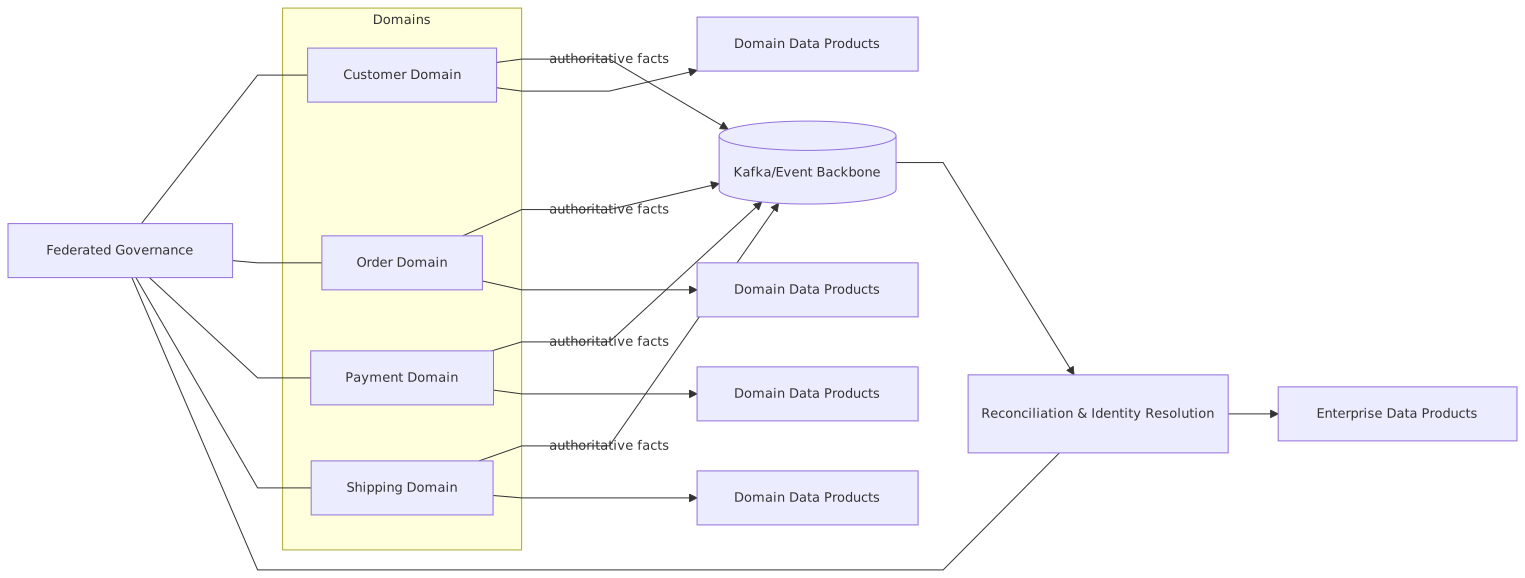
The key idea in this architecture is that domains publish facts and local products, while enterprise-wide products that require cross-domain consistency are built through explicit reconciliation. This preserves local autonomy without lying about enterprise truth.
Architecture
A healthy data mesh architecture has four layers, even if you do not draw them that way.
1. Domain operational systems and service events
This is where business activity originates. Microservices, packaged applications, transaction systems, and stateful domain applications create the events and records that represent the domain’s behavior. If Kafka is present, this is where immutable business events should be published with careful contracts. microservices architecture diagrams
The discipline here is semantic, not technical. Publish events that reflect business facts, not internal implementation chatter. OrderPlaced is useful. OrderRowUpdatedV7 usually is not.
2. Domain data products
Each domain exposes data products designed for consumption. These may include event streams, queryable tables, APIs, or curated analytical datasets. They should have product-level metadata: owner, SLA, schema contract, lineage, freshness, quality dimensions, access policy, and deprecation status.
Crucially, domain data products should be classified:
- authoritative facts
- bounded-context views
- derived analytical products
That classification sounds bureaucratic until your finance team asks why “revenue” differs across dashboards.
3. Reconciliation and shared enterprise services
This is the part many data mesh conversations underplay because it muddies the purity of decentralization. In serious enterprises, you need shared services for identity resolution, reference data, master data alignment, policy enforcement, and reconciled business outputs.
This layer should not become a stealth central data team rebuilding everyone’s models. Its purpose is narrower and more important: resolve overlaps, align cross-domain keys, surface discrepancies, and produce enterprise-consistent products where required.
Think of this as a treaty zone between bounded contexts.
4. Consumption and governance plane
Consumers access domain products and enterprise products through discoverable interfaces and governed cataloging. Observability, lineage, access auditing, quality monitoring, and policy checks live here. A federated governance model should define standards centrally but enforce accountability through domain ownership. ArchiMate for governance
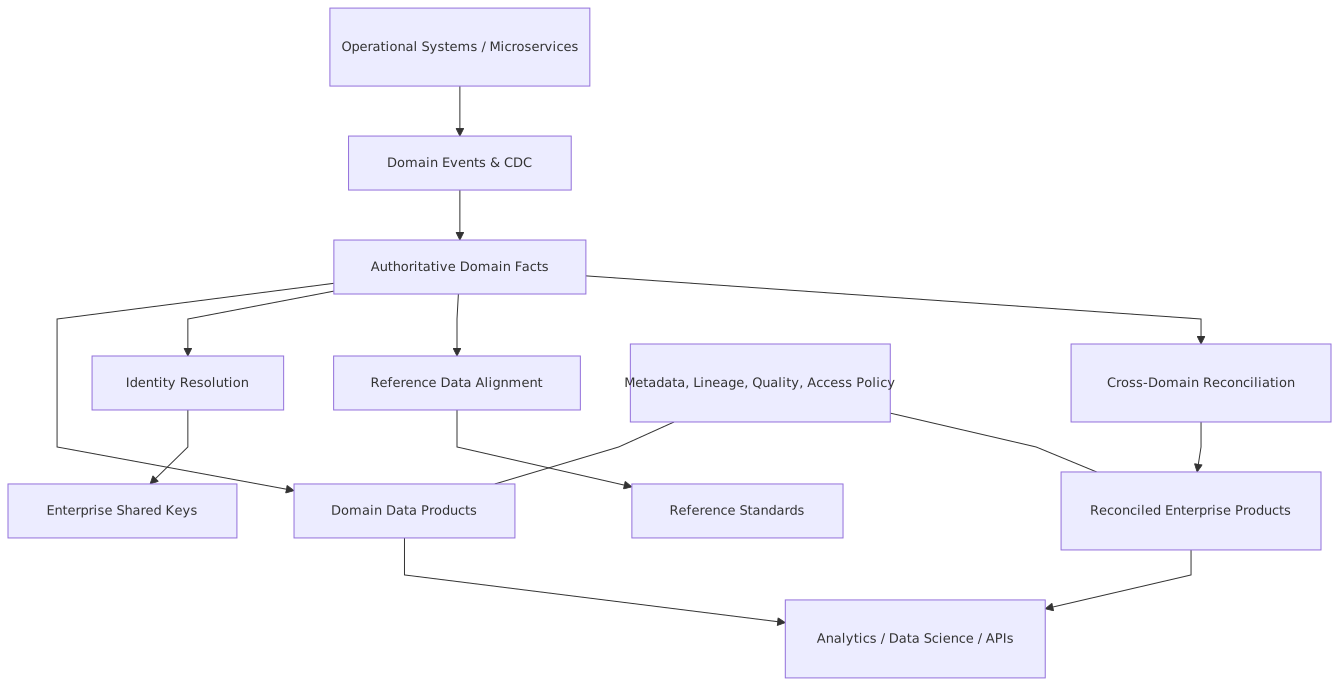
The architecture works when ownership is clear at each step. It fails when the same concept is “sort of” owned by multiple domains and “kind of” reconciled later.
Domain semantics matter more than pipelines
This point deserves emphasis. Data mesh failures are often dressed up as tooling issues: wrong lakehouse, weak catalog, poor orchestration, bad CI/CD. Those matter. But the deeper issue is semantic design.
In domain-driven design, bounded contexts exist because the same word can mean different things in different parts of the business. Data architecture should embrace that reality, not fight it. “Customer” in Billing may be the legally invoiced account. In Marketing, it may be an addressable person. In Support, it may be a service recipient. If you force one universal definition at publication time, you create distortion. If you allow all definitions without context, you create chaos.
The architecture needs both plurality and discipline. Let each bounded context define its semantics. Require explicit contracts, context labels, and mappings. Then reconcile where enterprise processes demand it.
That is grown-up architecture.
Migration Strategy
No large enterprise adopts this cleanly from scratch. They migrate from warehouses, integration hubs, brittle ETL estates, reporting marts, and undocumented extracts. The right migration pattern is progressive strangler, not big bang.
Begin by identifying a narrow but meaningful business flow with obvious ownership candidates and high pain in the current platform. Order-to-cash is common. So is claims processing, customer onboarding, or product inventory.
Then follow these steps.
Step 1: Map business facts and bounded contexts
Identify the business events, records, and decisions in the flow. Who can actually assert each fact? Which systems are systems of record? Where do semantics differ? Where are downstream consumers depending on unofficial extracts? This is domain discovery as much as architecture.
Step 2: Publish a small set of authoritative domain products
Do not start with every dataset. Start with a few products that are high-value and semantically defensible. For example:
- Order domain publishes order lifecycle facts
- Payment domain publishes settlement facts
- Customer consent domain publishes consent state changes
These products should be observable, contract-managed, and clearly owned.
Step 3: Introduce reconciliation as a product, not a hidden job
If finance needs a reconciled revenue view combining order, payment, and refund semantics, build that explicitly. Name it as a reconciled enterprise product. Document the rules. Track exceptions.
Step 4: Strangle legacy dependencies
Shift consumers gradually from legacy warehouse tables or integration feeds to the new domain and reconciled products. Measure adoption. Deprecate old feeds only after behavior is proven equivalent or differences are understood and accepted.
Step 5: Expand by capability, not by platform mandate
Once the model works for one flow, extend to adjacent contexts. Do not force every domain to publish everything at once. A mesh grows where ownership is strongest.
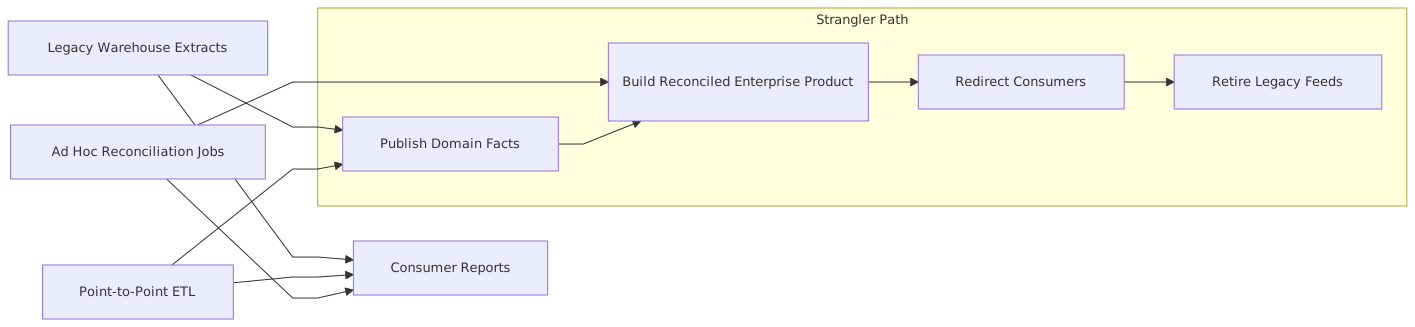
Why progressive migration matters
Because ownership is learned through operation, not declared in kickoff workshops. A domain team may think it owns a dataset until a regulatory change reveals three hidden dependencies and a legal retention rule controlled elsewhere. Migration lets these realities surface while blast radius is still manageable.
A big-bang data mesh rollout usually produces one of two outcomes: either the central team secretly does most of the work, or the domains publish low-quality products that consumers avoid. Both are expensive ways to avoid honesty.
Enterprise Example
Consider a global insurer modernizing its data platform.
The company has policy administration systems in multiple regions, a central finance ledger, a CRM platform for broker relationships, and a claims platform acquired through acquisition. It wants to move from a centralized data lake team to a federated data mesh model. On paper, the domains are obvious: Policy, Claims, Billing, Broker, Customer.
But the trouble starts with “customer.”
In Policy, a customer is the policyholder attached to a legal contract. In Claims, the customer may be claimant, claimant representative, or injured party. In Broker systems, the customer is often the broker organization, not the insured individual. In CRM, the customer is a contactable party with consent and relationship status. These are not the same thing. Yet the initial data mesh program tried to create a unified customer data product owned by the Customer domain.
That failed quickly.
Why? Because no single team could assert all customer facts. Consent updates came from CRM. Legal name and party role came from policy systems. Payment account details came from billing. Claims interactions introduced additional parties. The so-called Customer domain became a coordination forum, not an owner.
The architecture changed course.
Instead of one universal customer product, each bounded context published its own authoritative party-related facts:
- Policy domain published policyholder and insured party facts
- Claims domain published claimant and claim participant facts
- CRM domain published contact and consent facts
- Billing domain published payer account facts
A shared identity resolution service created enterprise party keys where confidence thresholds and matching rules allowed. A reconciled enterprise “Customer Interaction Eligibility” product was then built for omnichannel communications, combining consent, role, product relationship, and active status. Finance and compliance received separate reconciled products tailored to legal and reporting needs.
Kafka was used for event publication where systems supported it, while CDC captured changes from older policy systems. The platform team provided contract testing, metadata tooling, lineage capture, and policy enforcement. Domains remained responsible for semantics and quality of their authoritative facts.
The result was not a pure mesh manifesto. It was better: a working enterprise architecture. Time-to-publish improved for domain products. Governance became clearer. Reconciliation moved out of shadow SQL jobs into explicit, monitored services. And perhaps most importantly, people stopped arguing about the one true customer.
That is a real sign of progress.
Operational Considerations
A federated architecture lives or dies in operations.
Data product SLOs
Every product needs service objectives: freshness, completeness, timeliness, quality thresholds, and support ownership. If no one is paged when a product degrades, it is not really owned.
Contract management
Schemas must evolve safely. Event contracts in Kafka should use compatibility rules, versioning strategies, and deprecation timelines. Breaking downstream consumers with silent field changes is not autonomy. It is vandalism.
Quality observability
Measure null rates, key uniqueness, referential coverage, event lag, volume anomalies, and semantic assertions. Quality needs to be visible to both publishers and consumers.
Exception handling and reconciliation queues
Cross-domain reconciliation will produce mismatches. Unmatched keys, late events, duplicated records, and conflicting statuses are not rare edge cases. Build exception workflows, triage ownership, and audit trails from the start.
Access and policy enforcement
Federated does not mean relaxed. Sensitive data, consent constraints, residency rules, and legal holds require strong centralized policy enforcement even if products are domain-owned.
Metadata discipline
Catalog entries must be part of the publication pipeline, not a wiki exercise. Ownership, semantics, classification, lineage, retention, and consumer guidance should be generated and validated automatically where possible.
Tradeoffs
Data mesh, implemented with real discipline, buys scalability of decision-making and closer alignment between business knowledge and data publication. But the tradeoffs are sharp.
You gain local responsiveness. You lose some uniformity.
You gain domain accountability. You increase the need for semantic negotiation.
You reduce the central team bottleneck. You increase coordination overhead between domains.
You expose business complexity honestly. You also make that complexity visible to consumers who may have preferred a single polished fiction.
And reconciliation becomes a permanent architectural concern. Some architects resist this because they want cleaner boundaries. But enterprises are not clean. If your business spans legal entities, channels, geographies, acquisitions, and legacy systems, the architecture must absorb that reality somewhere. Better an explicit reconciliation layer than dozens of unofficial ones.
Failure Modes
Let us be blunt. These are the most common failure modes.
1. Named ownership without decision rights
A domain is declared owner, but source systems, funding, release control, or policy decisions sit elsewhere. The domain gets accountability without authority. This always fails.
2. Tables masquerading as products
A raw table in object storage or a Kafka topic without semantic documentation is not a data product. It is an artifact. Products need contracts, support, discoverability, and lifecycle management.
3. Shared entities with no bounded-context separation
The enterprise tries to publish one “Customer,” “Product,” or “Revenue” object for all use cases. This usually creates endless modeling debates and unstable semantics.
4. Hidden reconciliation
Discrepancies between domains are resolved in BI models, analyst notebooks, or overnight SQL scripts. The enterprise depends on reconciled outputs but cannot govern or explain them.
5. Platform overreach
The central platform team, frustrated by weak domains, starts building business logic into ingestion, quality, and transformation frameworks. The mesh recentralizes, but without admitting it.
6. Kafka topic sprawl
Every service emits everything. Topics proliferate. Naming is inconsistent. Events lack business durability. Consumers bind to low-level change events and become fragile. Event-driven architecture turns into distributed tight coupling.
7. Governance theater
Standards exist on paper but are not enforced in pipelines, access controls, or release processes. Domains can technically bypass them, so they eventually do.
8. Migration fatigue
The organization launches too broadly, asks every domain to publish products, and overwhelms teams already carrying operational work. Adoption stalls and the old warehouse remains the real platform.
When Not To Use
Do not use a data mesh if your organization does not have meaningful domain autonomy. If every material system change still requires central approval and shared release windows, federation will be cosmetic.
Do not use it if your data landscape is small, stable, and well served by a central team. Not every company needs a federated operating model. A simpler hub-and-spoke platform may be entirely adequate.
Do not use it when semantic maturity is low and leadership expects tooling to compensate. A catalog will not invent ownership. Kafka will not fix vocabulary. A lakehouse will not settle business disputes.
Do not use it if your main goal is to avoid investing in enterprise-wide governance, identity, or reconciliation capabilities. A mesh actually needs more discipline there, not less.
And do not use it as a rebranding exercise for decentralized data engineering. If the model does not change decision rights, accountability, and product semantics, it is not data mesh. It is just distributed ETL.
Related Patterns
Several related patterns matter here.
Domain-driven design is foundational. Bounded contexts, ubiquitous language, and context mapping are more useful than most data platform playbooks.
Strangler fig migration is the right modernization pattern for replacing centralized warehouse dependencies incrementally.
Event-driven architecture and Kafka-based streaming are useful for publishing domain facts and enabling near-real-time products, but only when event semantics are stable and business-oriented.
Master data management still has a place, especially for reference domains and enterprise keys, but it should not be mistaken for a universal semantic authority.
Data contracts are essential. They provide the publication discipline that many mesh programs assume but do not operationalize.
CQRS-like separation of write models and read products is also relevant. Operational services and analytical products serve different needs; forcing one model to satisfy both creates unnecessary tension.
Summary
A data mesh fails when federated domains sit on broken ownership lines.
That is the central lesson. The architecture is not rescued by more decentralization, more streaming, or more platform tooling. It is rescued by clarity: clear bounded contexts, clear authoritative facts, clear distinction between domain products and enterprise reconciled products, and clear decision rights for the teams that publish them.
In practical enterprise architecture, this means accepting some uncomfortable truths. There is no single enterprise-wide semantics for many core concepts. Reconciliation is not an embarrassment; it is a necessary capability. Kafka can accelerate propagation but also amplify ambiguity. Central platform teams should provide strong policy, tooling, and interoperability standards, but they should not pretend to own business meaning. Domains should own what they can truly assert, not what the org chart suggests they ought to.
And migration should be progressive. Start small. Publish facts. Reconcile explicitly. Strangle legacy dependencies one business flow at a time.
A good data platform is not one where every domain shouts its own version of reality. It is one where each domain speaks with authority about its own world, and the enterprise has a disciplined way to listen across the borders.
Frequently Asked Questions
What is a data mesh?
A data mesh is a decentralised data architecture where domain teams own and serve their data as products. Instead of a central data team, each domain is responsible for data quality, contracts, and discoverability.
What is a data product in architecture terms?
A data product is a self-contained, discoverable, trustworthy dataset exposed by a domain team. It has defined ownership, SLAs, documentation, and versioning — treated like a software product rather than an ETL output.
How does data mesh relate to enterprise architecture?
Data mesh aligns data ownership with business domain boundaries — the same boundaries used in domain-driven design and ArchiMate capability maps. Enterprise architects play a key role in defining the federated governance model that prevents data mesh from becoming data chaos.