⏱ 7 min read
Modern enterprises increasingly rely on large-scale data platforms to support analytics, machine learning, and operational decision-making. Over the past decade, organizations have moved from traditional data warehouses toward data lakes, and more recently toward lakehouse architectures. The Databricks Lakehouse platform has emerged as one of the most widely adopted solutions for building unified data platforms. However, implementing Databricks successfully requires more than deploying clusters and pipelines — it requires clear enterprise architecture principles, governance models, and platform design patterns. Sparx EA guide
Why enterprises are moving toward lakehouse architectures
Traditional data warehouses offered strong governance and structured analytics capabilities but struggled to scale with growing data volumes and modern data types: streaming events, application logs, IoT telemetry, and semi-structured data. Data lakes solved the scalability challenge but introduced new problems — lack of governance, inconsistent data quality, duplicated pipelines, and poor discoverability. The lakehouse architecture combines the strengths of both approaches: scalable storage, transactional reliability (via Delta Lake's ACID transactions), unified analytics and machine learning workloads, and centralized governance. EA governance checklist
High-level Databricks Lakehouse architecture
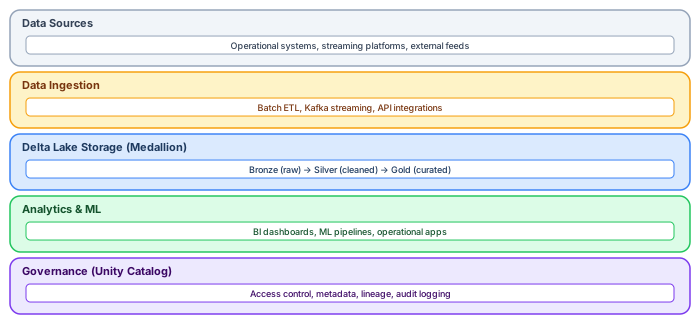
From an enterprise architecture viewpoint, the Databricks platform serves four roles simultaneously: an enterprise data integration hub that consolidates data from operational systems, streaming platforms, and external sources; an analytics platform that serves BI dashboards and ad-hoc queries; a machine learning environment that supports feature engineering, model training, and deployment; and a governed data sharing platform that enables cross-domain data access with centralized access control and lineage. Sparx EA best practices
The Medallion architecture

The Medallion architecture organizes data into three quality layers, each with a clear purpose and transformation contract.
Bronze (raw data): Captures data exactly as it arrives — append-only ingestion with minimal transformation and schema-on-read. Bronze datasets include raw JSON events, CSV extracts, log files, and CDC change streams. The Bronze layer is the system of record: raw data is never overwritten, enabling full reprocessing when transformation logic changes.
Silver (cleaned data): Introduces structured transformations — deduplication, schema validation, normalization, and enrichment. Silver datasets represent core business entities (customers, orders, transactions) in a clean, consistent format. This layer is where data quality rules are enforced: null checks, referential integrity, business rule validation.
Gold (data products): Contains curated datasets optimized for specific business use cases — reporting aggregates, KPI tables, machine learning feature sets, and operational dashboards. Gold datasets are the enterprise data products that business users and applications consume directly.
Data ingestion patterns
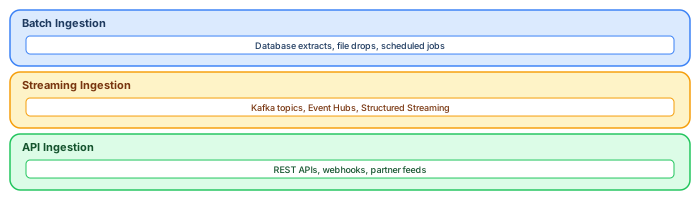
Enterprise platforms must support multiple ingestion mechanisms to accommodate diverse source systems. Batch ingestion handles database extracts, file drops, and scheduled ETL jobs — typically running on hourly, daily, or weekly cadences. Streaming ingestion processes real-time event flows from Kafka, Azure Event Hubs, or AWS Kinesis via Databricks Structured Streaming. API ingestion pulls data from REST APIs, webhooks, and partner feeds. Architecturally, ingestion should prioritize reliability and traceability over transformation complexity — keep ingestion simple and push transformation to the Silver layer. enterprise cloud architecture patterns
Streaming data architectures

Real-time analytics has become increasingly important for fraud detection, operational monitoring, and customer experience optimization. Databricks Structured Streaming enables unified batch and streaming processing on the same platform — the same Delta Lake tables serve both batch queries and streaming updates. This eliminates the traditional lambda architecture's complexity of maintaining separate batch and streaming pipelines.
Governance with Unity Catalog

Governance is the most critical element that separates a production-grade data platform from a collection of ad-hoc pipelines. Unity Catalog provides centralized metadata management (every table, view, and function is registered and discoverable), fine-grained access control (row-level and column-level security), automated lineage tracking (which pipelines produce which tables from which sources), and comprehensive audit logging (who accessed what data and when). Governance structures typically align with organizational domains — finance data is governed by finance rules, customer data by privacy regulations, and operational data by SLA requirements.
Machine learning integration

A major benefit of the lakehouse architecture is native machine learning support. Gold datasets feed feature engineering pipelines that produce features registered in the Feature Store. Models are trained using the same compute infrastructure that processes analytics workloads. MLflow manages the experiment tracking, model versioning, and deployment lifecycle. The Model Registry provides governance over which models are approved for production. This integrated approach eliminates the need to export data into separate ML environments — reducing data movement, maintaining governance, and accelerating the path from experimentation to production.
Data Mesh and domain-oriented architectures

Large organizations increasingly adopt data mesh architectures to decentralize data ownership. In this model, a central platform team maintains the Databricks infrastructure, Unity Catalog, and shared tooling. Domain teams (Finance, Customer, Operations) own their data products — the curated Gold datasets that other domains consume. Each domain manages its own Bronze-Silver-Gold pipeline within its namespace, following platform-wide standards for quality, documentation, and access control. Unity Catalog enables cross-domain data sharing with fine-grained permissions, ensuring that domain autonomy does not compromise enterprise governance.
Cost optimization and operational considerations
Enterprise architects must also design for cost efficiency and operational reliability. Auto-scaling clusters adjust compute capacity to workload demand, avoiding over-provisioning. Workload isolation separates interactive analytics (low-latency, high-priority) from batch processing (cost-optimized, fault-tolerant). Optimized storage formats (Delta Lake's data skipping, Z-ordering, and compaction) reduce query costs. Scheduled compute shutdown eliminates idle cluster costs during off-hours. Observability — pipeline monitoring, performance metrics, alerting, and log analysis — maintains trust in the platform. Cost governance becomes essential as platforms scale: tag resources by team and project, set spending alerts, and review cost attribution monthly. free Sparx EA maturity assessment
The Databricks Lakehouse architecture represents a major evolution in enterprise data platforms. By combining scalable storage, distributed compute, and centralized governance, organizations can build unified platforms supporting analytics, machine learning, and operational data services. However, the success of a lakehouse platform ultimately depends on architecture — not just technology. When governance, scalability, operational reliability, and organizational ownership align, the lakehouse architecture becomes a strategic foundation for data-driven enterprises.
Frequently Asked Questions
What is enterprise architecture?
Enterprise architecture is a discipline that aligns an organisation's strategy, business operations, information systems, and technology infrastructure. It provides a structured framework for understanding how an enterprise works today, where it needs to go, and how to manage the transition.
How is ArchiMate used in enterprise architecture practice?
ArchiMate is used as the standard modeling language in enterprise architecture practice. It enables architects to create consistent, layered models covering business capabilities, application services, data flows, and technology infrastructure — all traceable from strategic goals to implementation.
What tools are used for enterprise architecture modeling?
Common enterprise architecture modeling tools include Sparx Enterprise Architect (Sparx EA), Archi, BiZZdesign Enterprise Studio, LeanIX, and Orbus iServer. Sparx EA is widely used for its ArchiMate, UML, BPMN and SysML support combined with powerful automation and scripting capabilities.