⏱ 20 min read
Data platforms fail in familiar ways. Not with a dramatic crash, but with a slow, bureaucratic decay. A metric changes meaning without warning. A shared table grows into a junk drawer. A machine learning team quietly copies production data into its own warehouse because nobody trusts the “official” feed anymore. Then the meetings begin. People call it a governance problem, or a platform issue, or a communication gap. Usually it is simpler than that. EA governance checklist
Nobody really owns the meaning of the data.
That is the heart of data contract ownership in a data mesh. Not just who runs the pipeline. Not just who pays for the storage. Who is accountable for the semantics, the compatibility promises, the quality thresholds, the lifecycle, and the fallout when change ripples through the enterprise. Ownership is not a column in a RACI spreadsheet. Ownership is the right to define, and the duty to absorb consequences.
In traditional centralized data architecture, this responsibility often dissolved into the platform team or the analytics function. In a data mesh, that ambiguity becomes fatal. The whole point of a mesh is that domains publish data as products. Products need product owners. Data products need contract owners. If you skip that part, you do not get a mesh. You get distributed confusion.
This article lays out an opinionated view of data contract ownership in data mesh architecture: why it matters, how to structure it, how to migrate toward it, where Kafka and microservices fit, what tends to break, and when not to do it at all. event-driven architecture patterns
Context
Data mesh changed the conversation by bringing domain-driven design into data architecture. That was its real contribution. Not decentralization for its own sake. Not a fashionable rebellion against data lakes. The useful idea was that data has business meaning, and business meaning lives in domains.
If a Customer domain creates and maintains customer identity data, then that domain is the natural place to define what a customer is, what events represent customer lifecycle changes, what quality guarantees apply, and what downstream teams can rely on. The same is true for Orders, Payments, Claims, Inventory, Policies, Devices, or Accounts. The names vary by industry. The principle does not.
A data contract in this world is more than schema. Schema is the easy bit. A proper data contract includes:
- structural definition: fields, types, keys, constraints
- semantic definition: what each attribute means in domain language
- behavioral guarantees: ordering, delivery expectations, lateness, update cadence
- quality expectations: completeness, validity, timeliness, uniqueness
- compatibility rules: versioning, deprecation, additive vs breaking changes
- access and policy constraints: classification, privacy, retention, allowed uses
- support model: owner, escalation path, change process, service levels
That contract must have an owner. Not “IT”. Not “the data team”. A domain-aligned owner with enough authority to make and defend decisions.
In practice, this often intersects with Kafka event streams, microservice APIs, analytical tables, CDC pipelines, and data warehouse models. Enterprises rarely start clean. They have core systems, integration middleware, ETL jobs, warehouses, SaaS feeds, and shadow copies. So contract ownership has to survive messy reality. It has to work when events are late, schemas drift, business definitions evolve, and consumers want more than producers can safely promise.
Problem
Most organizations say they want domain ownership. Then they centralize semantics by accident.
A common pattern goes like this. Operational systems emit data. A central data engineering team ingests it into Kafka, lands it in object storage, builds warehouse models, and exposes curated datasets. Consumers begin to depend on those datasets. Over time, the central team becomes the de facto interpreter of business meaning. It renames fields, reconciles inconsistencies, fills nulls, applies reference data, and publishes “gold” models.
This looks efficient. For a while, it is.
Then the central team becomes a semantic bottleneck. Domains stop thinking deeply about the data they create because someone else will clean it up. Downstream teams stop talking to upstream domains because the warehouse team acts as translator. Breaking changes arrive sideways. Every disagreement about meaning turns into a triage ticket. The architecture diagram still says “domain-oriented.” The operating model says “semantic outsourcing.”
The real problem is not lack of data contracts. Many enterprises have schemas, interface docs, topic definitions, catalog entries, and API specs. The problem is unclear contract ownership across the lifecycle:
- Who defines the canonical meaning of a business event?
- Who approves contract changes?
- Who decides whether a field is mandatory?
- Who owns backward compatibility?
- Who pays for consumer breakage?
- Who resolves semantic conflicts between event streams and warehouse facts?
- Who handles reconciliation when operational truth and analytical truth diverge?
Without clear answers, a data mesh collapses into either central governance theater or local anarchy. ArchiMate for governance
Forces
There are several competing forces here, and architecture lives in the tension between them.
Domain autonomy vs enterprise consistency
Data mesh wants domains to move independently. Enterprises want consistent meaning across shared concepts. “Customer” in marketing, finance, service, and compliance is rarely the same thing. That is normal. But without disciplined bounded contexts, teams either force one fake universal definition or proliferate contradictory versions without explanation.
DDD gives us the language to handle this. A bounded context can define its own model. But crossing contexts requires explicit translation. Data contracts are the translation boundary, not a magic universal dictionary.
Speed vs compatibility
Producers want to evolve quickly. Consumers want stability. If contract ownership sits only with producers, consumers get broken. If consumers can veto everything, producers ossify. Good ownership means the producing domain owns the contract but evolves it under published compatibility rules and deprecation windows.
Event truth vs analytical truth
Kafka events capture things that happened. Analytical models often represent reconciled states, conformed entities, and periodized facts. These are not the same artifact and should not pretend to be. Confusion starts when an event stream is marketed as “the source of truth” for every use case. Events are source evidence. Analytical products may be derived truth.
Local optimization vs platform standardization
If each domain invents its own contract format, registry, versioning approach, and validation tooling, the mesh becomes expensive to operate. If the platform over-standardizes semantics, domains become clerks in a central process. The sweet spot is standardizing mechanics while leaving meaning with the domain.
Compliance vs usability
Ownership also includes data policy. Privacy classifications, retention periods, lawful use constraints, and data minimization rules must travel with the contract. In regulated enterprises, this is not optional. Yet too much policy friction leads to off-platform copies and spreadsheet workarounds. Architecture has to make the safe path the easy path.
Solution
My recommendation is simple and strict:
The producing domain owns the data contract for the data product it publishes. The platform owns the contract framework. The consuming domain owns its interpretation and local projection.
That split matters.
The producing domain owns:
- business semantics
- field definitions
- publication guarantees
- compatibility policy
- quality thresholds
- lifecycle and deprecation
- stewardship and support
The platform owns:
- contract templates
- schema registry or metadata registry
- validation tooling
- policy enforcement hooks
- observability, lineage, and scorecards
- automated compatibility checks
- publishing standards
Consumers own:
- subscription and dependency management
- local transformations
- bounded-context mapping
- tolerance to optional fields and deprecations
- consumer-side validation for critical use cases
This is not democracy. It is federated accountability.
The contract should be treated as a product artifact, versioned alongside code and domain documentation. For event-driven architecture, the contract is often attached to Kafka topics or event types. For analytical data products, it may be attached to tables, views, files, or semantic models. The form can vary. The ownership principle should not.
A healthy contract ownership model usually has these elements:
- Named owner in the domain
- Often a product owner, domain architect, or data product owner
- Must be accountable, not ceremonial
- Executable contract definition
- Avro, Protobuf, JSON Schema, OpenAPI, table spec, quality assertions
- Machine-validated, not just wiki text
- Semantic documentation
- Definitions in business language
- Examples, invariants, known exceptions
- Explicit distinction between event meaning and reporting meaning
- Change policy
- What is additive
- What is breaking
- How deprecation works
- How long versions are supported
- Quality and reconciliation rules
- Freshness expectations
- Null handling
- Duplicate semantics
- Late-arriving updates
- Reconciliation to source systems where needed
- Escalation path
- If quality fails, who gets paged
- If semantics are disputed, who arbitrates
- If a field must be retired, who coordinates consumer impact
Here is the core relationship.
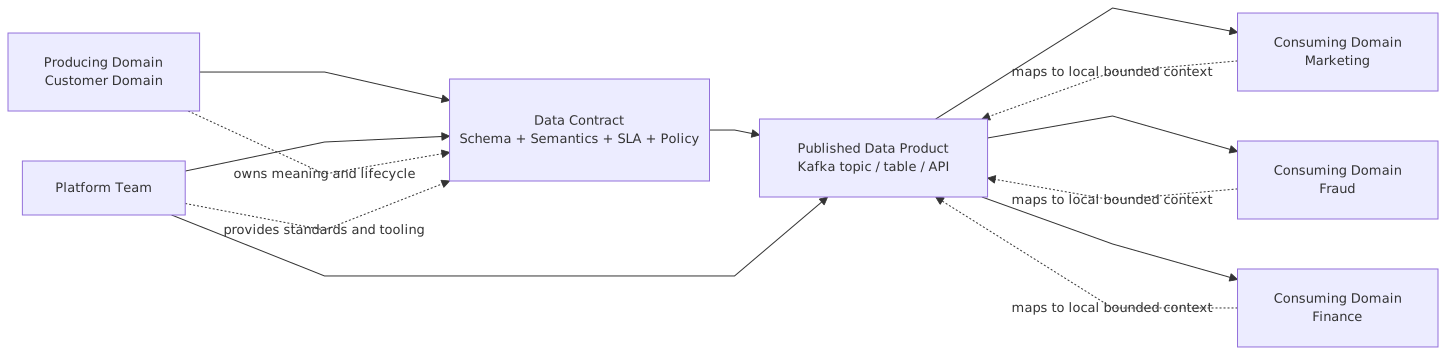
The important thing in that diagram is not the arrows. It is the asymmetry. Platform enables. Domain owns. Consumers adapt.
Architecture
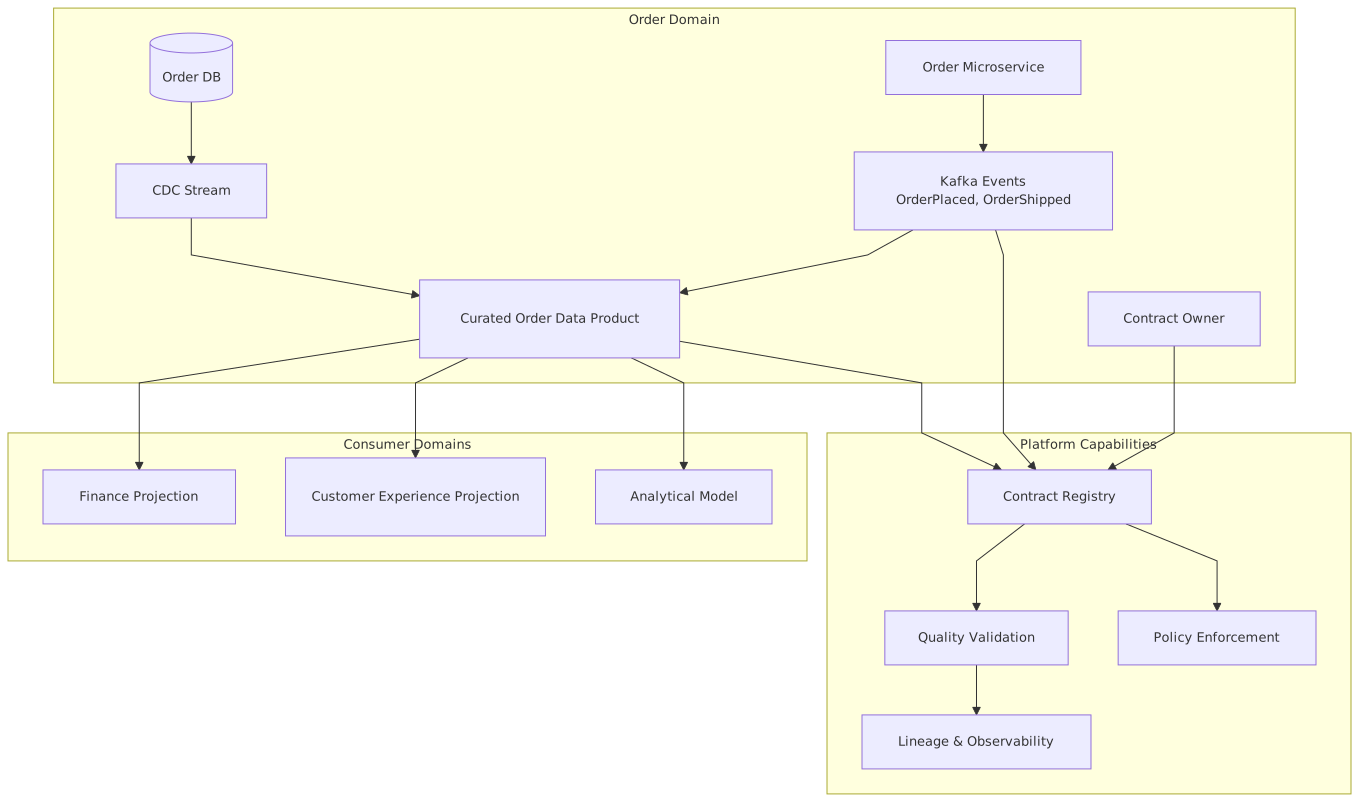
A workable enterprise architecture for contract ownership in a data mesh usually spans operational systems, event streams, analytical products, and governance services.
1. Domain-aligned producers
Each business domain publishes one or more data products. These may be:
- event streams from microservices via Kafka
- CDC-derived products from domain-owned databases
- curated analytical tables
- reference datasets
- materialized business aggregates
Not every table is a data product. A data product is intentional, discoverable, supported, and contracted.
2. Contract registry and metadata plane
You need a place to register contracts, versions, lineage, quality indicators, ownership metadata, and policy tags. The exact tool matters less than the discipline. Some enterprises use schema registries plus catalogs; some use broader metadata platforms. The key is that contracts are discoverable and enforceable.
3. Policy and quality enforcement
Contracts are not useful if violations are invisible. Pipelines should validate schema compatibility, required fields, and selected quality rules. Access controls should enforce classification and usage constraints. If a producer claims daily freshness, there should be an observable measure of daily freshness.
4. Consumer projections
Consumers should not couple directly to producer internals more than necessary. They should create local projections aligned with their own bounded contexts. Marketing may consume CustomerRegistered and CustomerConsentChanged events and build a campaign-eligibility model. Fraud may consume the same source but derive a risk identity graph. Shared inputs, local meaning.
5. Reconciliation paths
This is where many neat diagrams lie. Real systems drift. Events can be missed, duplicated, late, or replayed. CDC feeds can expose low-level mutations that do not map cleanly to business events. Warehouse models can lag. Contract ownership must include a reconciliation strategy:
- event-to-source reconciliation
- batch-vs-stream consistency checks
- snapshot plus changelog patterns
- compensating events
- audit trails for semantic corrections
A mature architecture often distinguishes between:
- operational contracts for events and APIs
- analytical contracts for curated, reconciled data products
Those are siblings, not substitutes.
Domain semantics discussion
The contract should express domain semantics, not just data shapes. That means writing down uncomfortable details:
- What does “order placed” mean if payment authorization fails seconds later?
- Is “customer” a legal entity, an account holder, a household member, or a person with consent?
- Does “active policy” include policies in grace period?
- Can a field be null because it is unknown, inapplicable, withheld, or not yet synchronized?
These distinctions sound pedantic until they trigger revenue leakage, compliance findings, or broken ML models. Semantics belong with the domain because only the domain understands the business process deeply enough to define them responsibly.
A useful pattern is to tie contracts to ubiquitous language. If a term is overloaded, say so. If contexts differ, separate them. The architecture should make translation explicit rather than smuggling ambiguity through generic fields.
Migration Strategy
Nobody walks into a Fortune 500 company and installs a perfect data mesh by Tuesday. Migration is the real architecture.
The best path is a progressive strangler migration. Start with the places where semantics already hurt and where a domain is mature enough to own a product. Leave the fantasy of a big-bang re-org to management consultants.
Step 1: Identify high-value, high-pain data products
Pick a handful of domain datasets with many consumers and frequent semantic disputes:
- customer master events
- order lifecycle events
- product catalog
- claims status
- account balances
These are painful enough to justify the change and visible enough to teach the organization.
Step 2: Make ownership explicit
Name the contract owner in the domain. Put it in the catalog, docs, incident routing, and governance process. If nobody in the domain is willing to own it, you have learned something important: the domain is not ready.
Step 3: Wrap existing feeds with contracts
Do not wait for ideal producer systems. Existing Kafka topics, CDC streams, or warehouse tables can be wrapped in a formal contract first. Clarify semantics before rebuilding plumbing.
Step 4: Introduce compatibility controls
Add schema compatibility checks, contract review, versioning rules, and deprecation policy. This is where platform earns its keep. Manual review does not scale.
Step 5: Carve out consumer-owned projections
Move consumers away from direct dependence on central conformed layers where sensible. Let them build local views from contracted products. This reduces semantic overloading in central models.
Step 6: Strangle central semantic transformations
As domains mature, central teams should stop inventing business meaning and instead focus on enablement, observability, and cross-domain concerns. This is hard because central teams are often rewarded for shipping transformed data fast. Incentives matter.
Step 7: Build reconciliation explicitly
During migration, old and new paths coexist. You need reconciliation reports comparing:
- source system counts vs topic counts
- event streams vs analytical aggregates
- old warehouse outputs vs new domain products
- contract version adoption by consumers
If you do not reconcile, migration becomes theology. People debate trust instead of measuring it.
Here is a pragmatic migration shape.

The strangler pattern works because it avoids demanding organizational perfection upfront. It lets ownership emerge where the business is ready and proves value through better trust, faster change, and fewer semantic incidents.
Enterprise Example
Consider a large retail bank.
The bank has a central enterprise data warehouse built over fifteen years. Customer data arrives from branch systems, mobile banking, CRM, credit card platforms, and anti-money-laundering tools. A central data engineering team has spent years creating a “golden customer” model. Everyone uses it: marketing, service, finance, risk, and compliance.
Then the bank adopts event-driven microservices and Kafka for digital channels. The Customer domain now emits events like: microservices architecture diagrams
- CustomerRegistered
- CustomerProfileUpdated
- CustomerAddressChanged
- CustomerConsentUpdated
At first, the central data team continues to absorb these events and reshape them into the warehouse golden model. But trouble appears fast.
Marketing treats a customer as someone eligible for campaigns.
Compliance treats a customer as a regulated identity under KYC rules.
Retail banking treats a customer as the party linked to one or more accounts.
The credit card unit includes secondary cardholders. The mortgage system does not.
The old warehouse model flattens these distinctions. It made life easier, until it made decisions wrong.
The bank changes course. It creates a domain-owned Customer Identity Data Product. The Customer domain contract owner defines:
- legal meaning of customer identity attributes
- event semantics for registration, merge, split, and consent changes
- identifier policy and survivorship rules
- freshness and late-update expectations
- privacy tags and retention constraints
- deprecation process for fields
The platform team provides schema registry, data catalog integration, quality dashboards, and policy enforcement. Marketing and Compliance consume the same product but build different projections. Marketing derives a Campaign Audience Projection. Compliance derives a KYC Subject Projection with stricter reconciliation to source records.
Crucially, the old warehouse “golden customer” is not killed immediately. Both paths run in parallel for several months. Reconciliation compares:
- customer counts by legal entity
- consent state differences
- duplicate rates
- unresolved merges
- event lag against source transactions
The migration surfaces a nasty failure mode: branch systems sometimes update addresses in nightly batch, while digital channels publish changes in near real time. During overlap, consumers see inconsistent address states. Rather than hiding this, the bank adds contract metadata on expected propagation latency and creates a reconciled analytical product for use cases that need stable daily state. Event truth for immediacy. Analytical truth for reporting and compliance snapshots.
That is real architecture. Not purity. Honest boundaries and managed inconsistency.
Operational Considerations
Contract ownership only matters if it survives operations.
Observability
Every data product should expose:
- freshness
- volume anomalies
- schema change events
- quality rule violations
- consumer dependency map
- incident status
Without observability, owners are blind and consumers become nervous copy-makers.
Version management
Breaking changes must be rare and deliberate. Favor additive evolution. Maintain explicit deprecation windows. Publish migration guidance. In Kafka ecosystems, use compatibility checks in CI/CD and registry enforcement at publish time.
Incident management
When a contract is violated, there should be no detective novel about who to call. Ownership metadata must connect to support channels, on-call rotation, and business escalation.
Access and policy
Data products should carry classification and usage constraints as first-class metadata. PII, financial data, health data, and regulated identifiers need controlled exposure. But policy should be machine-assisted, not hidden in committee.
Reconciliation operations
Reconciliation is not a one-time migration task. It is ongoing operational hygiene. Especially where streams, batch loads, APIs, and CDC overlap. Define:
- what is compared
- at what frequency
- acceptable drift thresholds
- who investigates exceptions
- when to publish compensating corrections
Product lifecycle
Data products should have onboarding, active use, deprecation, and retirement stages. Too many enterprises accumulate undead datasets: still queryable, no owner, suspiciously popular.
Tradeoffs
This approach is better, not free.
Benefits
- semantics stay close to business change
- consumers know who owns meaning
- contract change becomes more disciplined
- central teams stop acting as semantic middlemen
- data trust improves through explicit quality and lifecycle commitments
- bounded contexts become visible instead of hidden in SQL
Costs
- domains need stronger data capability
- ownership can fragment if standards are weak
- cross-domain analytics gets harder before it gets better
- local projections may duplicate transformation logic
- governance becomes federated and therefore politically harder
- some domains simply do not have the maturity to own products well
This is the classic enterprise tradeoff: move decision-making to where knowledge exists, then invest heavily in the guardrails that prevent chaos.
Failure Modes
A data mesh with poor contract ownership fails in recognizable ways.
1. Fake ownership
The domain is listed as owner, but the central platform or data team still defines semantics. This is theater. It breeds confusion because accountability and authority are split.
2. Schema-only contracts
Teams publish Avro or JSON Schema and call it done. Consumers still do not know what fields mean, what lateness to expect, or what quality guarantees exist.
3. Producer dictatorship
Producers change contracts with no regard for downstream impact because “the domain owns it.” Ownership is not license to break consumers casually. Compatibility policy matters.
4. Consumer capture
A powerful downstream team slowly dictates upstream semantics. The producer stops modeling its own domain and starts publishing a bespoke feed for one consumer. This is just point-to-point integration in modern clothes.
5. Central semantic relapse
As soon as inconsistencies appear, the central team quietly rebuilds a giant “trusted layer” that reinterprets domain data for everyone. Sometimes this is necessary for specific enterprise reporting products. Often it is just old habits returning.
6. Reconciliation denial
Teams assume events and analytical views will naturally align. They do not. Without explicit reconciliation, trust erodes.
7. Over-granular products
Every microservice topic is declared a data product. Most are not. Internal service events are often too unstable or too implementation-specific to be enterprise data products.
When Not To Use
Data contract ownership in a full data mesh style is not always the right move.
Do not force it when:
- the organization is small and a central team can still manage semantics effectively
- domains are weak, unstable, or politically undefined
- most data usage is enterprise reporting with little domain autonomy
- source systems are vendor SaaS platforms with minimal control over semantics
- the platform cannot provide basic tooling for contracts, quality, and discovery
- leadership wants decentralization in slides but centralized approval in practice
Also, do not pretend every dataset deserves a formal product contract. Internal transient events, exploratory data, one-off integration feeds, or short-lived experimentation pipelines may not justify the overhead.
Architecture should fit the operating model. If you cannot sustain federated ownership, a well-run centralized model is better than a mesh performed badly.
Related Patterns
Several adjacent patterns matter here.
Bounded Context Mapping
From domain-driven design, this is the discipline of making semantic boundaries explicit. Essential for understanding why “customer” is not one thing everywhere.
Event-Carried State Transfer
Useful in Kafka-based systems where domains publish changes for others to react to. Works well when paired with clear event semantics and compatibility rules.
Schema Registry and Contract Testing
Practical mechanisms for enforcing structural compatibility. Necessary, but not sufficient without semantic ownership.
Data Product Thinking
Treating datasets as products with owners, service expectations, discoverability, and lifecycle. This is the managerial companion to technical contracts.
Strangler Fig Migration
The right migration pattern for replacing central semantic layers incrementally. Wrap, compare, cut over, retire.
CQRS and Read Models
Consumers building local projections from shared events is close kin to CQRS. Different read models for different bounded contexts is a feature, not a flaw.
Reconciliation and Compensating Events
Critical where asynchronous systems, CDC, and analytical pipelines can diverge. Enterprises ignore this at their peril.
Summary
Data contract ownership is the load-bearing wall in a data mesh architecture. Without it, decentralization becomes a rumor and semantics leak into central teams, ad hoc transformations, and private copies.
The producing domain should own the contract: the meaning, guarantees, quality expectations, and lifecycle of the data product it publishes. The platform should standardize the mechanics: registries, validation, policy enforcement, observability, and automation. Consumers should own their local interpretations and projections, not hijack upstream models.
This is a domain-driven design problem as much as a data engineering one. Bounded contexts matter. Ubiquitous language matters. Translation matters. So do migration and reconciliation, because no enterprise starts from a blank page.
Use a progressive strangler migration. Wrap legacy feeds with explicit contracts. Move ownership into the domain where the business meaning lives. Build compatibility controls. Reconcile old and new paths until trust is earned, not announced.
And keep one hard truth in view: data contracts are not really about data. They are about responsibility. The schema is the easy part. The courage to own meaning is the architecture.
Frequently Asked Questions
What is a data mesh?
A data mesh is a decentralised data architecture where domain teams own and serve their data as products. Instead of a central data team, each domain is responsible for data quality, contracts, and discoverability.
What is a data product in architecture terms?
A data product is a self-contained, discoverable, trustworthy dataset exposed by a domain team. It has defined ownership, SLAs, documentation, and versioning — treated like a software product rather than an ETL output.
How does data mesh relate to enterprise architecture?
Data mesh aligns data ownership with business domain boundaries — the same boundaries used in domain-driven design and ArchiMate capability maps. Enterprise architects play a key role in defining the federated governance model that prevents data mesh from becoming data chaos.