⏱ 20 min read
Most data platforms don’t fail all at once. They decay.
Not with a dramatic outage, but with a thousand quiet compromises: a patch on a brittle ETL job, another exception path in a consumer, one more “temporary” backfill script nobody wants to touch. The platform still runs, dashboards still refresh most days, and executives still hear that the data estate is “strategic.” But under the hood, the thing has become a museum of defensive coding and tribal memory.
That is the moment architects start asking the wrong question.
They ask: Should we rebuild or repair? As if this were a matter of taste. As if one path were modern and the other conservative. As if the answer lived in technology alone.
It doesn’t.
The real question is simpler and harder: Where does the current platform still preserve business meaning, and where has it become a machine for reproducing ambiguity at scale? That is the fault line. Not old versus new. Not batch versus streaming. Not warehouse versus lakehouse. Meaning versus noise.
In enterprise data platforms, rebuild and repair are not merely delivery strategies. They are different bets on the shape of the domain, the quality of current semantics, the economics of migration, and the organization’s tolerance for parallel truth. Some systems deserve surgery. Others need replacement. A few need both, in the right order.
And this is where architecture earns its keep. Not by drawing boxes around Kafka, Snowflake, Spark, dbt, or microservices. Any team can do that. Real architecture decides what must remain continuous while the platform changes underneath: domain semantics, reconciliation discipline, operational trust, and the business contract for data. event-driven architecture patterns
This article lays out how to think about rebuild versus repair in data platforms, when each works, how to combine them, and why a progressive strangler migration is often the least reckless path. We’ll use domain-driven design thinking to frame the decision, examine tradeoffs and failure modes, and walk through a real enterprise example where “just modernize it” would have been a million-dollar mistake.
Context
Most enterprise data platforms were not designed. They were accumulated.
A reporting mart became a warehouse. The warehouse fed a data lake. The lake acquired CDC feeds, Kafka topics, microservices events, reverse ETL, notebook-based feature engineering, and eventually a semantic layer somebody promised would simplify everything. Each layer arrived to solve a genuine problem. None arrived with permission to redefine the whole. microservices architecture diagrams
The result is familiar: duplicated pipelines, inconsistent identifiers, event streams with weak contracts, slowly changing dimensions interpreted differently across teams, and transformation logic split across SQL, Python, orchestration tools, and application code. There are “gold” datasets that nobody trusts and “temporary” reconciliation reports that have outlived three CIOs.
In this environment, rebuild versus repair becomes a central platform strategy.
- Repair means preserving the current platform and incrementally improving what exists: refactoring pipelines, tightening contracts, fixing lineage, normalizing semantics, replacing hotspots, and reducing operational drag without changing the core shape too quickly.
- Rebuild means standing up a new target architecture—often with new ingestion, storage, transformation, and serving patterns—and migrating domains or capabilities into it, leaving the old platform to wither.
Both are legitimate. Both can fail spectacularly.
A common mistake is to frame repair as timid and rebuild as bold. In reality, repair can be the braver move when the domain is poorly understood and migration risk is high. Rebuild can be the safer move when the legacy system has become so semantically corrupted that every repair cements the wrong model deeper into the business.
The right answer starts with the domain, not the tooling.
Problem
The practical problem is not “legacy technology.” Enterprises run old technology successfully all the time. The practical problem is the widening gap between how the business understands its world and how the platform encodes that world.
That gap shows up in ugly, expensive ways:
- Revenue reported differently in finance, sales, and product analytics.
- Customer records split across CRM, billing, and support systems with no trustworthy golden identifier.
- Kafka topics that claim to represent business events but actually emit application state changes.
- ETL jobs that contain undocumented policy logic, effectively making the data platform the hidden source of business decisions.
- Backfills that never reconcile cleanly because source systems and downstream models disagree on time semantics.
- Microservices publishing events that are technically valid and semantically useless.
When this happens, teams start compensating locally. Each consuming team adds normalization logic. Every dashboard team creates “their version” of the metric. Data scientists extract directly from operational stores because the curated layer lags reality. The platform becomes a factory for divergence.
This is where the rebuild-versus-repair decision becomes urgent. Keep repairing too long, and you preserve a broken mental model. Rebuild too aggressively, and you create a second broken system while the first one still pays the bills.
The hidden problem is trust. Once trust in the data platform erodes, cost rises everywhere: governance, reporting, operations, and product development. Engineers build side channels. Executives ask for manual validation. Audit teams arrive with sharpened questions. Trust, once lost, does not come back because you bought a better query engine. EA governance checklist
It comes back when the platform starts telling one coherent story about the business.
Forces
There are several competing forces in play, and architecture is mostly the business of admitting they all matter at once.
1. Domain semantics versus technical simplification
A rebuild often promises a cleaner technical estate: fewer tools, modern storage, event-driven ingestion, streaming pipelines, unified governance. Good. But if the current platform still contains essential domain semantics—pricing rules, settlement logic, order lifecycle interpretation, policy exceptions—then a clean rebuild can become a clean erasure. ArchiMate for governance
Data platforms are full of accidental domain models. Some are wrong. Some are ugly but correct. You need to know which is which.
This is where domain-driven design helps. Not because the data platform should mimic every bounded context literally, but because the migration must respect where business language and invariants actually live. “Customer,” “order,” “active account,” and “recognized revenue” are not columns. They are contested meanings.
2. Time-to-value versus semantic debt retirement
Repair delivers local gains quickly. Fix the bad pipeline. Introduce schema contracts. Rationalize orchestration. Add observability. Decommission redundant marts. Teams feel progress.
Rebuild is slower at first but can pay off by resetting structural constraints: eliminating dead patterns, introducing canonical event contracts, re-partitioning data by domain, and creating a platform fit for future use cases like machine learning, real-time personalization, or compliance reporting.
The tension is obvious: the business wants visible progress now, but long-term value often requires changing fundamentals.
3. Continuity of operations
Data platforms are not side projects. They feed regulatory reporting, financial close, customer communications, planning, fraud detection, and operational decisions. You cannot simply “pause the business” while moving to a better architecture.
That makes dual-run, reconciliation, and cutover strategy first-class concerns. Not afterthoughts.
4. Organizational reality
Rebuild assumes you can create a competent target-state team, define target semantics, and sustain parallel operation long enough to migrate. Repair assumes you can improve a live estate without drowning in local exceptions and stakeholder pressure.
Both assumptions are fragile.
5. Event-driven ambition versus source-of-truth complexity
Kafka and microservices are often proposed as the path out of platform sprawl. Sometimes they are. But event-driven architecture can either clarify the enterprise or multiply ambiguity. If event contracts reflect bounded contexts and stable business events, they help. If they merely externalize application internals, they move chaos faster.
Streaming is not a substitute for semantics.
Solution
The most effective strategy in large enterprises is usually neither pure rebuild nor pure repair. It is repair to learn, rebuild to simplify, and migrate with a strangler pattern.
That sequence matters.
Start by repairing the areas that reveal domain semantics and operational truth:
- identify critical data products and consuming decisions
- map key business entities and lifecycle states
- document hidden transformation logic
- measure reconciliation gaps
- isolate unstable interfaces
- establish observability and data contracts
This is not busywork. It is reconnaissance. You do not rebuild what you do not understand.
Then rebuild selectively around coherent domains or capabilities, not around generic platform layers. A good rebuild target is typically one of these:
- a domain with high business value and high semantic pain, such as customer, order, policy, claim, or revenue
- a capability with repeated cross-domain utility, such as event ingestion, lineage, identity resolution, or reconciliation
- a serving layer whose current fragmentation creates disproportionate trust issues
The migration should be progressive. New pipelines and data products are introduced alongside legacy ones. Consumers are moved one by one. Reconciliation runs continuously. Legacy components are strangled as confidence grows.
That is the central idea: replace behavior at the edges while preserving the business contract in the middle.
A practical decision lens
Use a rebuild strategy when most of the following are true:
- current semantics are inconsistent and encoded in too many places
- core platform patterns block new requirements
- operational cost of the old platform is structurally high
- there is enough domain clarity to define target contracts
- the enterprise can sustain dual-running for a meaningful period
Use a repair strategy when most of the following are true:
- the platform’s core semantics remain valid
- pain is concentrated in specific pipelines or technical bottlenecks
- migration risk is high due to regulatory or operational dependencies
- organizational capacity for parallel build-out is weak
- time-to-value pressure is immediate
Use a hybrid strategy when the estate is mixed—which is to say, almost always.
Architecture
A mature target architecture for this problem usually separates concerns clearly:
- Source systems and operational domains remain the systems of record.
- Event and batch ingestion capture operational changes with explicit contracts.
- Domain-aligned raw and refined zones preserve provenance and business meaning.
- Reconciliation services compare legacy and rebuilt outputs continuously.
- Serving layers expose trusted data products for analytics, APIs, and operational use.
- Governance and observability sit across the flow, not bolted on later.
The most important architectural decision is not whether you use Kafka, CDC, dbt, Spark, Flink, Iceberg, Delta, or Snowflake. It is where you put the semantic boundary.
A useful pattern is to model data products by bounded context. Customer, billing, claims, fulfillment, and finance should not be crushed into one universal canonical model too early. Enterprises love canonical models because they look tidy on slides. In practice, they often become argument magnets. Better to publish well-defined domain products with explicit translation points where contexts meet.
Rebuild and repair coexistence
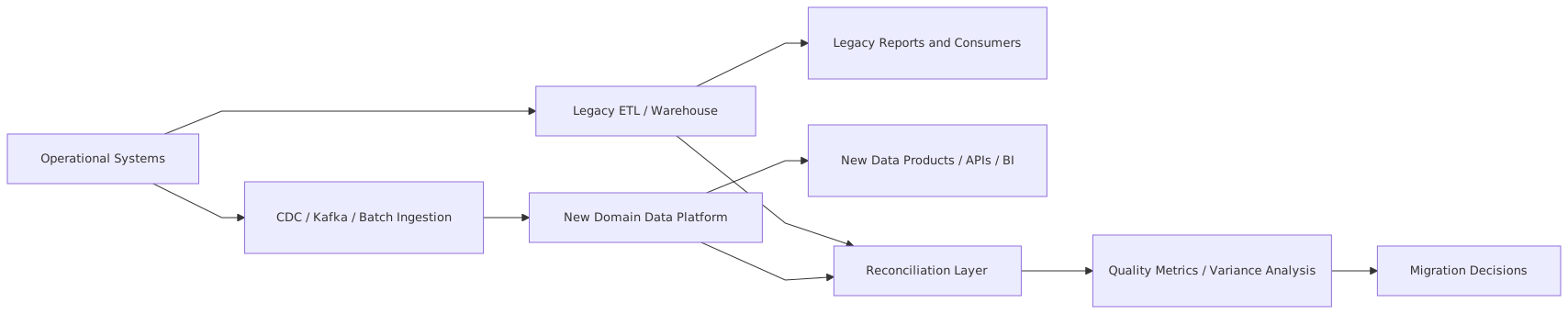
This coexistence architecture matters because it accepts reality: during migration, there will be two truths unless you actively govern one truth and one candidate truth. The reconciliation layer is what stops “parallel run” from becoming “parallel confusion.”
Domain-oriented target shape
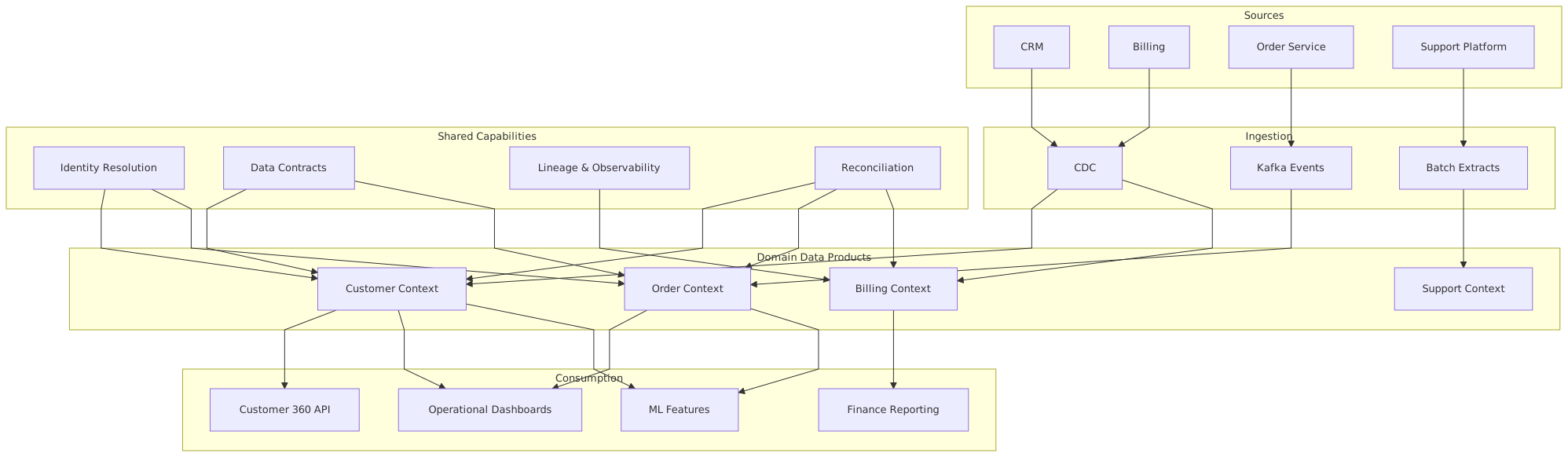
Why Kafka and microservices matter here
Kafka is useful when you need durable event streams, replay, and decoupled consumers. In a rebuild strategy, it often becomes the backbone for near-real-time ingestion and domain event propagation.
But be careful. There are three kinds of events in enterprises:
- business events: “OrderPlaced,” “PaymentSettled,” “ClaimApproved”
- process events: “WorkflowStepCompleted,” “BatchImported”
- technical events: “EntityUpdated,” “RecordChanged”
Only the first kind carries stable business semantics. The third kind is often just database mutation with a better marketing department. If your new platform is built mainly on technical events, you may simply reconstruct old confusion with lower latency.
Microservices matter for similar reasons. They can clarify domain ownership if each service owns a bounded context and publishes meaningful contracts. They can also fragment semantics if every team invents its own version of customer status, order completion, or entitlement.
The platform should not blindly trust application events. It should validate, enrich, and reconcile them against domain rules and source-of-record behavior.
Migration Strategy
The right migration strategy is usually a progressive strangler. Not because strangler patterns are fashionable, but because enterprises cannot afford semantic big bangs.
Here is the sequence that works in the field.
1. Identify domains, not tables
Start with business capabilities and the decisions they support. Ask:
- Which domains generate the most costly semantic disputes?
- Which reports or downstream systems are trust-critical?
- Which areas have stable business ownership?
- Where can a better data product retire multiple local workarounds?
You are not selecting schemas. You are selecting seams in the business.
2. Baseline current truth
Before building the target state, capture how the current platform behaves, including its defects. This includes:
- entity definitions
- metric logic
- source mappings
- timing assumptions
- known exceptions
- data quality thresholds
- consumer-specific overrides
This is not an endorsement of the current state. It is the minimum needed for controlled migration.
3. Build target data products alongside legacy pipelines
Stand up the new domain-aligned data products in parallel. Ingest from source systems directly where possible, using CDC, Kafka, or batch extraction as appropriate. Keep provenance. Preserve raw history. Do not prematurely collapse everything into a global model.
4. Reconcile relentlessly
Reconciliation is the hinge between rebuild and repair. Without it, every migration meeting becomes theology.
Compare old and new outputs continuously:
- row counts
- aggregate measures
- key business metrics
- lifecycle transitions
- latency windows
- identity matching rates
- exception populations
Expect differences. The point is not zero variance on day one. The point is explaining variance and deciding whether it reflects a defect, a semantic correction, or a tolerated policy change.
5. Move consumers incrementally
Migrate consumers by criticality and coupling:
- low-risk analytics consumers first
- downstream transformations second
- high-trust reports and operational dependencies last
Each move should be observable and reversible.
6. Strangle legacy components
Once a new data product has stable consumers, acceptable reconciliation, and operational maturity, begin decommissioning the corresponding legacy paths. Remove them fully. Half-dead pipelines are expensive ghosts.
Progressive migration flow
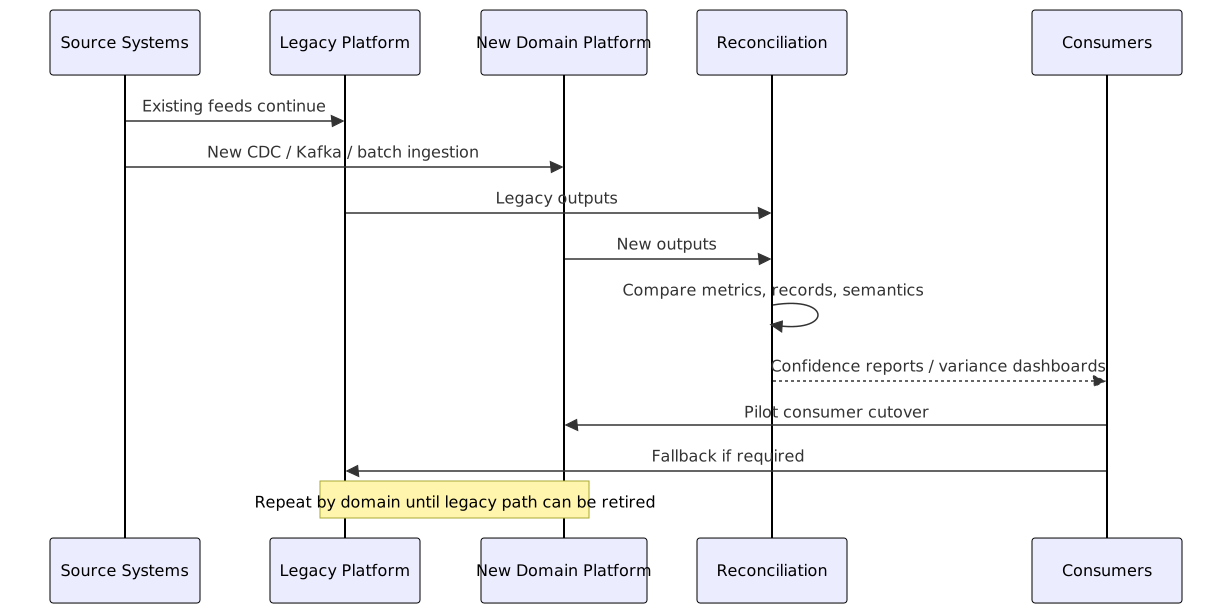
Why this beats big-bang replacement
Because big-bang data migration usually confuses technical completion with business readiness. The platform team says the pipelines are done. The business says the numbers changed. Audit asks why revenue moved between periods. Operations complains that customer status updates are delayed. Suddenly “done” means nothing.
Strangler migration makes semantics visible while there is still time to correct them.
Enterprise Example
Consider a global insurer with operations in twelve countries. Over a decade, it had built a central data warehouse fed by nightly ETL from policy administration, claims, billing, CRM, and partner systems. Regional teams added local marts. A newer streaming stack based on Kafka had been introduced for digital channels, but only for selected applications. The result was exactly what you would expect: three different definitions of active policy, multiple claim state models, and a finance close process held together by reconciliation spreadsheets and heroic people.
The board wanted a “modern data platform.” Vendors pitched a rebuild: lakehouse, event streaming, unified governance, real-time analytics. Technically attractive. Semantically dangerous.
The architecture team started with domain mapping. They found that the hardest problem was not tooling. It was the business meaning of policy lifecycle and claim liability. Different countries handled endorsement, cancellation, reinstatement, and reserve movement differently, and the old warehouse had embedded years of compensating logic to normalize that variation for group reporting.
A pure rebuild would have missed this. The new platform team would have ingested events, modeled entities cleanly, and quietly broken finance.
So they chose a hybrid strategy.
What they repaired
- legacy policy and claims transformations were documented and wrapped with observability
- lineage for key regulatory reports was made explicit
- duplicate regional reconciliation scripts were consolidated
- source system timing and late-arrival behavior were measured properly for the first time
What they rebuilt
- a new event and CDC ingestion layer using Kafka and change data capture
- domain data products for Policy, Claims, Billing, and Customer
- an identity resolution service for cross-system customer matching
- a reconciliation service comparing legacy warehouse outputs to new domain products at daily and intraday intervals
The critical architectural move
They did not create a universal enterprise canonical model upfront. Instead, they defined bounded-context data products with a shared governance layer and explicit translation rules for group finance reporting. That one decision prevented years of semantic trench warfare.
What happened in practice
The Customer and Billing domains migrated first because they had clear ownership and relatively stable semantics. Claims migrated later, after months of reconciliation around reserve adjustments and reopen events. Finance reporting remained on the legacy warehouse longer than anyone expected, but with improved lineage and reduced manual intervention.
After eighteen months:
- 40% of legacy ETL jobs were retired
- digital channel analytics moved to near real-time
- customer matching quality improved significantly
- regulatory reports still ran through a constrained legacy route, but now reconciled against new domain products
- the organization had one place to discuss data semantics per domain instead of twenty unofficial ones
This is what success looks like in enterprises: not a glorious cutover weekend, but a steady reduction in ambiguity.
Operational Considerations
Rebuild-versus-repair is often discussed as a design problem. It is just as much an operating model problem.
Reconciliation as a product
Treat reconciliation as a permanent capability, not a migration task. Variance dashboards, threshold alerts, explainability of mismatches, and sign-off workflows should all be first-class. In regulated industries especially, reconciliation becomes the social proof that new architecture deserves trust.
Observability beyond freshness
Most data observability stops at freshness and schema drift. Useful, but insufficient. You also need:
- semantic drift detection
- business-rule conformance
- cardinality shifts
- identifier match-rate monitoring
- event ordering and duplication metrics
- late-arrival windows and replay behavior
Data contracts
Contracts matter most at boundaries that are organizationally contested: source systems to ingestion, microservices to event streams, domain products to consumers. Good contracts specify not just schema but meaning, timing, completeness expectations, and change policy.
Backfill strategy
Backfills are where elegant rebuild plans go to die. Historical data often reflects old policies, source defects, and changing business rules. Decide early:
- how far back must the new platform restate history?
- where are policy changes allowed to create intentional divergence?
- what counts as “materially equivalent” for past periods?
A platform that works only forward in time is often useless to the enterprise.
Security and governance
Parallel platforms increase the attack surface and the governance burden. Access policy, masking, retention, and lineage must be consistent enough that migration does not create compliance blind spots.
Tradeoffs
There is no free strategy here.
Repair advantages
- faster visible wins
- lower immediate migration risk
- less consumer disruption
- preserves embedded domain knowledge
Repair disadvantages
- may entrench flawed architecture
- hard to eliminate systemic complexity
- often keeps too much logic in the wrong places
- can become endless maintenance without strategic simplification
Rebuild advantages
- resets technical constraints
- enables domain ownership and clearer contracts
- better supports streaming, ML, self-service, and future scale
- provides a forcing function for semantic cleanup
Rebuild disadvantages
- long time before value is obvious
- dual-running costs are high
- easy to lose hidden but essential business logic
- organizational stamina often runs out before migration completes
The tradeoff is not innovation versus caution. It is structural simplification versus continuity of meaning.
The best architectures take simplification where they can get it, and protect meaning where they cannot afford to lose it.
Failure Modes
This topic has some recurring disasters.
1. Rebuilding technology, preserving semantic chaos
The team adopts Kafka, lakehouse storage, streaming transforms, and shiny metadata tooling, but leaves business definitions unresolved. The new platform is faster and still disputed.
2. Repairing forever
Every problem gets a local fix. Nothing gets simpler. Costs compound. The platform becomes “stable” only in the sense that sedimentary rock is stable.
3. Canonical model fantasy
The enterprise attempts one universal business model for every domain before migration can proceed. Progress stops in committee.
4. No reconciliation discipline
Consumers are moved based on optimism and demos rather than measured equivalence. Mismatches surface only after executive reporting diverges.
5. Event contract naivety
Application teams emit technical events and call them business facts. Downstream consumers infer meaning that was never guaranteed.
6. Underestimating history
The new platform handles current data well but cannot reproduce prior-period logic, making finance, risk, audit, or customer support workflows unusable.
7. Ownership vacuum
Platform teams build pipelines, domain teams own semantics, and no one owns the agreement between them.
When Not To Use
A rebuild-heavy strategy is a bad idea when:
- the domain is deeply unstable and the business has not converged on key definitions
- there is no capacity for dual-run and reconciliation
- regulatory deadlines demand tactical reliability more than platform modernization
- the legacy platform, while ugly, still expresses the business correctly and can be incrementally improved
- leadership wants transformation rhetoric without funding migration reality
A repair-heavy strategy is a bad idea when:
- the current architecture blocks essential new capabilities
- semantic logic is fragmented beyond practical recovery
- operational cost of the current platform is structurally unsustainable
- every new use case requires bespoke extraction and one-off modeling
- trust has decayed so far that preserving the current core only prolongs dysfunction
And sometimes the right answer is: do less. Not every data platform needs event streaming, domain data products, real-time serving, and a full semantic layer. If the business runs on periodic reporting, stable source systems, and modest analytical needs, a disciplined repair of warehouse architecture may be better than an ambitious rebuild. Architecture should solve the enterprise you have, not the conference keynote you watched.
Related Patterns
Several related patterns fit naturally with rebuild-versus-repair strategies:
- Strangler Fig Pattern: progressively replace legacy behavior while keeping the business running.
- Domain-Oriented Data Products: align data ownership and semantics with bounded contexts.
- Change Data Capture: useful bridge from transactional systems into modern platforms during migration.
- Event-Driven Architecture: valuable when events represent stable business facts.
- Data Contracts: reduce ambiguity at producer-consumer boundaries.
- CQRS-style read models: helpful where operational services and analytical views need different representations.
- Anti-Corruption Layers: essential when consuming legacy semantics without letting them pollute the target model.
- Reconciliation and Dual Run: the missing discipline in most modernization programs.
Together, these patterns form a coherent migration toolbox. Used blindly, they form a very expensive diagram.
Summary
Rebuild versus repair is not a binary architecture choice. It is a strategy for managing semantic risk in a living enterprise.
Repair is right when the core meaning is still sound and the platform mainly suffers from technical erosion. Rebuild is right when the current estate has become a machine for scaling ambiguity. Most organizations need both: repair to uncover truth, rebuild to simplify structure, and a progressive strangler migration to move from one to the other without gambling the business.
The deepest lesson is this: data platforms succeed when they respect domain meaning more than platform fashion. Domain-driven design matters because enterprises do not run on tables or topics. They run on commitments, states, transitions, and decisions. If your architecture preserves that, the migration can be hard and still succeed. If it does not, no amount of Kafka, microservices, or modern storage will save you.
A data platform is not just where data goes. It is where the enterprise explains itself to itself.
If the explanation has gone rotten, rebuild what must be rebuilt. If the bones are sound, repair them. And if you are wise, do both with reconciliation in one hand and humility in the other.
Frequently Asked Questions
What is a data mesh?
A data mesh is a decentralised data architecture where domain teams own and serve their data as products. Instead of a central data team, each domain is responsible for data quality, contracts, and discoverability.
What is a data product in architecture terms?
A data product is a self-contained, discoverable, trustworthy dataset exposed by a domain team. It has defined ownership, SLAs, documentation, and versioning — treated like a software product rather than an ETL output.
How does data mesh relate to enterprise architecture?
Data mesh aligns data ownership with business domain boundaries — the same boundaries used in domain-driven design and ArchiMate capability maps. Enterprise architects play a key role in defining the federated governance model that prevents data mesh from becoming data chaos.