⏱ 14 min read
Introduction
Business Process Modeling is one of those disciplines that sounds abstract until you see it applied to a real governance challenge. In this article, we walk through a complete BPMN 2.0 model of an e-mail voting process — the kind of workflow that standards bodies, board committees, open-source governance groups, and regulatory panels use every day to make collective decisions.

What makes this example particularly instructive is that it is not a toy process. It covers structured multi-day discussion cycles with configurable deadlines, conference call scheduling with calendar integration, dual-channel vote collection (e-mail and conference call), real-time vote tallying with web publication, quorum validation and automatic re-announcement if participation is insufficient, majority checking with runoff logic when no clear winner emerges, and a full two-round voting mechanism that reduces options and allows vote changes. Every one of these behaviors is modeled using standard BPMN 2.0 constructs — gateways, timer events, message events, parallel flows, sub-processes, and data objects — without any proprietary extensions. integration architecture diagram
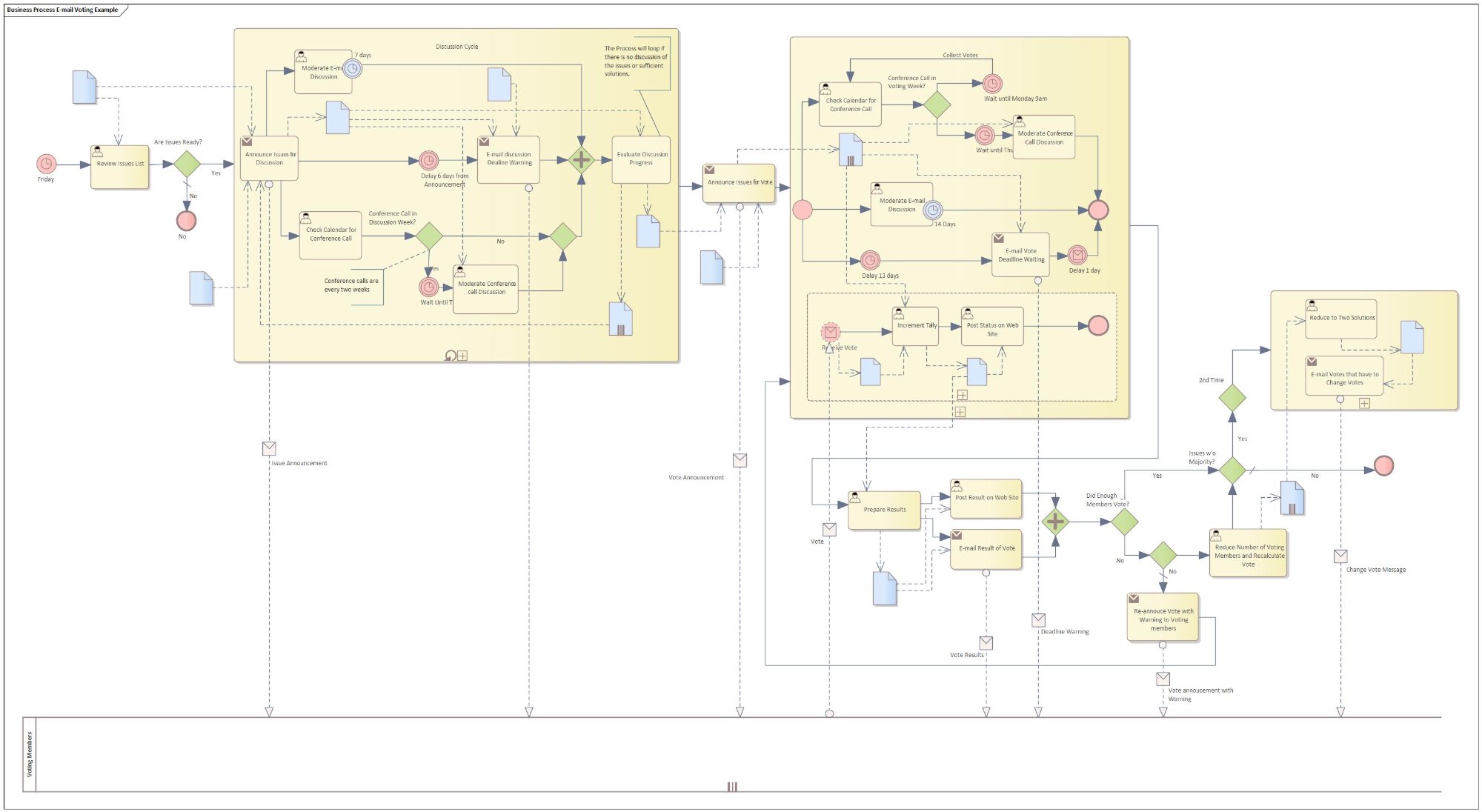
The diagram above shows the full process. Do not worry if it looks dense at first glance — we will walk through each phase step by step, explaining the BPMN patterns and design decisions along the way. By the end of this article, you will have a solid understanding of how to model complex governance workflows in BPMN 2.0.
Process Overview
The BPMN model is organized into three distinct phases, each handling a different aspect of the governance workflow. Phase 1 manages the structured discussion cycle, where issues are announced, debated via e-mail and conference calls, and evaluated for readiness. Phase 2 handles vote collection, supporting both e-mail and conference call channels, with real-time tallying and web publication. Phase 3 covers result evaluation, including quorum validation, majority checking, and a two-round runoff mechanism when no clear majority emerges. ArchiMate for architecture governance
The model uses two swimlanes: a main process lane (which could represent a secretariat, governance office, or automated orchestration engine) and a "Voting Members" lane at the bottom, representing the participants who receive announcements, participate in discussions, and cast their votes. Message flows (dashed lines) connect the two lanes, showing exactly where human interaction occurs.
What makes this model production-ready rather than merely illustrative is its handling of edge cases. What happens if not enough members vote? The model re-announces the vote with a warning. What happens if there is no majority? The model reduces the options and runs a second round. What happens if the second round still produces no majority? The process terminates with a documented outcome. These are the real-world governance rules that most "simple voting" models ignore.
Phase 1: Structured Discussion Cycle
The process begins every Friday with a timer start event. The first task — "Review Issues List" — is a human task performed by the governance coordinator. A data object (the issues list document) feeds into this task, establishing the information context right at the start.
The Readiness Gateway (XOR Pattern)
After the review, an exclusive gateway (XOR) asks: "Are Issues Ready?" This is the first decision point in the model. If the issues are not ready, the process terminates via an end event — there is nothing to vote on. If the issues are ready, the process enters the Discussion Cycle sub-process.
This is a clean application of the exclusive gateway pattern in BPMN. Only one outgoing path is taken, based on a business condition. In an executable model, this condition would be expressed as a gateway condition expression evaluating a process variable like issuesReady == true.
The Discussion Cycle Sub-Process
The Discussion Cycle is modeled as an expanded sub-process — a container that groups related activities into a reusable, collapsible unit. Inside the sub-process, the coordinator announces the issues for discussion, which triggers an "Issue Announcement" message to the Voting Members lane.
Several timer events enforce governance deadlines within the sub-process. A 5-day delay from the announcement allows time for e-mail discussion. A 7-day timer controls the e-mail discussion moderation window. A check for conference call scheduling uses a conditional flow: if the discussion falls in a conference call week, the model waits until Monday 9am and then holds a moderated conference call. If not, the e-mail discussion continues. Conference calls run every two weeks, which is captured as a timer annotation on the calendar check.
The "Moderate E-mail Discussion" and "Moderate Conference Call Discussion" tasks represent human-in-the-loop activities. These cannot be fully automated because they require judgment — a human moderator synthesizes the discussion, identifies consensus and disagreements, and determines whether sufficient deliberation has occurred.
The Iterative Loop
After discussion, the "Evaluate Discussion Progress" task assesses whether the discussion is sufficient. If not — if there has been no meaningful discussion or if key questions remain unresolved — the process loops back to another discussion round. An annotation in the diagram notes: "The process will loop if there is no discussion of the issue or sufficient solutions."
This is a controlled feedback loop — one of the most important patterns in governance process design. Without it, you risk pushing undiscussed issues to a vote, which undermines the legitimacy of the outcome. The loop ensures that every issue receives adequate deliberation before voting begins.
Phase 2: Vote Collection
Once discussion is complete, the coordinator task "Announce Issues for Vote" sends a "Vote Announcement" message to the Voting Members. The process then enters the "Collect Votes" sub-process.
Event-Based Gateway: Dual-Channel Voting
Inside the Collect Votes sub-process, an event-based gateway determines the voting channel. If it is a conference call voting week, the process checks the calendar, waits until Monday 9am, and conducts the vote during a moderated conference call. If not, the process enters an e-mail voting flow with a 14-day discussion and vote window, followed by a 1-day deadline waiting period before the vote closes.
The event-based gateway is different from a standard XOR gateway in an important way: the decision is based on which event occurs first, not on a data condition. This makes it ideal for modeling situations where the process must react to external events — in this case, whether a conference call is scheduled or whether the e-mail deadline expires.
Parallel Gateway: Concurrent Vote Processing
The vote processing flow uses a parallel gateway (AND split) to handle three concurrent activities whenever a vote is received. "Receive Vote" triggers the parallel split, which simultaneously runs "Increment Tally" (updating the vote count), "Post Status on Web Site" (publishing real-time results), and continues to accept additional votes. These branches are synchronized by a parallel join before the process continues.
This is a textbook application of the parallel gateway pattern. In a BPMN execution engine, the three branches would execute as parallel threads or tasks, each completing independently. The join waits for all branches to complete before proceeding. This pattern ensures that vote processing, public transparency, and continued collection happen simultaneously rather than sequentially.
Vote Aggregation and State Management
The "Increment Tally" task is more than it appears. It represents a stateful process pattern — the process instance maintains a running count of votes received, votes per option, and participation rate. In an executable BPMN model, this would be implemented as a service task that updates process variables or calls a vote management microservice. The tally state is the foundation for the quorum and majority checks in Phase 3.
Phase 3: Result Evaluation & Re-Vote Handling
After the voting window closes, the process enters its most complex phase: evaluating results and handling governance exceptions. This is where the model demonstrates real sophistication.
Result Preparation and Publication
A parallel gateway splits the result handling into concurrent paths: "Prepare Results" feeds into "Post Result on Web Site" (public transparency), while simultaneously "E-mail Result of Vote" sends the outcome to all members, and "Vote Results" data objects are archived. These branches join before the quorum check, ensuring that results are fully published before any re-vote logic activates.
Quorum Validation Pattern
An exclusive gateway asks: "Did Enough Members Vote?" This is the quorum validation pattern — a governance essential. If participation is below the required threshold, the process does not simply fail. Instead, it enters a recovery flow: "Reduce Number of Voting Members and Recalculate Vote" adjusts the quorum denominator (accounting for members who have formally recused or are unavailable), "Re-announce Vote with Warning to Voting Members" sends a new announcement with a deadline warning, and the process loops back to collect additional votes.
This is a critical governance safeguard. Many voting processes fail not because of disagreement but because of insufficient participation. The BPMN model makes this recovery path explicit, auditable, and repeatable — exactly what regulators and auditors want to see in a governance process.
Majority Decision Pattern
If the quorum is met, the next exclusive gateway asks: "Issues w/o Majority?" If a clear majority exists, the process ends successfully. If not, the model must handle the absence of a decisive outcome.
Here the model checks whether this is the first round or the second round (via a "2nd Time" conditional flow). If it is the first round, the process enters a runoff mechanism: "Reduce to Two Solutions" narrows the options, "E-mail Voters that have to Change Votes" notifies affected members, and a new gateway determines whether a majority now exists. If yes, the process concludes. If not, the process terminates with a "Change Vote Message" — documenting that the governance process was followed but no majority was achievable.
This two-round runoff pattern is common in parliamentary procedure (Robert's Rules of Order), standards body governance (ISO, IEEE), and corporate board voting. Modeling it explicitly in BPMN ensures that the process is followed consistently every time, rather than being improvised under pressure.
BPMN Elements Used in This Model
This single model uses a remarkably broad set of BPMN 2.0 constructs, making it an excellent reference for learning the notation.
- Start Event (Timer): the process triggers every Friday, demonstrating time-triggered process initiation
- End Events (multiple): several termination points covering successful completion, no-majority termination, and issues-not-ready termination
- Timer Intermediate Events: deadline enforcement at multiple points (5-day delay, 7-day discussion, 14-day voting, Monday 9am wait, 13-day delay, 1-day deadline)
- Message Events: issue announcement, vote announcement, deadline warning, vote results, and vote announcement with warning
- User Tasks: review issues, moderate discussions, evaluate progress, prepare results
- Service Tasks: increment tally, post to website, e-mail results
- Exclusive Gateways (XOR): readiness check, conference call week check, quorum check, majority check, 2nd time check
- Parallel Gateways (AND): concurrent vote processing, concurrent result publication
- Event-Based Gateways: dual-channel vote collection routing
- Expanded Sub-Processes: Discussion Cycle, Collect Votes — grouping related activities
- Data Objects: issue list, vote announcement, vote results, change vote message
- Swimlanes: main process lane and Voting Members participant lane
- Message Flows: dashed arrows between lanes showing cross-participant communication
- Annotations: explanatory notes attached to key elements for documentation
Six BPMN Patterns This Model Demonstrates
Beyond the individual BPMN elements, this model is a showcase for six recurring workflow patterns that appear across enterprise governance processes.
Pattern 1: SLA-Based Deadline Enforcement. Timer events throughout the model enforce fixed time windows for discussion (7 days), voting (14 days), and deadline warnings (1 day before close). In production, these timers would trigger escalation procedures, reminder emails, or automatic closure actions. The pattern ensures that governance processes do not stall indefinitely — a common problem with unstructured e-mail-based decision-making.
Pattern 2: Human-in-the-Loop Moderation. The moderation tasks acknowledge that not everything can be automated. Discussion synthesis, conflict resolution, and progress evaluation require human judgment. The BPMN model explicitly separates automated tasks (tally increment, web posting) from human tasks (moderation, review), making it clear where automation stops and human governance begins.
Pattern 3: Controlled Iteration. The discussion loop and re-vote loop both implement controlled iteration with clear exit conditions. The discussion loop exits when the evaluator deems the discussion sufficient. The re-vote loop exits when quorum is met or the adjusted quorum is satisfied. Neither loop is unbounded — there are termination paths that prevent infinite cycling.
Pattern 4: Event-Driven Routing. The event-based gateway that routes between conference call and e-mail voting is a pure event-driven pattern. The process does not decide based on data; it waits for one of two events to occur and follows whichever happens first. This pattern is essential for modeling processes that must adapt to external scheduling constraints.
Pattern 5: Concurrent Processing with Synchronization. The parallel gateways ensure that vote tallying, web publication, and result distribution happen simultaneously. This is not just an optimization — it is a governance requirement. Stakeholders expect real-time visibility into voting progress, which means publication cannot wait for all votes to be counted sequentially.
Pattern 6: Multi-Stage Decision Resolution. The two-round runoff mechanism is the most sophisticated pattern in the model. It handles the common governance scenario where initial voting produces no clear winner, reduces options to force a decision, notifies affected voters, and runs a final decisive round. This pattern is directly transferable to budget approval processes, standards ratification, and regulatory committee decision-making.
Implementation Considerations
If you want to move this model from a documentation artifact to an executable workflow, there are several practical considerations to address.
For process engine selection, this model is executable on any BPMN 2.0 compliant engine: Camunda, Flowable, jBPM, or cloud-native alternatives like Temporal with BPMN adapters. The timer events, gateways, and message events all have direct engine-level implementations. enterprise cloud architecture patterns
For integration architecture, the message events (issue announcement, vote announcement, result notification) would be implemented as e-mail service tasks or webhook calls to a notification service. The "Post Status on Web Site" task would call a CMS API or update a governance portal dashboard. modeling integration architecture with ArchiMate
For state management, the vote tally requires persistent process state. Most BPMN engines handle this natively through process variables, but high-volume voting scenarios might benefit from an external vote management service called via service tasks.
For audit and compliance, every gateway decision, every timer expiry, and every message sent is logged by the process engine. This audit trail is the governance record that proves the process was followed correctly — essential for standards bodies, regulatory committees, and any organization subject to process compliance requirements.
For model maintenance, this BPMN model should live in a versioned repository (ideally in Sparx Enterprise Architect or a similar tool) so that changes to governance rules — a new quorum threshold, a different discussion window, an additional voting round — can be reviewed, approved, and deployed through a controlled change process.
Conclusion
This e-mail voting BPMN model is far more than a diagram. It is a complete specification of a governance workflow that handles structured discussion with deadline enforcement, dual-channel vote collection, real-time result publication, quorum validation with automatic re-announcement, majority checking with two-round runoff resolution, and documented termination when no majority is achievable.
Every behavior is modeled using standard BPMN 2.0 constructs — no proprietary extensions, no custom notations. This means the model is portable across tools, executable on any compliant engine, and understandable by anyone trained in the BPMN 2.0 standard.
For enterprise architects and governance professionals, this model demonstrates that BPMN is not limited to simple approval workflows. It can capture the full complexity of real-world decision-making processes — including the edge cases and exception paths that matter most when things do not go as planned. Sparx EA best practices
For expert guidance on business process modeling, explore our BPMN 2.0 training, Sparx EA training, enterprise architecture consulting, and consulting services. Get in touch.
Frequently Asked Questions
What is enterprise architecture?
Enterprise architecture is a discipline that aligns an organisation's strategy, business operations, information systems, and technology infrastructure. It provides a structured framework for understanding how an enterprise works today, where it needs to go, and how to manage the transition.
How is ArchiMate used in enterprise architecture practice?
ArchiMate is used as the standard modeling language in enterprise architecture practice. It enables architects to create consistent, layered models covering business capabilities, application services, data flows, and technology infrastructure — all traceable from strategic goals to implementation.
What tools are used for enterprise architecture modeling?
Common enterprise architecture modeling tools include Sparx Enterprise Architect (Sparx EA), Archi, BiZZdesign Enterprise Studio, LeanIX, and Orbus iServer. Sparx EA is widely used for its ArchiMate, UML, BPMN and SysML support combined with powerful automation and scripting capabilities.