⏱ 13 min read
Introduction: what ArchiMate certification actually validates
ArchiMate certification is designed to validate that you can understand the ArchiMate modeling language and apply it to enterprise-architecture modeling scenarios — using standard notation, terminology, structure, and concepts. The key idea to internalize is that ArchiMate is not primarily a "diagramming style"; it is explicitly positioned as a shared language for architecture description and communication. That communication-first orientation is a recurring theme in The Open Group's guidance and is often what differentiates someone who "knows the symbols" from someone who can model for actual stakeholder decisions.
Recommended Reading
This guide covers the certification levels, exam format and strategy, a practical study plan, the core concepts and relationships you must master, common pitfalls, and how to make certification preparation directly useful for your enterprise architecture work.
Certification levels and exam structure
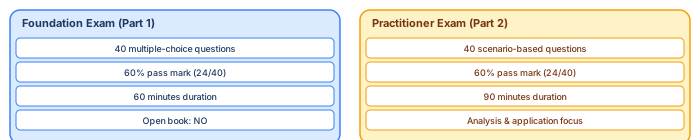
The ArchiMate 3 certification program contains two levels aligned to the ArchiMate 3.2 specification: ArchiMate 3 Foundation and ArchiMate 3 Practitioner.
Foundation (Part 1): 40 multiple-choice questions, 60 minutes, 60% pass mark (24/40), no open book. This level tests recognition and recall: can you identify the correct element type for a given scenario, determine whether a relationship is valid, and recognize viewpoint purposes. Candidates with enterprise modeling experience typically need 40–60 hours of study.
Practitioner (Part 2): 40 scenario-based questions, 90 minutes, 60% pass mark, analysis and application focus. This level tests higher-order skills: given a complex modeling scenario, can you choose the most appropriate viewpoint, identify errors in an existing model, and justify relationship choices based on ArchiMate semantics. If you are modeling to support investment decisions, migration planning, and governance, Practitioner-level competence is what the job requires. Budget an additional 30–40 hours of study beyond Foundation.
Both exams can be taken via self-study or through an accredited training course. Tools help you practice correct modeling, but certification validates knowledge and application of the language itself — you do not need a tool to pass the exam.
A study plan that maps to real architecture work

A high-yield study approach alternates between vocabulary learning and viewpoint-driven modeling practice. ArchiMate is meant to support viewpoints and stakeholder concerns — not one giant "model of everything." The study plan maps directly to how enterprise architects work. ArchiMate tutorial for enterprise architects
Week 1–2: Core elements and layers. Master the element types across all layers: Business (Actor, Role, Process, Function, Service, Object), Application (Component, Collaboration, Service, Interface, Data Object), Technology (Node, Device, System Software, Service, Artifact), and Strategy/Motivation (Driver, Goal, Outcome, Principle, Requirement, Constraint). Build micro-models with 5–10 elements that demonstrate each layer in isolation.
Week 3–4: Relationships and the metamodel. This is the most exam-critical topic. Practice drawing every valid relationship type and understand why invalid combinations are prohibited by the metamodel. For each relationship, be able to answer: which element types can it connect? What direction does it flow? How does it differ from similar relationships?
Week 5–6: Viewpoints and views. For each standard viewpoint (Organization, Business Process Cooperation, Application Cooperation, Technology Usage, Layered, Migration, Motivation), build a view using your own organization's architecture. Define the stakeholder concern each viewpoint addresses. This practice is directly applicable to your day job — you are building real architecture content while studying.
Week 7–8: Mock exams and scenario analysis. Practice under timed conditions. Review incorrect answers to identify knowledge gaps. Focus especially on relationship validity questions, viewpoint selection questions, and element-type identification questions — these make up the majority of both exams.
The relationship categories you must master
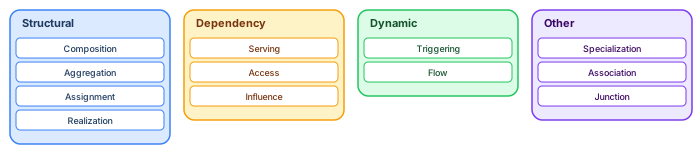
Relationship validity is the single most tested concept in both Foundation and Practitioner exams. ArchiMate defines four categories of relationships, each with specific rules about which element types they can connect. ArchiMate layers explained
Structural relationships define the static construction of the architecture. Composition means "is part of" (a department is part of an organization). Aggregation means "groups together" (a platform aggregates multiple services). Assignment means "is allocated to" (a business role is assigned to a business actor — meaning a person or team plays that role). Realization means "implements" (an application component realizes an application service). The key exam trap: Realization flows from the implementing element to the abstraction it realizes — Component --Realization--> Service, not the reverse.
Dependency relationships describe how elements depend on each other. Serving (formerly "used by") means one element provides functionality to another — the arrow points from the serving element to the element being served. Access means an element reads, writes, or reads-and-writes a passive structure element (like a Data Object). Influence connects motivation elements and captures positive or negative impact between goals, principles, and requirements.
Dynamic relationships describe behavioral connections. Triggering means one element causes the start of another — used to model sequential process steps. Flow represents the transfer of something tangible (data, goods, money) between behavioral elements.
Other relationships include Specialization (inheritance — "is a kind of"), Association (untyped link — weakest possible relationship), and Junction (split/join for relationship branching). Association should be used only when no specific relationship type applies. Overuse of Association is a red flag for undisciplined modeling.
Viewpoints: the organizing principle for the exam and for practice
ArchiMate 3.2 defines a catalog of standard viewpoints, each designed to address specific stakeholder concerns. For the exam, you need to know which viewpoint answers which question: ArchiMate relationship types
Organization viewpoint: "How is our organization structured?" Shows business actors, roles, collaborations, and their relationships. Stakeholders: HR directors, organizational design teams.
Business Process Cooperation viewpoint: "How do our processes interact?" Shows business processes, the services they use and produce, and the data objects they access. Stakeholders: process owners, operational managers.
Application Cooperation viewpoint: "How do our applications interact?" Shows application components, the services they expose and consume, and the data flows between them. Stakeholders: solution architects, integration teams.
Technology Usage viewpoint: "What infrastructure supports our applications?" Shows technology nodes, platform services, and how applications are deployed on infrastructure. Stakeholders: infrastructure architects, platform engineers.
Layered viewpoint: "How does the architecture fit together across all layers?" Shows elements from multiple layers with their cross-layer relationships — the most comprehensive but also most complex viewpoint. Stakeholders: enterprise architects, C-level leadership.
Migration viewpoint: "How do we get from current state to target state?" Shows plateaus (stable architectural states), gaps (differences between plateaus), and work packages (initiatives that close the gaps). Stakeholders: program managers, architecture review boards.
Motivation viewpoint: "Why are we making these architecture decisions?" Shows drivers, goals, outcomes, principles, requirements, and constraints — linking business motivation to architecture decisions. Stakeholders: strategy leaders, business sponsors.
Exam strategy and common pitfalls
The most common avoidable mistakes stem from "diagram thinking" rather than "language thinking":
Over-modeling: Creating large, visually complex diagrams that look "architectural" but do not answer a defined concern. ArchiMate is a means to make architecture understandable for decisions, not an end in itself. Every view should answer a specific question for a specific audience. If you cannot state the question, the view should not exist.
Relationship guessing: Drawing relationships because they "feel right" without checking the metamodel. In exams, the difference between a correct and incorrect answer often hinges on one specific metamodel rule. For example: can an Application Component directly serve a Business Process? (No — it serves via an Application Service.) Can a Technology Node realize an Application Component? (No — a Node is assigned to an Application Component, not a realization.)
Ignoring motivation and strategy: Many candidates focus exclusively on the core layers and neglect the Motivation and Strategy extensions. Both exams test Drivers, Goals, Principles, Outcomes, and their relationships. These elements connect "why" to "what" — the bridge between business intent and architecture decisions.
Confusing similar elements: Business Service vs. Application Service (one is business-facing, the other is application-facing). Business Process vs. Business Function (process is behavioral with a defined flow, function is a grouping of behavior). Application Component vs. Application Service (component is the structural unit, service is the exposed behavior).
Practice exercises for self-study
// Self-test: Which relationships are VALID?
// Mark each as ✓ (valid) or ✗ (invalid)
//
// 1. Application Component --Serving--> Business Process        ✗
//    (Needs intermediate Application Service)
//
// 2. Application Component --Realization--> Application Service ✓
//    (Component implements the Service)
//
// 3. Application Service --Serving--> Business Process          ✓
//    (Service provides functionality to the process)
//
// 4. Business Actor --Assignment--> Business Role               ✓
//    (Actor plays the Role)
//
// 5. Technology Node --Realization--> Application Component     ✗
//    (Wrong relationship: Node is ASSIGNED to Component, not Realization)
//
// 6. Business Process --Triggering--> Business Process          ✓
//    (One process triggers the next in a sequence)
//
// 7. Data Object --Access--> Application Component              ✗
//    (Wrong direction: Component accesses Data Object, not reverse)
//
// 8. Application Service --Composition--> Application Component ✗
//    (Wrong direction: Component composes Service, not reverse)
Exercise: Layer identification. Take any IT system in your organization. Identify the Business Service it supports, the Application Component that provides it, the Application Service it exposes, and the Technology Service it runs on. Draw these four elements with correct relationships. Verify every relationship against the metamodel.
Exercise: Viewpoint selection. Your CFO asks: "Which applications support our financial reporting?" Which viewpoint(s) do you use? (Answer: Application Usage or Business Process Cooperation viewpoint, showing the financial reporting process and the applications that serve it.) Your CTO asks: "What infrastructure do we need to decommission by end of year?" (Answer: Technology Usage viewpoint filtered by lifecycle status.)
Why certification matters in large organizations
In large organizations, the biggest value of certified capability is consistency: a shared visual vocabulary, repeatable modeling patterns, and stronger traceability from business intent to architecture change initiatives. When every architect uses the same language correctly, architecture reviews become faster and more focused. When viewpoints are standardized, stakeholders learn to read architecture content without translation. When relationships are valid, models can be queried and analyzed programmatically — enabling automated impact analysis, compliance checking, and portfolio management.
Certification also provides a credible baseline for hiring and team composition. When a job posting requires "ArchiMate Practitioner certified," both the hiring manager and the candidate know exactly what competence that represents. ArchiMate modeling best practices
Resources and next steps
The primary reference for exam preparation is the ArchiMate 3.2 Specification published by The Open Group. Complement this with hands-on modeling practice in Archi (free, open-source) or Sparx Enterprise Architect (commercial, multi-notation). The Open Group provides official study guides and sample questions for both Foundation and Practitioner levels. For team-based training that combines certification preparation with practical modeling using your organization's architecture, see our architecture capability development.
Element types by layer: the complete reference
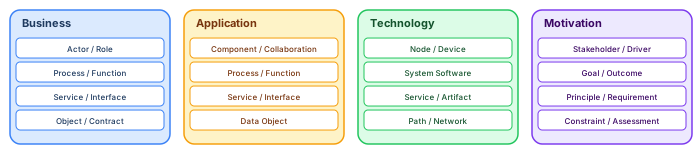
For the exam, you must distinguish between structurally similar element types across layers. Each layer has active structure elements (things that perform behavior), behavioral elements (the behavior itself), and passive structure elements (things acted upon).
Business layer active structure: Business Actor (a person or organizational unit), Business Role (a named responsibility), Business Collaboration (a temporary grouping of roles working together), Business Interface (a channel through which business services are offered). Behavioral: Business Process (a sequence of behaviors), Business Function (a collection of behavior grouped by skills or resources), Business Interaction (collaborative behavior), Business Event (something that triggers behavior), Business Service (externally visible behavior). Passive: Business Object (information relevant to the business), Contract (formal agreement), Representation (perceivable form of information).
Application layer mirrors the same categories with Application Component / Collaboration / Interface (active), Application Process / Function / Interaction / Event / Service (behavioral), and Data Object (passive). The key distinction: Application Service is what the component exposes to external consumers, while Application Function is internal behavior.
Technology layer includes Node (computational or physical resource), Device (physical hardware), System Software (software platform), and Technology Interface (active), plus Technology Process / Function / Interaction / Event / Service (behavioral), and Artifact / Communication Network / Path (passive or infrastructure).
Motivation layer includes Stakeholder, Driver, Assessment, Goal, Outcome, Principle, Requirement, and Constraint. These elements link "why" to "what" — connecting business motivation to architecture decisions. Driver → Goal → Requirement → Application Component creates the traceability chain that governance requires.
Exam-day tips from certified practitioners
Read the question twice. Exam questions are precisely worded. The difference between "which relationship is VALID" and "which relationship is MOST APPROPRIATE" matters. Valid means any relationship that the metamodel permits. Most appropriate means the best semantic choice.
Eliminate wrong answers first. On a 4-option multiple choice, you can usually eliminate 2 options immediately (obviously wrong element type or invalid relationship). Focus your analysis on the remaining 2.
When in doubt, check the direction. A large percentage of wrong answers result from relationship direction errors. Serving goes from provider to consumer. Realization goes from implementer to abstraction. Access goes from active element to passive element. If the direction in the answer option is wrong, the answer is wrong regardless of the relationship type.
Watch for "Association" traps. If an answer option uses Association where a more specific relationship exists, it is probably wrong. Association is the catch-all — examiners test whether you know the specific alternative.
If you’d like hands-on training tailored to your team — Sparx Enterprise Architect, BPMN, SysML, Apache Kafka or the Archi tool — or modelling coaching in ArchiMate and TOGAF-aligned governance, you can reach us via our contact page.
Frequently Asked Questions
What is enterprise architecture?
Enterprise architecture is a discipline that aligns an organisation's strategy, business operations, information systems, and technology infrastructure. It provides a structured framework for understanding how an enterprise works today, where it needs to go, and how to manage the transition.
How is ArchiMate used in enterprise architecture practice?
ArchiMate is used as the standard modeling language in enterprise architecture practice. It enables architects to create consistent, layered models covering business capabilities, application services, data flows, and technology infrastructure — all traceable from strategic goals to implementation.
What tools are used for enterprise architecture modeling?
Common enterprise architecture modeling tools include Sparx Enterprise Architect (Sparx EA), Archi, BiZZdesign Enterprise Studio, LeanIX, and Orbus iServer. Sparx EA is widely used for its ArchiMate, UML, BPMN and SysML support combined with powerful automation and scripting capabilities.