⏱ 9 min read
Introduction: choosing the right EA tool for your organization
Enterprise architecture tooling is a strategic decision that affects modeling productivity, governance capability, stakeholder engagement, and long-term maintainability. This article provides a practical comparison of Sparx Enterprise Architect against the main alternatives — Archi, LeanIX, Ardoq, MEGA HOPEX, and BiZZdesign — based on real project experience across multiple industries.
Recommended Reading
Comparison overview

Sparx Enterprise Architect
Sparx EA is a desktop-first, multi-notation modeling platform. It supports UML, ArchiMate, BPMN, SysML, and custom profiles through MDG Technologies. Its SQL-based repository enables powerful querying, scripting, and CI/CD integration. Strengths: unmatched modeling depth, strong automation via COM API, excellent price-to-feature ratio. Weaknesses: steep learning curve, dated UI compared to SaaS tools, and stakeholder engagement requires additional configuration (WebEA/Prolaborate). enterprise architecture guide
Archi
Archi is the leading open-source ArchiMate tool. It is free, fast, and focused exclusively on ArchiMate. Strengths: zero cost, intuitive interface, jArchi scripting, coArchi for Git-based collaboration. Weaknesses: ArchiMate only (no UML, BPMN, SysML), file-based repository limits concurrency, no built-in database or API for enterprise integration. ArchiMate best practices
LeanIX / Ardoq (SaaS platforms)
Cloud-native platforms that prioritize stakeholder engagement, automated data collection, and portfolio management dashboards. Strengths: modern web UI, strong collaboration, automated CMDB integration, excellent dashboards. Weaknesses: limited modeling depth, vendor lock-in, high subscription costs, and restricted customization compared to Sparx EA.
MEGA HOPEX / BiZZdesign
Enterprise-grade platforms with strong governance, compliance, and multi-framework support. Strengths: built-in TOGAF/ArchiMate support, risk and compliance modules, enterprise-scale governance. Weaknesses: very high licensing costs, complex deployment, and longer implementation timelines. ArchiMate layers explained
Decision framework
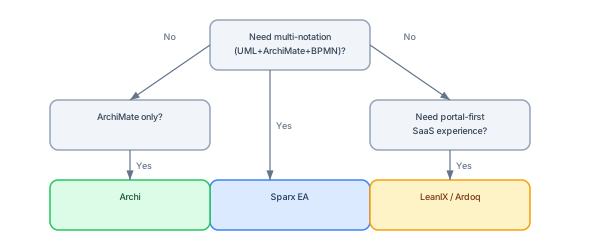
The right tool depends on your organization's needs across six dimensions:
Multi-notation support: If you need UML class diagrams, BPMN process models, AND ArchiMate architecture views in the same repository, Sparx EA is the clear choice. Archi is ArchiMate-only. SaaS platforms vary but generally lack modeling depth.
Repository and data access: Sparx EA's SQL repository enables direct querying, Power BI dashboards, and programmatic access. Archi uses file-based storage. SaaS platforms provide APIs but with vendor-specific schemas.
Automation and integration: Sparx EA's COM API and scripting engine are the most powerful automation capabilities available. jArchi provides good scripting for Archi. SaaS platforms offer REST APIs but with less flexibility.
Cost: Archi is free. Sparx EA is very affordable (hundreds per license). LeanIX, MEGA, and BiZZdesign are significantly more expensive (thousands per user per year).
Collaboration: SaaS platforms excel at browser-based collaboration and stakeholder dashboards. Sparx EA requires WebEA/Prolaborate for browser access. Archi uses coArchi/Git for collaboration.
Learning curve: Archi has the gentlest learning curve. SaaS platforms are moderate. Sparx EA has the steepest learning curve but the highest ceiling.
Recommendation matrix
Small team, ArchiMate only, budget-constrained: Archi. Zero cost, immediate productivity, jArchi for automation.
Enterprise team, multi-notation, strong governance: Sparx EA + Pro Cloud Server. Best modeling depth, SQL-based governance, excellent automation.
Stakeholder-first, portfolio management, cloud-native: LeanIX or Ardoq. Best collaboration and dashboards, moderate modeling depth.
Large enterprise, compliance-heavy, multi-framework: MEGA HOPEX or BiZZdesign. Built-in governance, risk, and compliance modules.
Migration considerations
Switching EA tools is expensive and disruptive. Before committing to a migration, consider the full cost: license procurement, repository migration (data conversion, relationship mapping, property translation), training for all users, process changes (governance workflows, report templates, integration reconfiguration), and productivity loss during the transition period (typically 3–6 months).
Migrating from Visio to Sparx EA: Visio diagrams can be imported via XMI or copy-paste, but they arrive as untyped shapes without metamodel semantics. Budget significant effort for "semantic uplift" — converting Visio boxes into properly typed ArchiMate/UML elements with properties and relationships.
Migrating from Archi to Sparx EA: Use the ArchiMate Open Exchange format (.xml) to export from Archi and import into EA. Elements and relationships transfer well; diagram layout requires manual adjustment. Tagged values map to EA properties with some configuration.
Migrating from Sparx EA to Archi: Export via Open Exchange format. Non-ArchiMate content (UML, BPMN, SysML) cannot be migrated — Archi only supports ArchiMate. This is the primary reason organizations stay with Sparx EA: the multi-notation content has no migration path to ArchiMate-only tools.
Total cost of ownership
Tool cost is more than license fees. Calculate total cost of ownership (TCO) including: license/subscription costs (per user, per year), infrastructure costs (database server, Pro Cloud Server, cloud hosting), administration effort (DBA time, PCS management, security configuration), training costs (initial and ongoing), integration development and maintenance, and productivity impact (learning curve, feature gaps).
For a team of 25 architects over 5 years: Archi costs approximately €0 in licenses + €50K in training/integration. Sparx EA costs approximately €15K in licenses + €20K in infrastructure + €60K in training. LeanIX costs approximately €250K–500K in subscription fees + €40K in training. The right choice depends on which costs your organization can absorb and which capabilities are non-negotiable.
Real-world selection scenarios
Based on our consulting experience across banking, pharma, government, and energy sectors, here are the patterns we see most often:
Scenario 1: Regulated financial institution, 30+ architects. Choice: Sparx EA with DBMS repository and Pro Cloud Server. Rationale: multi-notation support for UML data models, ArchiMate architecture views, and BPMN process models in a single governed repository. SQL access enables automated compliance reporting. WebEA provides auditor access. COM API integrates with existing ServiceNow CMDB.
Scenario 2: Mid-size tech company, 5 architects, ArchiMate focus. Choice: Archi with coArchi for Git collaboration. Rationale: zero license cost, ArchiMate-only scope matches needs, jArchi provides sufficient automation. When the team grows beyond 10 or needs UML/BPMN, migrate to Sparx EA.
Scenario 3: Digital transformation program, executive visibility priority. Choice: LeanIX or Ardoq as the stakeholder-facing layer, potentially with Sparx EA for detailed modeling underneath. Rationale: SaaS dashboards provide immediate executive visibility while detailed modeling happens in EA for architectural governance.
Scenario 4: Government agency, strict procurement rules. Choice: Sparx EA. Rationale: perpetual licensing model (no annual subscription), on-premise deployment (data sovereignty), and the most favorable price-to-feature ratio for procurement evaluation. Many government IT frameworks specifically list Sparx EA as a supported tool.
Hybrid approaches
Many organizations use multiple tools for different purposes. The most common hybrid patterns:
Sparx EA + Power BI: EA for modeling, SQL queries feed Power BI dashboards for executive reporting. Best of both worlds: deep modeling capability with modern visualization.
Sparx EA + Confluence: EA for architecture models, Confluence for documentation and collaboration. Hyperlinks connect the two. EA-generated reports (HTML, PDF) are published to Confluence pages.
Archi + Sparx EA: Archi for individual architects who prefer a lightweight tool, Sparx EA as the central governed repository. Models are synchronized via ArchiMate Open Exchange format. This works for organizations transitioning from Archi to EA.
Decision framework: choosing the right tool
The tool choice depends on three primary factors: notation breadth, deployment model, and automation needs.
If you need multi-notation modeling (UML class diagrams, ArchiMate enterprise architecture, BPMN process models, SysML systems engineering — all in the same repository with cross-notation traceability), Sparx EA is the clear choice. No other tool matches its notation breadth within a single repository.
If your scope is ArchiMate-only and your team is small (under 10 modelers), Archi is an excellent free option. It lacks the repository infrastructure for large teams but provides a clean, fast, ArchiMate-focused experience with jArchi scripting for automation.
If your priority is executive dashboards and portfolio management rather than deep modeling, SaaS platforms like LeanIX, Ardoq, or MEGA HOPEX provide portal-first experiences with strong visualization but limited modeling depth. These tools are better at answering "what do we have?" than "how does it work?"
Total cost of ownership comparison
Sparx EA has significantly lower license costs than SaaS alternatives ($229–$699 per seat perpetual vs. $500–$2,000 per user per year for SaaS platforms), but requires infrastructure investment (DBMS hosting, Pro Cloud Server) and admin expertise. Archi is free but has no vendor support and limited enterprise features. For a 50-person architecture team over 5 years, Sparx EA typically costs 40–60% less than SaaS alternatives when including infrastructure, while providing deeper modeling capabilities. TOGAF roadmap template
Migration considerations
Switching EA tools is expensive and disruptive. Before committing, run a proof of concept with your actual modeling scenarios (not the vendor's demo). Test with your data volume (import 1,000+ elements), your user count (10+ concurrent modelers), your integration requirements (can it connect to your CMDB/Jira/ServiceNow?), and your governance workflows (can you enforce naming conventions and required properties programmatically?).
Conclusion
There is no universally "best" EA tool — only the best tool for your context. Evaluate against the six dimensions above, run a proof-of-concept with your actual content, and involve both modelers and stakeholders in the decision. The tool that best serves your governance model, modeling needs, and stakeholder engagement requirements is the right one.
If you’d like hands-on training tailored to your team — Sparx Enterprise Architect, BPMN, SysML or the Archi tool — or modelling coaching in ArchiMate and TOGAF-aligned governance, you can reach us via our contact page.
Frequently Asked Questions
What is Sparx Enterprise Architect used for?
Sparx Enterprise Architect (Sparx EA) is a comprehensive UML, ArchiMate, BPMN, and SysML modeling tool used for enterprise architecture, software design, requirements management, and system modeling. It supports the full architecture lifecycle from strategy through implementation.
How does Sparx EA support ArchiMate modeling?
Sparx EA natively supports ArchiMate 3.x notation through built-in MDG Technology. Architects can model all three ArchiMate layers, create viewpoints, add tagged values, trace relationships across elements, and publish HTML reports — making it one of the most popular tools for enterprise ArchiMate modeling.
What are the benefits of a centralised Sparx EA repository?
A centralised SQL Server or PostgreSQL repository enables concurrent multi-user access, package-level security, version baselines, and governance controls. It transforms Sparx EA from an individual diagramming tool into an organisation-wide architecture knowledge base.