⏱ 5 min read
Enterprise architecture teams are no longer co-located. They operate across countries, time zones, regulatory domains, security zones, and hybrid cloud environments. In regulated ecosystems — EU institutions, banking, critical infrastructure, utilities, and cross-border digital programs — collaboration is not simply about productivity. It is about model integrity, controlled evolution, auditability, traceability, governance enforcement, and segregation of duties. enterprise cloud architecture patterns
The real problem: model entropy in distributed environments
Distributed modeling introduces systemic risk: model entropy. Entropy manifests as parallel conflicting changes, broken traceability chains, duplicate semantic concepts, inconsistent naming conventions, diverging viewpoints, orphaned requirements, and performance degradation. Unlike source code, architecture models are graph-based (not linear text), deeply interconnected, meta-model constrained, cross-layer dependent, and semantically coupled. Git can detect textual differences. It cannot detect semantic corruption of a model graph.
Pattern A: Centralized repository via Pro Cloud Server

The centralized pattern uses Sparx EA's Pro Cloud Server as the single access point. All EA clients (thick client and WebEA) connect via HTTPS. The Pro Cloud Server manages concurrency, authentication (via Active Directory or Azure AD integration), and package-level authorization. The backend is a relational database (SQL Server, MySQL, or Oracle) that stores the model as a single governed repository. Sparx EA training
Strengths: single source of truth, no XMI merge conflicts, immediate change visibility across all clients, and fine-grained package security. Limitations: requires stable network connectivity and needs a disciplined ownership model to prevent concurrent editing conflicts.
Pattern B: Distributed repository with Git

The distributed pattern enables offline work. Each architect works on a local repository and commits XMI exports to a Git repository. Other architects pull changes. Strengths: offline work possible, strong history tracking, DevOps integration. Risks: XMI merge conflicts (XMI is XML, and three-way merge of deeply nested XML is unreliable), semantic inconsistencies across copies, and cross-package dependency breakage when architects modify shared elements independently.
Model partitioning strategy
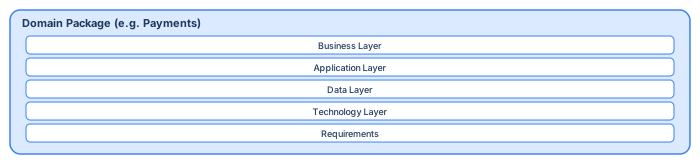
The most common anti-pattern is horizontal partitioning: separate packages for Business Layer, Application Layer, and Technology Layer. Real-world changes cut vertically across layers (a payment feature involves business processes, application components, data models, and infrastructure). Horizontal partitioning maximizes cross-package dependencies and merge conflicts.
Recommended: domain-based vertical partitioning. Each domain (Payments, Customer, Risk) owns a package containing all layers — Business, Application, Data, Technology, and Requirements. This provides high cohesion within each package, clear ownership boundaries, bounded change scope, and alignment with organizational structure.
Baseline governance

A baseline is not a branch — it is an immutable snapshot. Baselines serve as regulatory submission evidence ("this was the architecture at the time of submission"), go-live freeze records ("this was the approved architecture for release 3.2"), and audit trail anchors. In Sparx EA, baselines are created at the package level and can be compared against the current model to show exactly what changed. Require a baseline before every major milestone, regulatory submission, and production release. Sparx EA best practices
Security and segregation of duties
In regulated environments, unrestricted write access to the architecture repository is a compliance risk. Implement role-based access: Modelers can edit within their assigned domain packages, Reviewers can read all packages and approve changes, and Release Managers can create baselines and promote content between environments. Authenticate via Active Directory or Azure AD. Authorize at the package level using Sparx EA's built-in security model. Log all changes for audit — Sparx EA's audit log captures who changed what and when. free Sparx EA maturity assessment
CI/CD integration

Architecture can and should integrate into DevSecOps pipelines. On commit (or on schedule), a pipeline validates the model: naming convention compliance (regex checks on element names), orphaned element detection (elements with no relationships), stereotype compliance (every Component must have a required tagged value), and documentation generation (automated HTML or PDF report production). Published outputs feed an architecture portal where stakeholders access current views without needing the Sparx EA thick client. This makes architecture a living, continuously validated artifact rather than a periodically reviewed document. architecture decision records
Anti-patterns and maturity roadmap
Common anti-patterns to avoid: shared .eapx file on a network drive (file locking, corruption risk), entire model under one version-controlled root (massive merge conflicts), no ownership boundaries (everyone edits everything), long-running architecture branches (semantic drift guaranteed), and no baselines (no audit evidence).
The maturity roadmap progresses through five levels. Initial: central database, basic access control. Structured: database plus baselines, domain ownership. Advanced: controlled packages with Git integration for versioning. Mature: CI/CD governance with automated validation. Optimized: full DevSecOps integration where architecture is continuously validated, published, and traced to implementation artifacts.
Frequently Asked Questions
What is Sparx Enterprise Architect used for?
Sparx Enterprise Architect (Sparx EA) is a comprehensive UML, ArchiMate, BPMN, and SysML modeling tool used for enterprise architecture, software design, requirements management, and system modeling. It supports the full architecture lifecycle from strategy through implementation.
How does Sparx EA support ArchiMate modeling?
Sparx EA natively supports ArchiMate 3.x notation through built-in MDG Technology. Architects can model all three ArchiMate layers, create viewpoints, add tagged values, trace relationships across elements, and publish HTML reports — making it one of the most popular tools for enterprise ArchiMate modeling.
What are the benefits of a centralised Sparx EA repository?
A centralised SQL Server or PostgreSQL repository enables concurrent multi-user access, package-level security, version baselines, and governance controls. It transforms Sparx EA from an individual diagramming tool into an organisation-wide architecture knowledge base.