⏱ 6 min read
Introduction
In the age of digital transformation, pharmaceutical companies are increasingly turning to knowledge graphs to integrate, visualize, and reason over complex regulatory, clinical, and safety data. These graphs go beyond data warehouses—they represent meaning, relationships, and semantics across domains. When modeled using tools like Archi and Sparx EA, knowledge graphs become powerful assets for compliance, pharmacovigilance, and R&D innovation. Sparx EA training
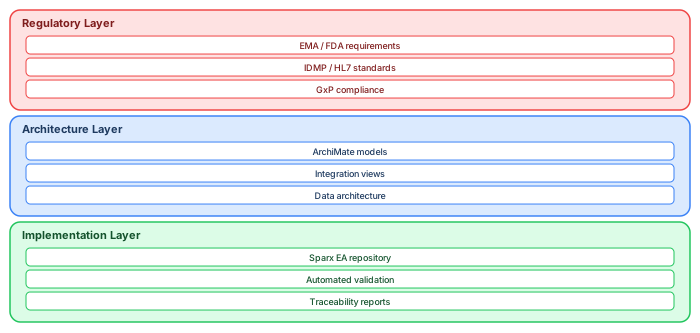
This article explains how enterprise architecture tools can be used to define and manage pharma knowledge graphs, enabling cross-domain data integration and semantic traceability across the drug lifecycle. integration architecture diagram
1. What Are Pharma Knowledge Graphs?
Knowledge graphs are semantic data models that capture entities (e.g., drug, patient, molecule) and their relationships in a graph structure. In pharma, these graphs can represent:
- Drug development workflows
- Adverse event relationships
- Regulatory references
- Clinical outcome linkages
Unlike traditional data models, knowledge graphs are built for interoperability, inference, and exploration using standards like RDF, OWL, and SPARQL.
2. Modeling Graphs in Sparx EA and Archi
Both Sparx EA and Archi provide the ability to model ontologies and semantic relationships: Sparx EA best practices
- In Sparx EA: Use UML class diagrams with associations and tagged values to represent triples (subject–predicate–object). Export as XMI for transformation into RDF or OWL.
- In Archi: Use ArchiMate to model relationships visually between business, data, and application layers. Annotate with URIs or semantic metadata.
3. Aligning Graph Nodes with Controlled Vocabularies
Knowledge graphs gain strength when aligned with reference terminologies:
- Link drug entities to WHO-DD or RxNorm IDs
- Use MedDRA for adverse event nodes
- Map conditions and interventions to SNOMED CT
In Sparx EA, use stereotypes and tagged values to store external identifiers. In Archi, visualize standard mappings in layered diagrams. free Sparx EA maturity assessment
4. Connecting Regulatory, Clinical, and Safety Domains
Pharma knowledge graphs unify domains that were historically siloed:
- Regulatory: Structured Product Labeling (SPL), IDMP standards, eCTD sections
- Clinical: Trials, outcomes, populations, interventions, endpoints
- Safety: Adverse events, risk management plans, post-market surveillance
Use EA tools to define relationships such as “clinical study demonstrates efficacy of product” or “adverse event associated with active substance.”
5. From EA to RDF: Exporting Semantic Models
To convert EA models into usable knowledge graphs:
- Export UML or ArchiMate models from Sparx EA or Archi in XMI format
- Use XSLT, Python (e.g., RDFLib), or tools like TopBraid to transform into RDF triples
- Load into a triple store like GraphDB, Blazegraph, or Stardog for querying
6. Use Cases in Pharma
- Pharmacovigilance: Link safety signals to real-world data, regulatory actions, and known drug interactions
- Regulatory Submission: Auto-generate IDMP-compliant artifacts by tracing metadata
- Clinical Trial Optimization: Analyze trial outcomes, eligibility criteria, and molecular biomarkers in a unified model
7. Governance and Ontology Lifecycle
Enterprise knowledge graphs require governance:
- Version control for ontologies
- Review and publishing workflows via EA tools or ontology editors
- Change management for taxonomy updates (e.g., MedDRA version changes)
8. Case Study: Integrating Global Labeling and Safety Systems
A global top-10 pharma built a knowledge graph spanning regulatory, labeling, and safety data using Sparx EA. They modeled:
- SPC and SPL data linked to structured substances and indications
- Signal management workflows traced to MedDRA-coded events
- Dashboards showing connections between regulatory actions and clinical outcomes
This reduced manual reconciliation by 80% and accelerated signal validation turnaround by 60%.
Conclusion
Knowledge graphs are the future of intelligent pharmaceutical data management. By modeling relationships semantically using Archi and Sparx EA, pharma organizations can achieve deep interoperability, automate reasoning, and gain strategic insight across the product lifecycle. Architecture isn’t just about structure—it’s about meaning and connection.
Knowledge Graph, Sparx EA, ArchiMate, Archi, RDF, OWL, Pharma Ontologies, Regulatory Architecture, Clinical Trials, MedDRA, SNOMED CT, WHO-DD, IDMP, eCTD, Pharmacovigilance, Safety Architecture, Semantic Modeling, Enterprise Architecture in Pharma, Semantic Interoperability, Real-World Data, Drug Labeling, EA Governance enterprise architecture guide
If you’d like hands-on training tailored to your team — Sparx Enterprise Architect, BPMN, SysML or the Archi tool — or modelling coaching in ArchiMate and TOGAF-aligned governance, you can reach us via our contact page.
Getting more from your Sparx EA investment
Most organizations use less than 20% of Sparx Enterprise Architect's capabilities. Three underutilized features deliver disproportionate value when activated: model validation, document generation, and the automation API.
Model validation checks every element and relationship against metamodel rules, catching errors that human reviewers miss. Enable ArchiMate validation under Specialize → Technologies to prevent invalid relationships (for example, a Composition between elements in different layers). Add custom validation scripts that enforce your organization's naming conventions, required tagged values, and maximum elements per diagram.
Document generation produces Word or PDF reports directly from the model. Configure templates that pull element properties, tagged values, relationships, and diagrams into formatted documents. When the model changes, regenerate the document — it is always synchronized. This eliminates the manual document maintenance that typically consumes 30-40% of architect time.
The automation API (JavaScript, VBScript, or .NET) enables bulk operations that would take hours manually: updating tagged values across hundreds of elements, generating traceability matrices, exporting element catalogs to Excel, or validating naming conventions. A single validation script that runs nightly catches more errors than a monthly manual review.
Frequently Asked Questions
What is Sparx Enterprise Architect used for?
Sparx Enterprise Architect (Sparx EA) is a comprehensive UML, ArchiMate, BPMN, and SysML modeling tool used for enterprise architecture, software design, requirements management, and system modeling. It supports the full architecture lifecycle from strategy through implementation.
How does Sparx EA support ArchiMate modeling?
Sparx EA natively supports ArchiMate 3.x notation through built-in MDG Technology. Architects can model all three ArchiMate layers, create viewpoints, add tagged values, trace relationships across elements, and publish HTML reports — making it one of the most popular tools for enterprise ArchiMate modeling.
What are the benefits of a centralised Sparx EA repository?
A centralised SQL Server or PostgreSQL repository enables concurrent multi-user access, package-level security, version baselines, and governance controls. It transforms Sparx EA from an individual diagramming tool into an organisation-wide architecture knowledge base.