⏱ 22 min read
There is a particular kind of organizational lie that enterprises tell themselves about data.
It sounds reasonable. It even sounds efficient. “We’ll have a central team build the pipelines. The domains can just consume the outputs.” For a while, this works. Dashboards appear. Reports stabilize. A machine learning team gets a cleaner feature table. Somebody declares victory.
Then the business changes.
A product line is renamed. A customer lifecycle gets redefined. A refund process splits into three variants. The meaning of “active customer” drifts in marketing, finance, and operations at exactly the same time—and in three different directions. The central pipeline team, sitting faithfully in the middle, becomes an interpreter of other people’s language. They don’t own the business concepts, but they do own the code that operationalizes them. That is the crack where trust begins to leak.
This is why pipeline ownership matters in a data mesh. Not as a slogan. As an architectural boundary.
In a proper data mesh, ownership of data pipelines follows ownership of domain semantics. The team that understands the business event, the lifecycle, the edge cases, the awkward exceptions, and the inconvenient truths should own the transformation logic that turns raw operational signals into reusable data products. If they don’t, you’ve created a delivery model that centralizes implementation while decentralizing accountability. That arrangement looks tidy on an org chart and behaves terribly in production.
The hard part is that enterprises do not begin with clean domain ownership, event-driven systems, or pristine bounded contexts. They begin with warehouses, ETL estates, Kafka topics with dubious names, service boundaries that leak, and reporting logic embedded in places no one dares touch. So the question is not whether domain-owned pipelines are elegant in theory. The question is how to get there without breaking reporting, compliance, or the confidence of the business.
That is the subject here: data pipeline ownership in a data mesh, why it matters, how to structure it, how to migrate toward it, and where it can go badly wrong.
Context
Data mesh is often reduced to a simplistic formula: decentralize data ownership, create data products, and provide a self-serve platform. That summary is not wrong, but it is thin. The practical issue in most enterprises is not merely who publishes tables. It is who owns the logic that gives data its business meaning.
Pipelines are where meaning becomes executable.
A customer transaction is not yet revenue. An order event is not yet a fulfilled sale. A support case closure is not yet customer satisfaction. Somewhere, someone writes the logic that decides what counts, what is excluded, what is late, what gets corrected, and how historical changes are reconciled. That “somewhere” has enormous architectural significance.
In centralized data platforms, this logic usually ends up in shared ingestion teams, warehouse engineering groups, or analytics engineering functions. These teams become de facto custodians of domain semantics. They are asked to codify pricing rules, claims logic, policy status transitions, campaign attribution, or supply chain exceptions. They are rarely staffed, incented, or organized to own that knowledge deeply.
Domain-driven design gives us better language. Pipelines should sit inside or adjacent to the bounded contexts that produce the business facts they transform. A data product is not just a dataset with documentation. It is a published expression of a domain’s semantics with explicit contracts, service levels, and stewardship.
That means pipeline ownership is not an implementation detail. It is part of the domain model.
Problem
The classic enterprise data architecture creates a semantic vacuum in the middle.
Operational systems emit records. Central teams ingest them. Downstream consumers ask for curated outputs. Every gap in business understanding gets filled by the central data team because the pipeline must do something. Slowly, transformation logic migrates away from domains and settles into an estate of SQL models, Spark jobs, Kafka stream processors, and warehouse views.
The result is familiar:
- Business definitions are duplicated across pipelines.
- Changes require multi-team negotiation for even small semantic updates.
- Data quality issues are discovered late, downstream, and politically.
- Consumers do not know which version of the truth to trust.
- Pipeline teams become bottlenecks for every domain.
- Domain teams disclaim ownership because “the data team handles reporting.”
This is not simply a coordination problem. It is an ownership anti-pattern.
If a Payments domain does not own how payment authorization, settlement, reversal, and chargeback are represented in data products, someone else will. That someone else will eventually encode assumptions that work until they don’t. Enterprises often discover this during regulatory reporting, financial close, customer remediation, or a major product launch.
A useful test is simple: when a business rule changes, who is expected to know first, change code first, and explain the consequences first? If the answer is a central pipeline team rather than the domain, you do not have domain ownership. You have semantic outsourcing.
Forces
Several competing forces shape pipeline ownership in a data mesh.
1. Domain expertise versus platform efficiency
Domain teams understand the meaning of events, state transitions, and exceptions. Central platform teams understand reusable infrastructure, governance, observability, and operational hardening. Good architecture separates these concerns without divorcing them. EA governance checklist
The domain should own what the data means.
The platform should enable how data products are built and operated safely.
If the platform owns too much logic, semantics drift away from the business. If domains own everything without standards, you get a federation of accidental complexity.
2. Speed of change versus consistency
Central teams promise standardization. Domains demand responsiveness. Both are right.
A product domain changing a subscription lifecycle should not wait three sprints for a central backlog slot. But a finance or risk consumer also cannot tolerate every domain inventing bespoke metadata, quality measures, and publication patterns.
This is why federated governance matters. Data product standards must be shared. Domain semantics must remain local. ArchiMate for governance
3. Event truth versus analytical truth
Kafka topics and service events are not automatically analytics-ready. An event stream may represent operational facts, retries, compensations, and out-of-order messages. Analytical consumers often need durable state, slowly changing interpretations, conformed identifiers, and reconciled historical records.
Owning the event does not mean consumers can derive every curated fact correctly. The domain must usually publish one or more higher-order data products that bridge operational truth and analytical usefulness.
4. Local optimization versus enterprise interoperability
A domain can optimize for its own consumers and accidentally create pain for everyone else. Naming, keys, grain, retention, and SLA choices have enterprise consequences.
The architecture has to acknowledge a blunt truth: domains are autonomous, but they are not sovereign kingdoms. In a large enterprise, they are citizens of a federation.
5. Legacy reality versus target state purity
Most organizations are migrating from warehouses, ETL hubs, reporting marts, and service integration patterns that predate data mesh. Purity is not a strategy. Migration is.
You need a model that allows old and new ownership to coexist while semantics are moved toward domains gradually, safely, and measurably.
Solution
The core solution is straightforward:
Data pipelines should be owned by the domain team responsible for the business semantics of the data product, while a shared data platform provides the tooling, guardrails, and runtime capabilities.
That sentence does a lot of work. Let’s unpack it.
A domain-owned pipeline means the domain team is accountable for:
- The business meaning of the data product
- Transformation rules and semantic logic
- Contract definition and versioning
- Data quality expectations tied to domain rules
- Lifecycle management and deprecation
- Consumer communication for semantic changes
The platform team is accountable for:
- Standard pipeline templates and paved roads
- Data product catalog, lineage, and discoverability
- IAM, security, privacy, and policy enforcement
- CI/CD, orchestration, observability, and runtime services
- Schema registry and contract tooling
- Shared storage, stream, and compute foundations
This is classic domain-driven design in data clothing. The bounded context owns the language. The platform provides the roads and traffic rules.
A useful mental model is to treat a data pipeline not as plumbing but as a domain publication mechanism. It is the executable path by which a domain says, “Here is what happened, here is what it means, and here is how you may rely on it.”
That has implications.
First, pipelines should be aligned to data products, not generic technical stages. “Bronze/silver/gold” can be useful operationally, but it is not an ownership model. Ownership belongs with semantic outputs such as Order Fulfillment Events, Customer Account State, Net Premium Written, or Store Inventory Position.
Second, domains should publish both raw-enough and curated-enough products as needed. One stream of immutable business events may exist for integration and replay; another curated table or topic may expose reconciled state optimized for analytical or downstream operational use.
Third, data contracts must include semantic commitments, not only schema. A field named customer_status is useless without controlled vocabulary, timing semantics, null handling rules, and correction behavior.
Here is the high-level ownership model.
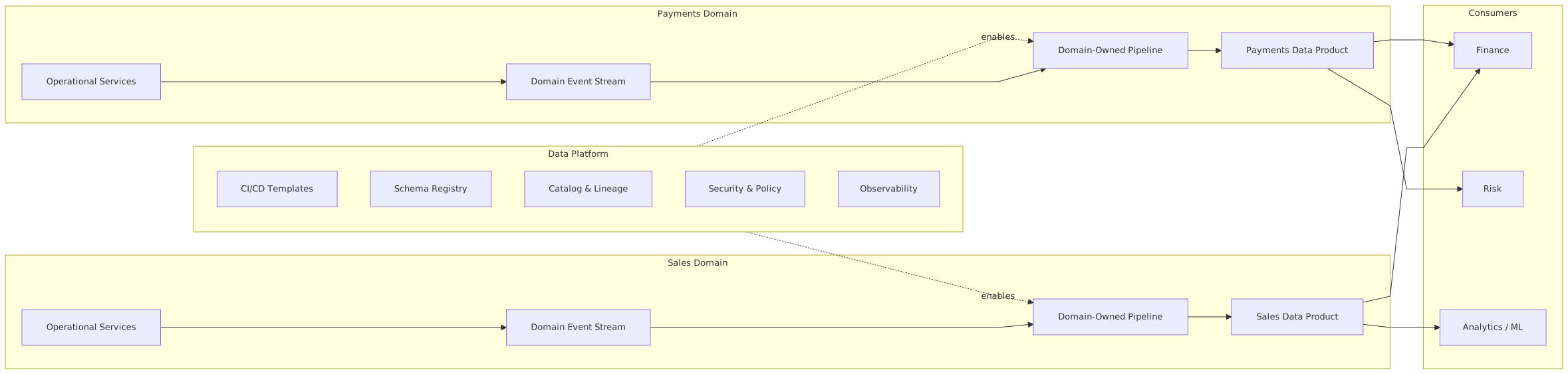
The key is the dotted line. Platform enables. Domain owns.
Architecture
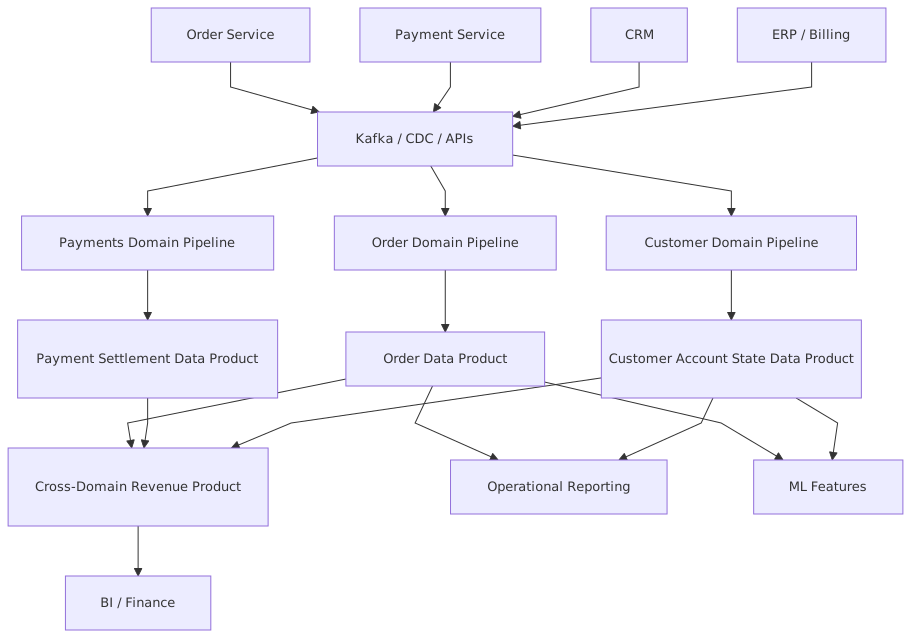
A workable enterprise architecture for pipeline ownership in data mesh usually has four layers.
1. Operational systems and event sources
These are microservices, packaged applications, legacy systems, SaaS platforms, and transactional stores. In event-driven estates, Kafka often sits here as the transport backbone. Domains emit operational events from within their bounded contexts. event-driven architecture patterns
Not every source is event-native. Some are CDC-based, file-based, or API-polled. That is fine. The architectural principle is still the same: the domain must own the semantic interpretation of those raw signals before they become enterprise data products.
2. Domain pipeline layer
This is where domain-owned transformation logic lives. It may be implemented with Kafka Streams, Flink, Spark, dbt, SQL-based transformations, or workflow tools. Technology is secondary.
The pipeline does several jobs:
- Maps source system structures to domain concepts
- Applies business rules and enrichments
- Produces stable keys and join semantics
- Handles corrections and late-arriving data
- Reconciles state with authoritative systems
- Publishes contract-governed data products
This layer is where semantic accountability should sit.
3. Shared platform services
The platform supplies standard ways to build, deploy, monitor, and govern pipelines. It does not decide whether a canceled order counts as abandoned demand in your specific business. It does decide how contract tests run, how lineage is captured, how PII policy is enforced, and how incident telemetry is exposed.
In healthy organizations, this platform is product-like. It is not a ticket queue.
4. Cross-domain consumption and composition
Consumers use domain data products directly where possible. Some enterprise-wide products may be composed from multiple domains—for example, a Customer 360, Enterprise Revenue, or Supply Chain Health product. These compositions should themselves have explicit ownership, usually by a domain or a clearly named cross-domain business capability, not by an anonymous integration team.
A common trap is to hide central semantic ownership inside “shared analytics models.” If a composed product makes business assertions across bounded contexts, someone must own those assertions.
Here is a more detailed view.
Domain semantics and bounded contexts
This is where many data mesh efforts quietly fail. They decentralize implementation but never clarify semantics.
Consider “customer.” In a telecom enterprise, Sales may mean prospect or account-holder. Billing may mean invoice party. Support may mean service recipient. Identity may mean authenticated person. There is no universal customer without qualification. Domain-driven design tells us not to force false unity. Instead, let bounded contexts define their terms precisely and publish products with explicit semantics.
That means pipeline ownership should be attached to those bounded contexts. A Billing Customer Account State product belongs with Billing semantics. A Service Subscriber State product belongs with Service Management semantics. An enterprise Customer 360 may still exist, but it is a composition with deliberate rules and explicit ownership, not a magical canonical truth.
Canonical models are often architecture’s favorite shortcut and data’s favorite future incident.
Reconciliation as a first-class concern
Enterprise data pipelines live in a world of retries, duplicates, out-of-order delivery, missing records, late corrections, and changing identifiers. If ownership is real, reconciliation cannot be an afterthought.
A domain-owned pipeline should define:
- The authoritative source for each business fact
- Rules for duplicate suppression or idempotency
- Handling of late-arriving events
- Backfill and replay strategy
- Correction semantics: restate, append-adjust, or overwrite
- Reconciliation checkpoints against source-of-record totals
For example, a payments domain may emit authorization and capture events in near real time through Kafka. But finance may require daily settlement reconciliation against acquirer files. The domain-owned pipeline must bridge both worlds. If it publishes a Payments Settled product, it should encode whether rows reflect operational captures, reconciled settlements, or post-adjustment financial truth. That distinction matters.
Migration Strategy
Nobody starts greenfield. So let’s talk about the only migration pattern that consistently works in big firms: the strangler.
Do not try to reorganize all data pipelines around domains in a single move. You will spend a year drawing boxes, offend every delivery team, and still run month-end close on the old warehouse jobs. Better to migrate product by product, domain by domain, proving ownership where it hurts most and where business semantics matter most.
A progressive strangler migration usually follows these steps.
1. Identify semantic hotspots
Start where central pipelines currently carry business logic they should not own. Typical candidates:
- Revenue recognition
- Customer status and lifecycle
- Claims and policy state
- Fulfillment and returns
- Payment settlement
- Inventory availability
These are areas where semantic errors have visible business consequences.
2. Map current logic to domains
Inventory the pipeline logic, not just the jobs. Ask:
- Which business rules are encoded?
- Which team understands and validates them?
- Which bounded context should own them?
- Which consumers depend on them today?
This exercise is often revealing. You will find central SQL models implementing logic no domain team knew existed.
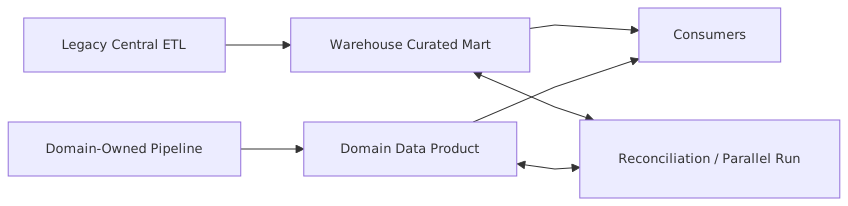
3. Establish domain data products alongside existing outputs
Do not rip out the warehouse mart immediately. Create a new domain-owned data product in parallel. Publish contracts. Route a small number of consumers first. Compare outputs with the legacy pipeline.
Parallel run is not bureaucracy. It is how you build confidence.
4. Add reconciliation and comparison
For a migration to survive enterprise scrutiny, you need explicit reconciliation. Compare record counts, key metrics, and semantic outcomes between old and new products. Investigate differences. Some differences reveal bugs in the new pipeline. Others reveal long-standing flaws in the legacy one.
This step is where architecture stops being PowerPoint and starts being engineering.
5. Shift consumers incrementally
Move downstream consumers in slices: one dashboard domain, one finance process, one ML feature set, one operational report. Avoid giant cutovers unless regulation or platform deadlines force them.
6. Retire central semantic logic, keep central platform capability
As domain-owned products mature, remove semantic transformations from shared pipelines. Keep shared services for ingestion, orchestration, security, and metadata where useful.
Here is the migration shape.
A note on Kafka in migration
Kafka can be a useful bridge in strangler migrations. Existing microservices can continue publishing operational events while domains build new stream processors or downstream materializations. But Kafka does not remove the need for ownership. A badly owned stream is still badly owned, only faster. microservices architecture diagrams
Use Kafka where event replay, real-time propagation, and decoupled consumption help. Do not use it as an excuse to spray raw events across the enterprise and call that a mesh.
Enterprise Example
Consider a global insurer with separate domains for Policy, Claims, Billing, and Broker Management.
Historically, the company ran a centralized enterprise data warehouse. A shared ETL team ingested policy admin records, claims transactions, billing files, and broker hierarchies. Over a decade, the central team accumulated semantic logic for premium earned, claim lifecycle stage, broker of record, customer status, reinstatements, cancellations, and endorsements.
The pain became obvious during a digital product expansion. New policy variants launched every quarter. Claims handling workflows changed by region. Billing introduced installment flexibility. Every business change triggered a flood of central pipeline modifications, reconciliations, and argument about definitions. Finance distrusted operational reporting. Underwriters distrusted finance numbers. The data warehouse became the place where semantics went to die slowly.
The insurer adopted a data mesh model, but wisely did not start with every domain. They began with Billing and Claims.
Billing domain ownership
Billing owned the semantics of invoices, premium due, payment application, failed collection, write-off, and reinstatement. They built a domain-owned pipeline that consumed Kafka events from billing microservices, CDC from the legacy billing platform, and settlement files from payment providers. The output was a Billing Account State data product and a Premium Cash Application data product.
The central platform provided standardized ingestion templates, schema contract checks, lineage, and access policy controls. But the transformation rules sat with Billing engineers and product specialists. When installment logic changed, Billing changed the pipeline. No translation layer in the middle.
Claims domain ownership
Claims built a Claim Lifecycle product, explicitly defining intake, triage, investigation, reserve set, settlement initiated, settlement completed, reopened, and closed. Previously, those states had been inferred centrally from transaction patterns. Now the domain published them as business semantics.
Reconciliation and coexistence
For six months, legacy warehouse outputs and domain-owned products ran in parallel. The enterprise architecture team insisted on daily and monthly reconciliation packs:
- claim counts by lifecycle stage
- premium cash totals by day and by policy
- reopened claims variance
- cancellations and reinstatements by region
This surfaced both migration bugs and long-standing warehouse assumptions. One important finding: the old central pipeline had treated policy reinstatements after failed payment as new active policies in some reports and as resumed policies in others. Billing fixed the semantic ambiguity in the new product and documented the contract explicitly.
Results
The insurer did not eliminate all central data assets. Finance still owned a cross-domain Insurance Revenue and Exposure product composed from Policy, Billing, and Claims. But the semantic raw material now came from domain-owned products. The central team stopped guessing what business states meant and focused on composition, governance, and platform enablement.
That is a real enterprise outcome: not decentralization for its own sake, but relocation of meaning to the teams that own it.
Operational Considerations
Ownership without operability is theater.
If you ask domains to own pipelines, you must make that ownership workable. Otherwise they will either fail or quietly hand responsibility back to a central team.
Data product SLAs and support
Each domain-owned pipeline needs clear expectations:
- freshness SLA
- availability or publication reliability
- incident response model
- support contacts
- consumer communication path
- deprecation window
A data product with no operating model is a file with aspirations.
Observability
At minimum, domain teams need:
- pipeline health metrics
- lag and throughput visibility
- schema change alerts
- data quality rule failures
- lineage to source and downstream consumers
- reconciliation dashboards
Observability should be standardized by the platform, but interpreted by the domain.
Security and policy
Domains should not reinvent privacy controls. Access patterns, masking, retention, and policy enforcement belong on the platform. But domains must classify their products correctly and annotate sensitive fields. Shared guardrails, local accountability.
Versioning and change management
Semantic change is inevitable. The contract must distinguish:
- backward-compatible schema additions
- breaking structural changes
- semantic redefinitions
- historical restatements
Consumers can tolerate change if it is signaled clearly. They cannot tolerate discovering three weeks later that “active customer” quietly changed.
Team topology
In most enterprises, the best setup is not a separate “data team” detached from the domain. It is a domain team with embedded data engineering capability, working closely with product and operational experts. Sometimes this means a hybrid model where a data engineer reports into a central craft community but is assigned long-term to a domain. Fine. Matrixes are ugly, but less ugly than semantic ambiguity.
Tradeoffs
There is no free lunch here.
Pros
- Better alignment between business meaning and transformation logic
- Faster adaptation to domain changes
- Clearer accountability for data quality and semantics
- Less hidden logic in central data estates
- Better trust in data products
- Stronger fit with event-driven microservices and DDD
Costs
- Domains need stronger engineering maturity
- Some logic will still be duplicated across domains
- Federated governance is harder than command-and-control
- Cross-domain composition remains a real architectural task
- Platform investment must increase before decentralization works
One tradeoff deserves blunt treatment: domain ownership can lead to uneven quality. Some domains will build excellent pipelines. Others will struggle. This is not an argument against the model. It is an argument for platform quality, clear standards, and coaching.
Another tradeoff is local semantics versus enterprise consistency. Data mesh does not abolish enterprise definitions; it forces you to be honest about where they are local, where they are shared, and where they are composed.
Failure Modes
Most failures are predictable.
1. “You build it, but central still owns incidents”
This creates split accountability. Domains make changes, central teams carry the pager, and nobody truly owns reliability. Avoid it.
2. Raw events are published, and semantics are pushed downstream
This is decentralization theater. Domains say they own data because they expose Kafka topics, but every consumer must reconstruct business meaning themselves. That is not a data product strategy. That is outsourced confusion.
3. Platform becomes a gatekeeper
If every pipeline change requires platform review, exception handling, and manual provisioning, the platform has become a new central bottleneck. Platforms should be opinionated but self-service.
4. Canonical model fantasies
Enterprises try to solve semantic disagreement with a single universal model. Usually this just hides disagreement until later. Better to publish bounded-context products explicitly and compose where necessary.
5. No reconciliation during migration
Without parallel run and reconciliation, migrations become belief systems. In regulated industries, this is reckless.
6. Domain teams are named but not staffed
Ownership without people is just branding. If the Payments domain lacks engineers who can operate streaming and batch pipelines, ownership remains fictional.
When Not To Use
Data pipeline ownership by domain is not always the right answer.
Do not force this model when:
- The organization has no meaningful domain boundaries and works as a single product team.
- Data volumes and use cases are small enough that a lightweight central analytics team is entirely sufficient.
- The platform maturity is too low to support federated delivery.
- Regulatory or operational constraints require a tightly centralized publishing model.
- The “domain” is really a project or reporting function rather than a durable business capability.
Also, avoid over-engineering. A mid-sized company with a handful of systems and one analytics team does not need to cosplay as a global federated enterprise. Architecture should solve the problem you actually have.
Data mesh is most useful where business complexity, organizational scale, and semantic change make central pipeline ownership a drag on flow and trust.
Related Patterns
Several adjacent patterns show up repeatedly.
Data product thinking
Pipeline ownership only makes sense when the output is treated as a product: discoverable, documented, governed, observable, and supportable.
Bounded contexts
From domain-driven design, this is the backbone of semantic ownership. The same term can mean different things in different contexts. Good architecture allows this rather than pretending otherwise.
Event-driven architecture
Kafka, event logs, CDC streams, and pub/sub patterns are useful enablers. They make decoupled publication and replay easier. They do not replace semantic design.
Strangler migration
Essential for moving from central ETL or monolithic warehouses toward domain-owned publication incrementally.
Reconciliation patterns
Control totals, ledger comparison, dual-run validation, and exception workflows are critical in enterprise migration and ongoing trust management.
Federated governance
A mesh without shared standards becomes chaos. Shared standards without domain autonomy becomes centralization in disguise. Federated governance is the uncomfortable middle, which is usually where reality lives.
Summary
Pipeline ownership in a data mesh is not about moving ETL code to different Git repositories. It is about placing executable business meaning inside the domains that actually understand it.
That is the heart of the matter.
When central teams own semantic pipelines for everybody, they become translators of business concepts they do not truly own. The result is delay, ambiguity, brittle trust, and a warehouse full of hidden assumptions. Domain-driven design gives us a better path: let bounded contexts own the language, let domain teams publish data products, and let a strong platform provide the paved road.
Do this with eyes open. The tradeoffs are real. Domains need capability. Platform investment matters. Reconciliation is not optional. Cross-domain products still require deliberate ownership. Kafka helps, but it does not absolve anyone from semantic clarity.
The migration path is equally clear: use a progressive strangler approach, start with semantic hotspots, run in parallel, reconcile relentlessly, and move consumers gradually. Real enterprises succeed here not by chasing purity, but by relocating responsibility to the teams that can explain what the data means when the business changes on a Tuesday afternoon.
That is the test worth using.
If a number changes, who can explain it without calling three committees?
In a healthy data mesh, the answer is the domain that owns the meaning—and the pipeline that publishes it.
Frequently Asked Questions
What is a data mesh?
A data mesh is a decentralised data architecture where domain teams own and serve their data as products. Instead of a central data team, each domain is responsible for data quality, contracts, and discoverability.
What is a data product in architecture terms?
A data product is a self-contained, discoverable, trustworthy dataset exposed by a domain team. It has defined ownership, SLAs, documentation, and versioning — treated like a software product rather than an ETL output.
How does data mesh relate to enterprise architecture?
Data mesh aligns data ownership with business domain boundaries — the same boundaries used in domain-driven design and ArchiMate capability maps. Enterprise architects play a key role in defining the federated governance model that prevents data mesh from becoming data chaos.