⏱ 23 min read
Most enterprise data platforms do not fail because they lack storage, compute, or clever engineers. They fail because the business says “customer” and five systems nod politely while meaning five different things.
That is the real battlefield.
In a centralized data architecture, this mismatch is often hidden under layers of ETL, reporting conventions, and tribal knowledge. In a data mesh, the problem becomes impossible to ignore. You have autonomous domains publishing data products, each with its own language, incentives, cadence, and technical stack. That autonomy is the point. But autonomy without semantic discipline turns the mesh into a polite distributed mess.
This is where data model federation matters.
Federation is not the same thing as standardization, and it is certainly not a backdoor attempt to rebuild the enterprise canonical model that everyone swore they had abandoned. A federated model is a negotiated way of aligning semantics across domains without erasing domain boundaries. It accepts that Sales, Billing, Support, Risk, and Logistics are different worlds. It also insists that they must be able to exchange meaning, not just bytes.
That distinction is everything.
In data mesh architecture, federated data models provide the connective tissue between domain-owned data products. They let teams preserve local models optimized for their operational reality while exposing interoperable contracts for analytics, machine learning, regulatory reporting, and cross-domain workflows. Done well, federation creates a common semantic surface without centralizing delivery. Done badly, it becomes committee-driven taxonomy theater.
This article looks at the architecture of data model federation in a data mesh: why it emerges, what forces shape it, how to design it, how to migrate toward it using a strangler approach, and where it breaks. We will also examine reconciliation patterns, Kafka and microservices implications, and what a real enterprise implementation looks like. event-driven architecture patterns
Because in the end, data mesh is not just about decentralizing pipelines. It is about decentralizing responsibility without decentralizing meaning into oblivion.
Context
Data mesh grew up as a reaction to centralized data teams becoming bottlenecks. The promise was attractive and, frankly, overdue: let business-aligned domains own their analytical data as products, publish them through self-serve infrastructure, and govern them through federated computational governance rather than command-and-control architecture boards. EA governance checklist
There is a lot to like in that.
But the first wave of data mesh discussions sometimes glossed over an inconvenient truth: data products are not isolated apps. They are part of an enterprise conversation. As soon as multiple domains need to compose data products, compare KPIs, reconcile entities, or answer regulatory questions, they collide on meaning.
A Customer domain may define a customer as a legal account holder. A Digital domain may define a customer as an authenticated user. Marketing may care about audience identity, Billing about invoicing party, and Support about service contact. None of these are necessarily wrong. In fact, forcing them into one local operational schema is often a design mistake. This is classic domain-driven design territory: the same term can carry different meanings in different bounded contexts.
The problem begins when the enterprise expects one report, one risk model, one personalization engine, or one compliance extract to stitch these concepts together.
In a monolith, people often solved this with a shared database and institutional memory. In a warehouse era, they solved it with central modeling teams, slowly built conformed dimensions, and a great deal of late-night SQL. In microservices and event-driven estates, the situation gets sharper: data originates in many systems, flows through Kafka topics and APIs, and lands in distributed analytical platforms. There is no single place where semantics magically become coherent. microservices architecture diagrams
So federated modeling appears not as theory, but as necessity.
A useful way to think about it is this: data mesh decentralizes ownership; federation preserves coherence. You need both. One without the other is either bureaucracy or chaos.
Problem
The core problem is simple to state and hard to solve:
How do independently owned domains expose data products that can be meaningfully consumed across the enterprise without collapsing autonomy into a central schema dictatorship?
That challenge shows up in several forms.
First, there is semantic drift. Domains evolve independently, and names that look aligned are not. “Order date” might mean order creation, customer submission, payment authorization, or warehouse release. If those distinctions are buried in implementation detail, every downstream consumer becomes a detective.
Second, there is entity fragmentation. Core business concepts such as customer, product, policy, claim, contract, employee, or shipment often exist in multiple systems with different identifiers, states, and lifecycle rules. Data consumers need some way to link or reconcile them.
Third, there is integration asymmetry. Domains publish events and tables optimized for their own use. Consumers then build point-to-point transformation logic. This scales badly. The enterprise thinks it has a mesh; in reality it has a spaghetti bowl with prettier documentation.
Fourth, there is governance confusion. Teams hear “federation” and imagine one of two extremes: either no standards at all, or a canonical enterprise data model imposed from above. Both are wrong. Real federation is negotiated, selective, and explicit about where semantic equivalence exists and where it does not.
Finally, there is the issue of change over time. Models evolve. Domains split. Regulations arrive. Mergers happen. Product lines get retired. A federated model must tolerate change without forcing synchronized enterprise rewrites every quarter.
This is why model federation is fundamentally an architectural problem, not just a data catalog problem. Catalogs can describe assets. They cannot, by themselves, settle semantic boundaries, ownership, reconciliation rules, or migration sequencing.
Forces
The architecture is pulled by competing forces. Any serious design has to acknowledge them.
Domain autonomy versus enterprise interoperability
This is the central tension. Domain teams need freedom to model according to their business reality. Yet the enterprise needs comparable, composable data. Too much autonomy creates semantic entropy. Too much standardization crushes domain usefulness and slows delivery.
Bounded contexts versus shared business language
Domain-driven design teaches us that bounded contexts are healthy. It also teaches us that enterprises still need a ubiquitous language within each context and explicit translation between contexts. Federation lives in that translation space. It is not trying to erase bounded contexts. It is making them legible to each other.
Event-driven flow versus analytical consistency
Kafka and streaming systems encourage fine-grained, near-real-time publication of domain events. That is valuable. But enterprise analytics often needs reconciled, historized, and policy-aware views. A stream of events is not a semantic agreement. It is raw material.
Local optimization versus global auditability
Teams optimize for their own service boundaries, release schedules, and storage formats. Meanwhile regulators, finance teams, and executive dashboards demand consistent lineage, quality controls, and definitions that hold across domains.
Change velocity versus contract stability
If every data product changes whenever its source service changes, downstream consumers suffer death by schema evolution. If contracts never change, the mesh ossifies. Federation needs a versioning and compatibility discipline that absorbs local change while protecting shared semantics.
Central stewardship versus distributed accountability
Somebody must curate shared concepts such as customer identity, financial period, product hierarchy, market, and legal entity. But if that stewardship becomes a central delivery monopoly, the mesh is dead on arrival. Federated governance works only when authority over standards is separated from ownership of implementation. ArchiMate for governance
These forces do not disappear. The design has to balance them, not wish them away.
Solution
The workable solution is to create a federated semantic layer of domain data products, with explicit mappings, contracts, and reconciliation rules across bounded contexts.
That sounds grand. In practice, it means a few very concrete things.
1. Keep local models local
Each domain owns its operational model and its domain data products. Sales can model opportunities, accounts, and pipeline stages in ways that make sense for sales. Billing can model invoice parties, payment terms, and tax identities in ways that satisfy finance and compliance. No central team should force these into one physical schema.
This is a DDD principle worth defending. Local models reflect local truths.
2. Define shared business concepts where composition matters
Some concepts need enterprise-level agreement, not because they are universal in every context, but because cross-domain use demands explicit comparability. Examples include customer identity classes, product master references, legal entity, business calendar, geography, and transaction status harmonization.
These are not raw tables. They are semantic contracts.
3. Use mapping, not replacement
Federation works through mapping from domain models to shared concepts. A domain does not abandon its own semantics. It declares how selected parts of its model relate to federated concepts: exact match, narrower than, broader than, derived from, or not equivalent.
That last category matters. Honest non-equivalence is healthier than fake alignment.
4. Introduce reconciliation as a first-class capability
Entity resolution, survivorship rules, identity graphs, temporal reconciliation, and lineage-aware transformations are not implementation details. They are part of the architecture. If multiple domains expose customer-related data, the platform needs a transparent reconciliation service or product that can link them under agreed rules.
5. Publish domain data products and federated data products separately
A common mistake is to expect domain teams to publish both raw domain truth and enterprise-curated truth in one artifact. Better to distinguish them:
- Domain data products: context-specific, owned by the domain, optimized for local semantics
- Federated data products: cross-domain views, standards, or reference products built through agreed mappings and reconciliation
This preserves accountability. A federated product is not just “someone else’s transformation.” It is a governed product with explicit ownership.
6. Make contracts executable
Definitions buried in wiki pages are architecture theater. The federation layer should be represented in schemas, metadata, quality rules, lineage models, compatibility tests, and policy controls. If a Product domain changes a code set, the impact on federated contracts should be detected automatically.
That is what makes governance computational rather than ceremonial.
Architecture
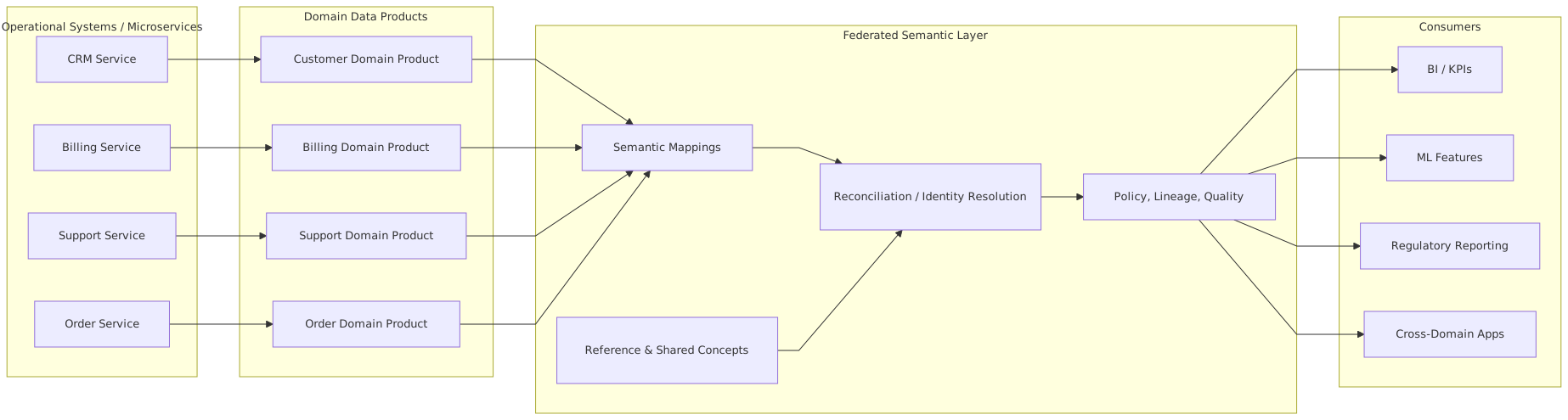
A practical architecture for data model federation in data mesh has four layers:
- Operational systems and microservices
- Domain data products
- Federated semantic and reconciliation services/products
- Consumption products for analytics, ML, regulation, and business workflows
The key point is that federation is not a giant hub with all logic centralized. It is a set of shared capabilities that domains use to expose interoperable meaning.
Domain products
These should expose business entities, events, and measures in domain language. They may be implemented using Kafka topics, lakehouse tables, API-accessible datasets, or query endpoints. The important part is that they are versioned, documented, testable, and owned.
For example, the Order domain may publish:
- order-submitted events
- order-line snapshots
- fulfillment status timeline
- order margin metrics
None of those need to pretend they are already enterprise-standard.
Semantic mappings
Mappings translate domain attributes and entities to shared concepts. This is not just renaming columns. It may include unit normalization, code set translation, temporal interpretation, or relationship semantics.
For example:
- Billing.invoice_party maps to FederatedCustomer.legal_party
- Support.contact_user maps to FederatedCustomer.service_contact
- CRM.account maps to FederatedCustomer.commercial_account
These are related, not identical. Good federation makes that visible.
Reconciliation services
This is where many architectures get serious or get embarrassed.
If different domains refer to the same real-world entity under different keys, you need resolution logic. That might be deterministic matching, probabilistic entity resolution, golden record survivorship, or a link graph. In heavily regulated environments, you may prefer linked identities over a single “master” record because provenance matters.
Reconciliation also includes temporal alignment. Two domains may both describe the same customer, but at different points in time and under different effective-date rules. Without time-awareness, reconciliation creates false certainty.
Shared reference concepts
Some semantics are best handled as shared products: legal entity hierarchy, business calendar, exchange rates, product taxonomy, location hierarchy, privacy classification, and identity classes. These are reference domains in their own right, not incidental metadata.
Governance and policy automation
Every federated contract should carry machine-readable metadata: schema versions, domain ownership, PII classification, retention rules, quality SLAs, compatibility checks, lineage, and approved mappings.
Without this, federation decays into slideware.
Domain semantics and bounded context translation
Let’s be blunt: if you skip bounded context thinking, you will build either a brittle canonical model or a jungle of incompatible datasets.
DDD gives us better tools.
A bounded context defines the boundary within which a model is internally consistent. In a retail enterprise:
- Sales cares about account ownership, pipeline, opportunity, and commercial relationship
- Fulfillment cares about shipment, delivery promise, and inventory allocation
- Billing cares about invoicing party, tax identity, and payment liability
- Support cares about contact identity, entitlement, and case history
“Customer” exists in all four, but not with the same semantics.
A federated model should therefore define relationship patterns between contexts, not force one local definition to dominate all others. Context mapping becomes a serious design activity:
- equivalent
- upstream/downstream
- customer-supplier
- conformist
- anti-corruption layer
- published language
These DDD ideas are not theoretical luxuries. They are practical architecture tools for data mesh. A federated semantic layer is, in effect, the published language and translation boundary for cross-domain data use.
One memorable rule helps here: shared words are cheap; shared meaning is expensive.
Pay for meaning.
Kafka, microservices, and streaming federation
Microservices and Kafka add both power and danger.
The power is obvious. Domain events can be published close to the source, and consumers can subscribe in near real time. You can create data products directly from event streams, preserve fine-grained lineage, and support operational analytics or feature generation with low latency.
The danger is semantic overconfidence. Teams often assume that because an event is published from the source system, it is therefore enterprise truth. It is not. It is source truth in one bounded context.
A Kafka topic like customer-created tells you that a service emitted an event. It does not settle whether that entity is the legal customer, the service user, the payer, or the household representative.
A sensible streaming architecture for federation separates domain event publication from semantic harmonization.
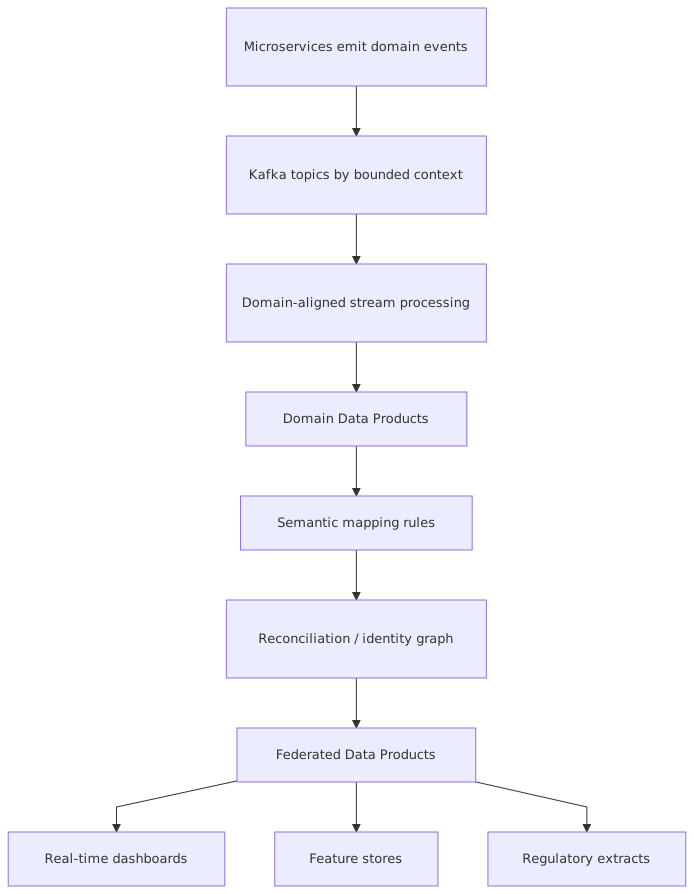
This allows several important practices:
- Event schemas remain domain-owned.
- Stream processors can enrich and normalize events into domain products.
- Federated products are derived through governed mappings.
- Reconciliation can happen incrementally, not only in batch.
- Consumers choose between local domain truth and cross-domain federated views.
That last choice matters. Not every use case needs federation. A support dashboard may be perfectly fine using Support domain truth only. A churn model spanning product usage, billing delinquency, and complaint history absolutely needs reconciled semantics.
Migration Strategy
Nobody wakes up in a clean federated mesh. Enterprises arrive carrying warehouses, point-to-point integrations, Kafka topics with creative naming, and a graveyard of “temporary” mapping tables.
So migration has to be progressive. This is a strangler problem.
The right move is not to declare a grand new enterprise model and demand a synchronized cutover. That approach has buried many architecture programs. Instead, introduce federation incrementally around the highest-value semantic seams.
Step 1: Identify cross-domain pain, not abstract purity
Start where inconsistency is expensive: customer reporting, revenue recognition, regulatory exposure, fraud detection, or product profitability. Pick one or two concepts where the enterprise already pays a tax for semantic fragmentation.
Step 2: Define bounded contexts and current meanings
Map the existing semantics by domain. Do not rush to harmonize. First make the differences explicit. This often reveals that teams were not disagreeing about data quality so much as talking about different things.
Step 3: Publish domain data products with clear contracts
Before federation, improve local clarity. Give domains ownership, schemas, SLAs, lineage, and documentation. A federated layer built on ambiguous source products will only industrialize confusion.
Step 4: Introduce a minimal federated concept model
Define only the shared concepts needed for the selected business outcomes. Keep it thin. This is not the moment to model the whole enterprise. If the first use case is customer risk exposure, define the customer identity classes, legal entities, account relationships, and exposure measures required for that use case.
Step 5: Build anti-corruption mappings
For each participating domain, create mapping logic from local semantics to federated concepts. In DDD terms, this acts as an anti-corruption layer. It protects the domain from semantic pollution while making integration possible.
Step 6: Add reconciliation services
Implement identity linking, deduplication, temporal alignment, and survivorship logic where necessary. Start with transparent rules. Avoid black-box matching that nobody can explain to auditors or business owners.
Step 7: Strangle old centralized transformations
As federated data products become trustworthy, retire equivalent logic from the warehouse or bespoke integration layer. This is the migration win: not adding one more transformation stack, but replacing fragile old ones.
Step 8: Expand concept by concept
Move next to product, contract, transaction, asset, or location semantics. Federation grows by stable seams, not by enterprise big-bang.

A strangler migration works because it respects operational continuity. The warehouse does not vanish overnight. Kafka does not solve semantics by announcement. You progressively shift the center of gravity from hidden central transformations to explicit federated products.
Enterprise Example
Consider a multinational insurer. A very normal enterprise, which is another way of saying very complicated.
It has grown through acquisition. Customer data lives in policy administration systems, claims platforms, agent portals, CRM, billing, and regional support tools. The company wants a unified view for risk, regulatory reporting, cross-sell analytics, and digital service experience.
Historically, they built a central warehouse with a “canonical customer dimension.” It looked elegant in architecture diagrams and generated misery in practice. Why? Because the policyholder, beneficiary, claimant, billing party, and portal user were being flattened into one customer concept. Every country had exceptions. Every acquisition had local identifiers. Every compliance review reopened the argument.
The move to data mesh improved ownership. Domains such as Policy, Claims, Billing, Distribution, and Digital Experience began publishing their own data products. But now the inconsistency was more visible. The Claims domain used person-level identity tied to incidents. Billing modeled account liability. Distribution modeled household and broker relationships. Digital Experience modeled authenticated users and consent profiles.
At first, some executives interpreted this as a failure of mesh. It was actually a healthy exposure of reality.
The architecture team introduced a federated semantic model with these principles:
- Domains keep their own customer-related models.
- A shared Party and Role federated concept is introduced.
- Reference products define legal entity, region, and policy product taxonomy.
- Reconciliation builds a linked identity graph rather than a single overwrite-style golden record.
- Domain mappings explicitly state whether a record represents policyholder, payer, claimant, insured party, or portal user.
- Kafka streams propagate domain events; stream processing updates both domain products and the identity graph.
- Regulatory and risk reporting consume federated products; operational teams continue to use domain-specific products where appropriate.
This changed the conversation.
Instead of asking, “What is the one true customer table?” the enterprise asked, “Which party role do you need, under what legal and temporal interpretation?” That is a much better question.
The result was not perfect harmony. It was something more valuable: controlled semantic plurality. Risk analytics improved because exposures could be aggregated by reconciled legal party. Claims fraud models improved because incident actors could be linked without pretending they were billing customers. Customer service improved because support agents could see a role-based consolidated view without forcing upstream systems into one schema.
That is what mature federation looks like in the wild. Not a pristine universal model. A disciplined way to connect valid but different truths.
Operational Considerations
Architecture drawings are easy. Keeping federation alive in production is where the work begins.
Metadata and lineage
Mappings, transformations, and reconciliations must be traceable. Consumers need to know not only where data came from, but under which semantic rule it was interpreted. If a federated “active customer” metric depends on policy status plus billing recency plus region-specific exclusions, that logic must be inspectable.
Data quality
Quality has to be assessed at two levels:
- Domain quality: completeness, timeliness, validity within the bounded context
- Federation quality: mapping coverage, reconciliation confidence, cross-domain consistency, drift detection
The second level is often forgotten. A domain can be internally clean and still produce low-confidence federation if identifiers are missing or reference mappings are stale.
Versioning
Semantic contracts need versioning discipline. Additive changes are usually manageable. Breaking changes require compatibility windows, migration guidance, and automated impact detection. A federated mesh without version governance quickly becomes an archaeological site.
Security and privacy
Federation tends to create richer linked views, which increases sensitivity. Identity graphs, customer role mappings, and cross-domain joins often elevate privacy risk. Policy controls, masking, purpose limitation, and access segmentation must be enforced at product and query levels.
Performance and latency
Not all federation should happen at query time. Some use cases need precomputed reconciled products; others can tolerate late binding. The architecture should choose intentionally:
- precomputed for heavy regulatory or repeated BI workloads
- streaming or incremental for operational intelligence
- virtualized or query-time for exploratory and low-frequency use
Ownership model
Federated products need clear owners. If everyone owns them, nobody does. Typically, stewardship is shared across participating domains, while implementation may sit with a platform or cross-domain product team. This is one place where governance and product management have to work together, not in sequence.
Tradeoffs
There is no free lunch here.
Benefit: semantic interoperability
Cost: additional modeling overhead
Federation reduces downstream inconsistency but requires deliberate mapping, documentation, and stewardship work. Teams will feel this as friction unless the value is tangible.
Benefit: domain autonomy preserved
Cost: duplication remains visible
Because domains retain local models, some apparent duplication will continue. That is not failure. It is the price of respecting bounded contexts. The trick is to duplicate responsibly and map explicitly.
Benefit: better cross-domain analytics
Cost: more moving parts
Identity resolution, reference data, contract tests, schema registries, metadata platforms, and stream/batch processing pipelines all add operational complexity. If your organization cannot run these capabilities reliably, federation will become brittle.
Benefit: evolutionary migration
Cost: hybrid coexistence pain
For a period, you will have both legacy warehouse logic and federated products. Reports may disagree. This is normal, but politically uncomfortable. Reconciliation of systems is often easier than reconciliation of executive expectations.
Benefit: transparency of meaning
Cost: uncomfortable conversations
Federation forces domains to state what they mean. That sounds obvious. In practice, it surfaces organizational ambiguity and power struggles. The architecture is technical, but the resistance is often social.
Failure Modes
Most failed federation efforts die in familiar ways.
1. Recreating the canonical enterprise data model
This is the classic trap. The team calls it “federation” but really builds a giant all-purpose schema. Delivery slows, domains resist, and the model becomes either too abstract to use or too detailed to govern.
2. Treating the catalog as the solution
A data catalog is useful. It is not semantic architecture. If there are no executable mappings, reconciliation rules, or contract tests, you have searchable confusion.
3. Leaving reconciliation implicit
If cross-domain identity linkage is hidden in analyst notebooks or BI logic, federation is fake. Reconciliation must be explicit, reusable, and governed.
4. Overfederating low-value data
Not every domain concept needs enterprise harmonization. Trying to federate everything creates bureaucracy and little business value. Focus on concepts that drive composition, reporting, risk, or customer experience.
5. Ignoring temporal semantics
A customer linked today may not have been linked last quarter. Product hierarchies change. Legal entities merge. If the federation model is not time-aware, historic reporting becomes suspect.
6. No product ownership for federated outputs
Federated products need lifecycle management like any other product: roadmap, SLAs, support, deprecation policy, consumer engagement. Without this, they become side effects no one trusts.
When Not To Use
Data model federation is not universally necessary.
Do not reach for it when:
- You have a small organization with one primary operational system and limited cross-domain analytics.
- Your data use cases are mostly domain-local and do not require semantic composition.
- The enterprise lacks the maturity to manage data products, contracts, and metadata operationally.
- The current pain is basic data quality or platform instability rather than semantic inconsistency.
- You are using “federation” as a politically safer label for a centralized canonical data rewrite.
In these cases, simpler patterns may be enough: conformed reporting marts, local domain contracts, or a lightweight reference data service.
Federation shines when the enterprise is large, domain-diverse, and integration-heavy. It struggles when the organization wants the language of decentralization without the discipline of explicit semantics.
Related Patterns
Several architecture patterns sit close to data model federation.
Canonical Data Model
Useful in narrower integration scenarios, especially when one dominant process needs standardized exchange. Dangerous at enterprise scale when it tries to erase bounded contexts.
Master Data Management
Still relevant, especially for core reference and party data. But modern federation often prefers linked identity and role-aware semantics over a single overwrite-style golden record.
Data Virtualization
Helpful for access abstraction, but it does not solve semantic alignment by itself. Virtualized confusion is still confusion.
Event Carried State Transfer
Common in Kafka-based microservices. Useful for propagation, but publication format should not be mistaken for enterprise semantics.
Anti-Corruption Layer
A vital DDD pattern for mapping local models to federated concepts without infecting domains with external assumptions.
Strangler Fig Pattern
Essential for migration. Introduce federated products around the edges of existing warehouse or integration logic and progressively replace them.
Summary
Data mesh without semantic federation is a road network without agreed maps. Cars move. Nobody arrives where they expected.
The heart of the problem is not technology. It is meaning. Enterprises operate through multiple bounded contexts, and those contexts are allowed to model reality differently. In fact, they should. But once the business needs cross-domain insight, control, regulation, personalization, or automation, those contexts must become interoperable.
That is what data model federation provides.
Not one giant universal schema. Not chaos dressed up as autonomy. Something harder and more useful: explicit semantic contracts, bounded context translation, reconciled entities, shared reference concepts, and executable governance.
The migration path matters just as much as the target state. Progressive strangler adoption is the sensible route. Start with painful seams. Publish domain products clearly. Introduce thin federated concepts. Add reconciliation. Retire old hidden transformations as trust grows.
And stay honest about the tradeoffs. Federation adds overhead. It needs stewardship. It can fail through over-modeling, under-governing, or pretending that event streams are semantic truth. It is not for every organization, and it is not a substitute for basic platform and data quality discipline.
But for large enterprises running microservices, Kafka, multiple business domains, and serious analytical or regulatory demands, federated data modeling is one of the few ways to preserve both local autonomy and enterprise coherence.
That is the real promise of a mature data mesh.
Not distributed pipes.
Distributed meaning, under control.
Frequently Asked Questions
What is a data mesh?
A data mesh is a decentralised data architecture where domain teams own and serve their data as products. Instead of a central data team, each domain is responsible for data quality, contracts, and discoverability.
What is a data product in architecture terms?
A data product is a self-contained, discoverable, trustworthy dataset exposed by a domain team. It has defined ownership, SLAs, documentation, and versioning — treated like a software product rather than an ETL output.
How does data mesh relate to enterprise architecture?
Data mesh aligns data ownership with business domain boundaries — the same boundaries used in domain-driven design and ArchiMate capability maps. Enterprise architects play a key role in defining the federated governance model that prevents data mesh from becoming data chaos.