⏱ 19 min read
Most enterprise architecture problems do not start with technology. They start with language.
A team says “customer,” another says “account,” a third says “party,” and all three swear they mean the same thing. They do not. One means a legal entity, one means a billing relationship, and one means a human being with three half-complete addresses and an expired consent flag. Then the integration program begins, someone draws boxes and arrows, Kafka topics appear, APIs multiply, and the organization discovers an old truth: systems do not merely exchange data, they collide over meaning. event-driven architecture patterns
That is where bounded context mapping earns its keep.
Bounded contexts are one of the sharpest ideas in Domain-Driven Design because they force a discipline many enterprises avoid: admitting that the business is not one coherent model. It is a federation of models, each locally sensible, each globally dangerous if treated as universal. A context map is the architecture artifact that makes those boundaries explicit and describes the relationship patterns between them. Not just connectivity. Not just interfaces. Power, translation, ownership, and semantic leakage.
This matters even more in modern estates with microservices, event streams, data products, and cloud integration platforms. The old fantasy was a canonical model that would unify the enterprise. The new fantasy is that event-driven architecture somehow removes the need for semantic alignment. It does not. Kafka can transport an event across a continent in milliseconds; it cannot make two business domains agree on what “order shipped” means.
So this article is about context map variants: the patterns for connecting bounded contexts, the situations they fit, the migrations they enable, and the traps they create. We will look at the forces, the architectural choices, the tradeoffs, and the failure modes. We will also look at how these patterns play out in real enterprise modernization, where nobody gets to start greenfield and every elegant model eventually meets a procurement system from 2007.
Context
In Domain-Driven Design, a bounded context is the boundary within which a domain model has consistent meaning. Inside the boundary, terms, aggregates, invariants, and workflows hang together. Outside it, the same words may mean something else entirely.
That sounds simple. It is not.
Large organizations accumulate multiple models because they have multiple business purposes. Sales wants a prospect funnel. Billing wants payment obligations. Fulfillment wants physical shipment units. Customer service wants interaction history. Risk wants exposure and fraud signals. These are not views over one model. They are different domains with different semantics, optimized for different decisions.
A context map describes the relationships among these bounded contexts. It shows who depends on whom, where translation happens, how teams coordinate, and what shape the integration takes. In practice, context mapping sits at the seam of business architecture, solution architecture, and team topology. It is as much about organizational behavior as software design.
That is why context maps age badly when they are drawn as static documentation. The useful version is not a pretty picture for a steering committee. It is a living statement of semantic contracts and dependency politics.
Problem
The problem is not “how do we integrate systems.” Enterprises know how to integrate systems. They have ESBs, APIs, ETL tools, brokers, event buses, iPaaS platforms, and enough middleware to heat a small country.
The real problem is how to preserve domain integrity while enabling collaboration between contexts that do not, and should not, share the same model.
If you ignore bounded contexts, several predictable pathologies appear:
- one context starts imposing its model on the others
- upstream schema changes break downstream services
- events become de facto shared databases
- teams spend more time reconciling meanings than building capabilities
- “customer 360” becomes a swamp of conflicting truth claims
- migration stalls because old and new systems cannot coexist safely
The most expensive failures come from semantic drift. A field survives every API version, every Avro schema evolution, every CDC pipeline, and still means something different six months later. The mechanics hold. The business breaks.
Forces
A good context map pattern is chosen under pressure from competing forces.
Semantic autonomy
Each domain needs freedom to model reality in a way that supports its own decision-making. If every context must conform to a shared enterprise model, local clarity dies.
Integration pressure
Business processes cross domain boundaries. Quote-to-cash, claims handling, onboarding, returns, and collections all require contexts to interact. Isolation is healthy; total separation is fantasy.
Team autonomy and power
Some teams can coordinate closely; others cannot. Some contexts are politically dominant because they own the system of record. Others are downstream consumers with little leverage. Context mapping is partly a map of organizational gravity.
Legacy constraints
Modern architecture rarely starts on a blank page. You inherit an ERP, a CRM, a mainframe, a warehouse, perhaps three MDM initiatives and a Kafka platform added in a burst of optimism. Migration choices are shaped by what already exists.
Change frequency
If an upstream model changes often, tight coupling is dangerous. If downstream consumers are many and brittle, direct exposure becomes reckless.
Operational reliability
Synchronous dependencies create runtime fragility. Asynchronous messaging improves resilience but introduces eventual consistency, replay concerns, idempotency issues, and reconciliation obligations.
Compliance and audit
In regulated environments, translation is not just an engineering concern. You may need traceability from source semantics to downstream decision. That changes how anti-corruption layers and event transformation are designed.
Solution
The solution is not one pattern. It is a family of relationship patterns, each expressing a different balance of autonomy, coordination, and translation. The most useful context map variants include:
- Shared Kernel
- Partnership
- Customer-Supplier
- Conformist
- Anti-Corruption Layer
- Open Host Service
- Published Language
- Separate Ways
The trick is not memorizing the names. The trick is understanding what they say about the domains, the teams, and the likely future migration path.
Architecture
Let’s walk through the key bounded context mapping patterns as architecture choices rather than catalog entries.
Shared Kernel
A Shared Kernel is a deliberately shared subset of the domain model between two contexts. It can work when two teams genuinely share a small, stable core concept and are willing to coordinate changes tightly.
This is useful. It is also dangerous.
A shared kernel often begins as a tiny island of common meaning and expands like a damp patch on a ceiling. If the shared surface grows, autonomy shrinks. Teams begin negotiating changes constantly, release cadence slows, and the kernel becomes a Trojan horse for coupling.
Use it for truly stable concepts with clear ownership and active collaboration. Think tax calculation primitives or a tightly governed product classification vocabulary used by two adjacent domains. Do not use it as a polite name for “we could not decide the boundary.”
Partnership
Partnership assumes two teams succeed or fail together and can coordinate closely. The relationship is collaborative, symmetric, and high-touch. This works in a narrow band of enterprise reality: adjacent domains, aligned incentives, and mature teams.
It fails when one side moves faster, the release process differs, or leadership changes and the “partnership” becomes wishful thinking. In architecture reviews, I treat Partnership as a social pattern first and a technical pattern second. If the teams do not already trust each other, the diagram is lying.
Customer-Supplier
This is one of the most practical patterns in the enterprise. One context is upstream and supplies capabilities or data. Another is downstream and acts as a customer, influencing the contract through negotiation. The relationship has asymmetry but not helplessness.
This pattern works well for internal platforms and domain services: pricing supplying quote assembly, identity supplying access claims, inventory supplying availability signals. The key is explicit service expectations. The supplier cannot behave like a sovereign empire; the customer cannot demand bespoke semantics for every edge case.
Conformist
Conformist is what happens when a downstream context simply adopts the upstream model. Sometimes this is the right call. If the downstream domain is weak, the upstream model is stable, and speed matters, conforming saves money.
But let us be honest: Conformist is often the architecture of political surrender.
A downstream service that conforms too eagerly inherits semantic assumptions, lifecycle constraints, and release volatility it does not control. It may look efficient in the first quarter and become costly in the third year. Conformist is acceptable when the downstream does not need a distinct model. It is reckless when it does.
Anti-Corruption Layer
The Anti-Corruption Layer, or ACL, is the adult choice in messy enterprises. It translates between models so that one bounded context can interact with another without polluting its own domain language.
This pattern is invaluable in modernization, especially when introducing new microservices around legacy systems. The new service keeps its domain clean. The ACL absorbs legacy semantics, weird reference data, overloaded status codes, and all the other archaeological layers of an old platform. microservices architecture diagrams
An ACL is not free. It adds code, latency, transformation logic, and testing burden. But compared to the cost of infecting a clean domain with legacy nonsense, it is usually cheap.
Open Host Service and Published Language
An Open Host Service exposes a well-defined protocol for others to consume. Published Language provides the shared format or vocabulary used in communication. In API-first architecture, this often means versioned REST or gRPC contracts; in event-driven systems, it may mean a schema-managed event contract carried over Kafka.
These patterns are strongest when the exposed model is intentionally externalized and stable enough for broad use. They are weakest when teams publish internal data structures and call it architecture.
Separate Ways
Sometimes the right pattern is no pattern. Separate Ways means contexts do not integrate because the cost of coordination exceeds the business value. This is a deeply underused decision. Enterprises often wire domains together because integration feels virtuous. It is not always virtuous. Sometimes it is just expensive.
If two capabilities barely interact and can be reconciled through reporting or human process, keeping them separate may be cleaner than forcing a brittle technical relationship.
A simple context map view
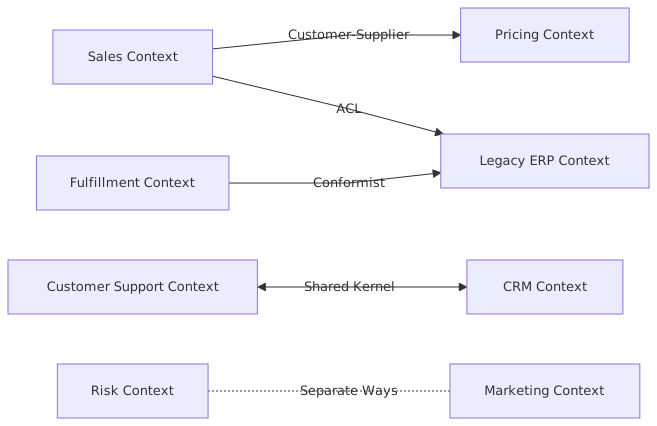
This diagram is simple on purpose. A context map should reveal relationship style, not hide it behind a generic “integrates with.”
Domain semantics: where the real work is
The hardest part of context mapping is not choosing boxes. It is doing semantic surgery.
Take “Order.” In Sales, an order may mean a commercial commitment. In Fulfillment, it means a set of shippable lines with sourcing constraints. In Billing, it means a basis for invoicing. In Analytics, it may be just a fact row with a timestamp and amount. None of these is “the real order.” Each is real inside its context.
This is why context maps matter. They force us to ask:
- What concept is native here?
- What concept is imported?
- Where is translation required?
- Where are we pretending translation is unnecessary?
In event-driven architecture, semantics become more treacherous because events feel neutral. They are not neutral. An event such as OrderCompleted can encode multiple business thresholds. Completed by whom? Commercially booked? Credit approved? Packed? Delivered? Invoiced? Refunded window expired?
If your Kafka topic is carrying an event with unresolved semantics, you have built a semantic ambiguity distribution platform.
Published language needs more than field schemas. It needs business definitions, state transition meaning, identity rules, and timing semantics. Does the event represent a fact, an intention, or a derived projection? Can it be revoked? Is it immutable? What is the idempotency key? What are the replay effects? These are architecture questions because they shape context boundaries and failure handling.
Integration architecture variants
Different patterns imply different technical forms.
Synchronous API integration
Useful for query-style interactions where fresh information is needed and latency is acceptable. Dangerous when overused in business workflows because runtime dependencies spread like ivy.
Asynchronous event integration
Kafka and similar platforms are excellent for decoupling time, supporting replay, and broadcasting business facts to multiple consumers. But they do not remove the need for bounded contexts. If anything, they amplify the need for published language discipline and downstream translation.
Data replication and projections
Sometimes a context consumes upstream facts and builds a local read model. This is a strong fit with Customer-Supplier or ACL. It supports autonomy and local optimization but introduces reconciliation responsibilities.
Batch exchange
Still common. Still useful. In some domains, nightly or hourly synchronization is enough. Architecture maturity is not measured by how quickly you eliminate batch. It is measured by whether timing fits the business.
Context map with translation and event flow
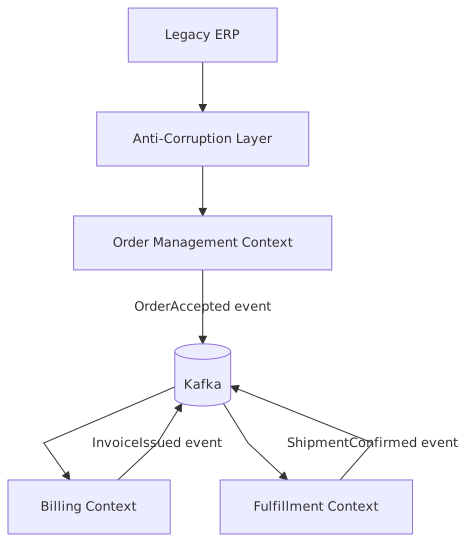
Here the new Order Management context protects its model from ERP semantics via an ACL, then publishes domain events for downstream contexts. That is the clean story. The operational story is less neat, which brings us to migration.
Migration Strategy
Context map patterns are not just static relationship types. They are migration tools.
In enterprise modernization, the most effective strategy is often progressive strangler migration: peel capabilities away from a legacy core, establish explicit bounded contexts, use anti-corruption layers to shield the new domain, and gradually redirect traffic and events.
The mistake is trying to replace a monolith with a fleet of microservices while preserving old semantics everywhere. That gives you distributed legacy instead of modern architecture.
A more sensible sequence looks like this:
- Identify distinct business capabilities inside the current estate.
- Define candidate bounded contexts around domain semantics, not around database tables.
- Choose one context with clear business pain and manageable external dependencies.
- Place an ACL between the new context and the legacy system.
- Introduce event publication or replicated views for downstream consumers.
- Run old and new paths in parallel.
- Reconcile outcomes aggressively.
- Shift writes, then reads, then decommission legacy behavior.
The critical word is reconcile.
Parallel run is not a confidence ritual. It is a semantic test. During migration, you need to compare decisions, state transitions, and financial outcomes between old and new models. Where they differ, you must decide whether the new model is wrong, the old model was compensating for undocumented business rules, or the boundary itself was drawn poorly.
Progressive strangler migration
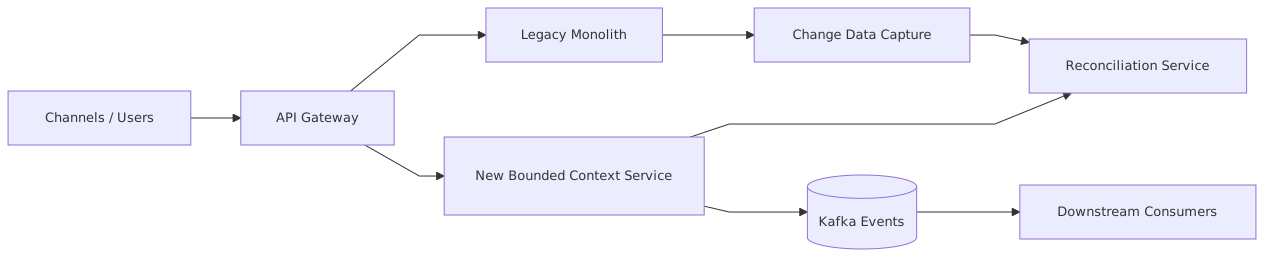
This is the practical shape of many enterprise migrations. Both legacy and new services coexist. A reconciliation service compares outputs or state. Kafka distributes events from the new context without forcing all consumers to migrate at once.
Reconciliation patterns
Reconciliation deserves far more attention than it usually gets.
When contexts coexist during migration, you often have:
- duplicate identifiers
- different lifecycle states
- mismatched timestamps
- reference data discrepancies
- transactions split across systems
- delayed event delivery
- reprocessing after failure
You need explicit reconciliation processes:
- record matching rules
- divergence thresholds
- exception queues
- compensating actions
- audit trails
- operational dashboards
Without this, eventual consistency becomes eventual confusion.
Enterprise Example
Consider a global insurer modernizing claims processing.
The legacy claims platform stores “claim” as a giant aggregate spanning incident, policy coverage, reserve, payment, fraud flags, and repair workflow. It has grown over fifteen years. Every downstream system consumes extracts from it. The company wants faster digital FNOL, fraud analytics, and partner repair orchestration.
If the insurer treats “Claim” as one enterprise concept, modernization collapses under its own weight. Instead, it identifies bounded contexts:
- Claims Intake
- Coverage Decisioning
- Fraud Assessment
- Payments
- Repair Network
- Customer Communication
Claims Intake becomes the first extraction candidate. It owns incident capture and initial case creation. A new service is built with its own domain model, optimized for digital intake and validation. It does not reuse the legacy object structure. An ACL translates between the new intake model and the legacy claim record.
Fraud Assessment consumes ClaimReported events from Kafka. But it does not conform to the intake model directly. It builds its own fraud case representation. Payments remains downstream from the legacy core at first, because financial controls and ledger integration make it too risky to move early. Customer Communication listens to both new and old event streams and uses reconciliation logic to avoid duplicate notifications.
This is not glamorous architecture. It is enterprise architecture as it really exists: half old, half new, semantics under negotiation, and every integration carrying operational consequences.
The context map might look like this:
- Claims Intake to Legacy Claims Core: Anti-Corruption Layer
- Fraud Assessment to Claims Intake: Customer-Supplier via Kafka events and published language
- Payments to Legacy Core: Conformist for an interim period
- Customer Communication to both: ACL plus reconciliation
- Repair Network to Claims Intake: Open Host Service for partner APIs
What makes this work is not the diagram. It is the discipline around language. Intake defines what “reported” means. Fraud defines what “suspicious” means. Payments defines what “approved for payment” means. Each context owns its semantics. The map governs the crossings.
Operational Considerations
Architects often discuss context maps as if they stop at design. They do not. They have serious operational implications.
Versioning
Published language needs compatibility rules. For APIs, this means explicit versioning strategy and deprecation policy. For Kafka events, this means schema evolution, consumer tolerance, and field lifecycle management. You need to know what can change without breaking downstream assumptions.
Observability across contexts
When a business journey crosses bounded contexts, tracing matters. Correlation IDs, business keys, and event lineage become essential. Otherwise incidents turn into archaeology.
Idempotency and replay
Event consumers must tolerate duplicates. Replay may re-trigger side effects if boundaries are poorly designed. Context maps should influence message contract design: what is a fact, what is a command, and what can be processed repeatedly without harm.
Data quality monitoring
Translation layers are magnets for data anomalies. Measure translation failures, schema mismatches, reconciliation drift, and unmapped codes. If you do not monitor semantic health, your architecture will fail quietly before it fails loudly.
Security and privacy boundaries
Bounded contexts often align with different privacy obligations. A marketing context may not need raw claims notes. A support context may need selective customer details but not full financial data. Translation layers should filter as well as transform.
Tradeoffs
Every context mapping pattern buys something and costs something.
Shared Kernel buys consistency and lowers translation effort, but it increases coordination overhead and reduces autonomy.
Partnership buys rich collaboration, but it depends on organizational maturity that many enterprises cannot sustain.
Customer-Supplier buys structured dependency with room for influence, but requires product thinking from the supplier and disciplined contract management.
Conformist buys speed, but exports upstream assumptions into places they may not belong.
Anti-Corruption Layer buys semantic protection, but adds complexity and can become a maintenance hotspot.
Open Host Service and Published Language buy scalable integration, but only when the published model is intentionally designed rather than accidentally exposed.
Separate Ways buys independence, but may defer needed integration and create fragmentation if overused.
There is no perfect pattern. There is only a pattern that fails more slowly than the alternatives in your situation.
Failure Modes
Some failure modes are so common they should be printed on architecture review templates.
The fake bounded context
A service is called a bounded context but still uses the upstream schema, terminology, and lifecycle wholesale. This is not a bounded context. It is a deployment boundary with identity issues.
The canonical data model comeback
An enterprise platform team creates a universal event schema “for consistency.” Soon every context must publish and consume it. Translation disappears because “alignment” was mandated. Semantic compromise returns through the side door.
ACL as dumping ground
The anti-corruption layer becomes a mess of undocumented transformations, reference code hacks, and business rules no team wants to own. The cure becomes a new disease.
Event-driven conformism
Teams publish internal events directly to Kafka, downstream consumers bind tightly to them, and soon event contracts are as brittle as database tables. The event bus becomes a distributed shared kernel.
Over-fragmentation
Every noun becomes a microservice. Contexts are split too finely, and the business process is now a network of chatty dependencies and endless reconciliation. Domain-driven design does not mean domain atomization.
No reconciliation during migration
Old and new systems run in parallel, but discrepancies are handled manually or ignored. Confidence erodes, business users lose trust, and the migration becomes politically toxic.
When Not To Use
Context mapping is powerful, but not every problem warrants a heavy hand.
Do not overinvest in formal context mapping when:
- the domain is genuinely simple and stable
- one team owns the whole capability end-to-end
- semantics are not meaningfully divergent
- the integration is temporary or low-value
- a straightforward modular monolith is the better choice
Also, do not force bounded context purity into reporting or analytical landscapes where denormalized consumption models are acceptable. Analytics often needs cross-context facts. The trick is to preserve semantic provenance, not to pretend the warehouse is a domain model.
And do not use Kafka because a context map says “asynchronous.” If the interaction is low-volume, request-response, and needs immediate confirmation, an API may be simpler and safer. Event streams are not a moral upgrade.
Related Patterns
Context maps are strongest when used alongside other DDD and enterprise architecture patterns.
Aggregates
Inside a bounded context, aggregates define consistency boundaries. Across contexts, consistency becomes coordination and messaging.
Domain Events
Useful for expressing facts crossing context boundaries. They must be named from the publishing context’s semantics, not as universal truth statements.
Saga or process manager
Helpful when workflows span contexts and require compensation rather than atomic transactions.
Strangler Fig pattern
The natural migration companion to ACL and Customer-Supplier relationships during legacy modernization.
Hexagonal architecture
A good internal structure for a bounded context, especially when multiple adapters feed the same domain model.
Event sourcing
Sometimes useful, but not required. Do not confuse “we have events” with “we should event source.” Event sourcing increases the importance of semantic precision and replay safety.
Summary
Bounded context mapping is not decorative DDD. It is one of the few architecture practices that confronts the real source of enterprise complexity: competing models of the business living side by side.
The patterns matter because they encode more than integration style. They encode semantic intent, team relationships, migration posture, and operational burden. Shared Kernel, Partnership, Customer-Supplier, Conformist, Anti-Corruption Layer, Open Host Service, Published Language, and Separate Ways are not just labels. They are bets about where meaning should stay stable, where translation must occur, and where dependency is tolerable.
The strongest architectures are rarely the ones with the most services or the most event topics. They are the ones that protect domain language, make translations explicit, and evolve through migration rather than replacement fantasy.
If you remember one thing, remember this: the map is not about connecting systems. It is about containing ambiguity.
And in the enterprise, that is often the difference between architecture that scales and architecture that merely spreads.
Frequently Asked Questions
What is enterprise architecture?
Enterprise architecture aligns strategy, business processes, applications, and technology in a coherent model. It enables impact analysis, portfolio rationalisation, governance, and transformation planning across the organisation.
How does ArchiMate support architecture practice?
ArchiMate provides a standard language connecting strategy, business operations, applications, and technology. It enables traceability from strategic goals through capabilities and services to infrastructure — making architecture decisions explicit and reviewable.
What tools support enterprise architecture modeling?
The main tools are Sparx Enterprise Architect (ArchiMate, UML, BPMN, SysML), Archi (free, ArchiMate-only), and BiZZdesign. Sparx EA is the most feature-rich, supporting concurrent repositories, automation, scripting, and Jira integration.