⏱ 23 min read
ArchiMate for Application Portfolio Management: Strategy, Mapping & Governance
Learn how ArchiMate supports Application Portfolio Management by mapping applications, capabilities, dependencies, lifecycle, and governance to improve rationalization and investment decisions. ArchiMate tutorial for enterprise architects
ArchiMate, Application Portfolio Management, APM, enterprise architecture, application rationalization, application lifecycle management, capability mapping, technology portfolio, IT governance, dependency mapping, architecture modeling, application landscape, portfolio governance, business capability model, legacy modernization ArchiMate layers explained
Introduction
Application Portfolio Management (APM) is the discipline of making deliberate choices about the applications an organization runs: where to invest, what to modernize, what to retain for a period, and what to retire. In many enterprises, those choices are still based on fragmented inputs—spreadsheets, CMDB exports, vendor inventories, project plans, and cost reports. Each source may be useful in isolation, but together they rarely provide a reliable picture of how applications support business outcomes, where risk is accumulating, or what downstream effects a change will trigger.
This is where ArchiMate becomes particularly useful. Its value in APM is not limited to documenting applications. More importantly, it captures the relationships around them: which business capabilities depend on which application services, which application components provide those services, which data and technologies they rely on, and which initiatives are already changing them. That connected view turns raw inventory data into something leaders can use to make decisions. ArchiMate relationship types
Portfolio decisions are rarely about individual systems in isolation. An application may be expensive or technically outdated and still support a critical capability with no credible replacement. Another may look strategically important until the model shows that similar services already exist elsewhere. A legacy platform may seem minor functionally, yet remain difficult to retire because it holds authoritative data or sits at the center of multiple integrations. ArchiMate helps expose those conditions and gives stakeholders a structured way to discuss them. ArchiMate modeling best practices
Consider a simple example. A regional business unit proposes a new workflow product to speed up case handling. On its own, the request appears reasonable. Once mapped in the portfolio model, however, the same capability is shown to be supported already by an enterprise BPM platform used in two adjacent domains. The issue is no longer whether the proposed tool is technically sound; it is whether the organization wants to increase duplication and long-term support overhead for a capability that already has a strategic platform.
A practical ArchiMate-based approach to APM does not require a complete enterprise model from day one. In most organizations, a useful starting point is a focused set of concepts: business capabilities, application components, application services, key data objects, technology dependencies, lifecycle status, and a small set of assessment attributes such as fit, risk, and strategic relevance. Once those are connected, different stakeholder views can be derived from the same model: capability maps for executives, dependency views for architects, and transition views for transformation leaders.
This matters because APM is not a one-time inventory exercise. Application landscapes change continuously through modernization programs, mergers, cloud migration, regulatory change, and product retirement. A static application list loses value quickly. An ArchiMate-based repository can be updated incrementally and reused across strategy, governance, and roadmap planning. It provides traceability from architectural conditions to portfolio decisions, and from those decisions to delivery impact.
For organizations trying to reduce complexity while staying aligned to business needs, that is the real advantage. ArchiMate gives APM a shared architectural language for understanding the current estate, judging what matters, and planning change over time.
Why ArchiMate Matters in Application Portfolio Management
Most organizations are not short of application data. They usually know application names, owners, vendors, support arrangements, and often rough costs. The problem is that this information is rarely connected in a way that supports action. APM becomes difficult when application data exists without architectural context.
ArchiMate provides that context. It allows architects to model applications not as isolated assets, but as part of a wider enterprise system. In APM, an application should not be judged only by its technical condition. It also needs to be understood in relation to the business capabilities it enables, the services it exposes, the data it manages, the technologies it depends on, and the initiatives that will reshape it. ArchiMate brings those relationships together in one modeling language.
That integrated view makes several common portfolio questions easier to answer:
- Which applications support the same business capability?
- Which applications provide overlapping services?
- Which systems are difficult to retire because they hold critical data?
- Which applications carry risk because of obsolete platforms or excessive dependency concentration?
- Which planned initiatives reinforce, or undermine, the intended target portfolio?
A spreadsheet can list applications and scores, but it struggles to show dependency chains or the architectural blast radius of a retirement decision. An ArchiMate model can do that much more effectively. In an IAM modernization effort, for example, the model may show that a legacy directory is tied not only to authentication, but also to joiner-mover-leaver processes, privileged access workflows, and several custom integrations. That shifts the conversation from “replace the old tool” to “sequence a controlled identity transition.”
It also improves communication across stakeholder groups. APM brings together business leaders, enterprise architects, finance, security, operations, and delivery teams. Each group sees the application estate through a different lens. Executives want strategic clarity. Architects need dependency detail. Operations teams focus on platform exposure. Delivery teams need guidance on transition. ArchiMate allows those different views to come from one underlying model, which reduces inconsistency between audiences.
Another benefit is transparency in decision-making. Rationalization outcomes are often challenged because the reasoning behind them is hard to see. If one application is marked for investment and another for retirement, stakeholders want to know why. In an ArchiMate-based APM model, that rationale can be shown directly. A strategic application is not strategic because someone assigned it a label; it is strategic because it supports priority capabilities, aligns with the target state, runs on viable technology, and connects to planned initiatives. A retirement candidate is not simply unpopular; it can be shown as redundant, weakly aligned, high-risk, or no longer relevant.
Just as important, ArchiMate links assessment to execution. Many APM efforts identify duplication or technical debt and stop there. They do not carry those findings into roadmaps, projects, or governance controls. Because ArchiMate includes motivation and implementation concepts alongside structural ones, it can connect portfolio decisions to work packages, transition architectures, and migration plans. That is what turns a portfolio model from a static reference into a working architecture asset.
Core ArchiMate Concepts for APM
Effective APM does not depend on modeling everything. It depends on modeling the concepts that make portfolio decisions possible. In practice, a useful ArchiMate-based APM model combines selected elements from the business, application, technology, motivation, and implementation layers.
Application Component
The Application Component is usually the anchor for representing an application in the portfolio. Examples include a CRM platform, claims system, product information system, or data warehouse. Using this as the primary application element creates consistency across the repository.
The key decision is granularity. In most cases, the right level is the one at which investment, ownership, lifecycle, and retirement decisions are actually made. If a suite is funded and governed as a single asset, model the suite. If major modules have separate budgets and roadmaps, model them separately. Consistency matters more than theoretical precision.
Application Service
The Application Service represents the behavior an application exposes to users or to other applications. That distinction matters because applications are valuable not simply as systems, but because of the services they provide. Modeling services often reveals overlap more clearly than modeling components alone. Two applications may be technically different and still deliver very similar services. That is often where rationalization opportunities appear.
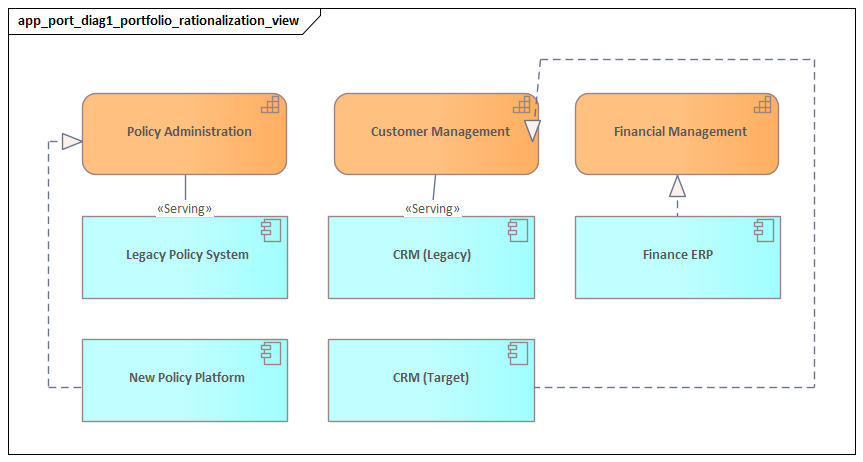
A common example is customer communication. One business unit may use a marketing platform to send notifications, while another relies on a bespoke service embedded in a policy administration system. At component level they look unrelated. At service level both are delivering outbound customer messaging, which is the more relevant portfolio insight.
Business Capability
For portfolio analysis, Business Capability is often the most useful business anchor. Capabilities express what the enterprise must be able to do, without tying the model too tightly to changing processes or organizational structures. Linking applications or services to capabilities allows architects to assess dependency, duplication, and criticality in business terms. That is usually the most effective way to make APM meaningful to executives.
Data Object
Data Object adds another essential perspective. Applications often remain in place not because their functionality is unique, but because they are the system of record for important data. Modeling key data objects helps reveal hidden retirement constraints, especially in legacy estates. A system with limited visible business functionality may still be difficult to replace if it owns regulatory, financial, customer, or product master data.
For instance, a decades-old policy administration system may support only a shrinking block of business, yet still hold the authoritative history needed for claims disputes and regulatory reporting. In portfolio terms, that changes it from an obvious retirement candidate to a controlled extraction and archival problem.
Technology Elements
Applications should also be linked to technology-layer elements such as Node, System Software, or Technology Service. Risk often comes from the underlying platform rather than from the application alone. Unsupported operating systems, aging middleware, brittle hosting arrangements, or obsolete integration components can all change a portfolio decision.
A common pattern is technology lifecycle exposure. Several applications may appear healthy until the model shows they all depend on an integration server version that leaves vendor support next year. The real issue is no longer the condition of each individual application, but a shared platform risk that affects a whole cluster of systems.
Motivation Elements
Structural modeling on its own is not enough for APM. The model also needs a way to capture evaluative reasoning. ArchiMate Motivation elements such as Assessment, Goal, Requirement, and Principle are useful here. They allow architects to express why an application matters, why it is problematic, or what strategic direction it needs to support. This is where the model shifts from descriptive to decision-oriented.
Implementation and Migration Elements
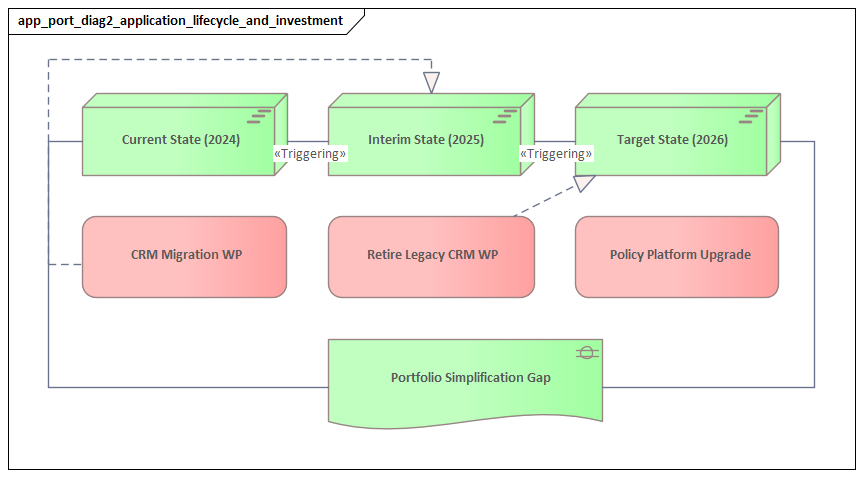
Because APM is dynamic, the model also needs to show change over time. ArchiMate’s Work Package, Plateau, and Gap are especially useful here. They allow architects to connect current-state findings to transition plans and target-state outcomes. These elements become critical when building realistic roadmaps rather than idealized future-state diagrams.
Mapping the Current Application Landscape
With the core concepts in place, the first practical task is to build a usable representation of the current estate. The aim is not a perfect digital twin of the enterprise. It is a decision-oriented baseline that captures the relationships most relevant to APM.
A common failure mode is over-modeling: trying to capture every interface, server, module, and dependency from the outset. The opposite problem is under-modeling: producing a thin catalog that lists applications but supports little real analysis. The right balance comes from selective modeling guided by portfolio questions.
Define What Counts as an Application
The first step is to define inclusion rules. Enterprise landscapes often include commercial packages, SaaS platforms, internally built systems, end-user tools, shared services, and even critical spreadsheets. If those are modeled inconsistently, the portfolio becomes distorted. Architects should define what counts as an application for APM purposes and apply that rule consistently.
Granularity should align with governance and decision-making. The goal is not technical taxonomy. The goal is portfolio usefulness.
Map Three Essential Relationship Types
A current-state model should usually capture three main relationship types.
Business dependence. Each application component should be linked to the business capabilities it supports, either directly or through application services. This shows concentration, duplication, and business criticality.
Application interaction. Major integrations and service dependencies between applications should be modeled. Integration complexity is often a stronger retirement constraint than functional scope. In an event-driven estate, for example, several channels may publish customer events to Kafka while downstream billing, analytics, and notification services all subscribe. That makes Kafka more than a platform choice; it becomes a shared dependency with portfolio significance.
Technology exposure. Applications should be linked to the key platforms and environments on which they run. This reveals concentrations of obsolescence and operational risk.
Together, these three relationship types provide the minimum architectural context needed for most APM analysis.
Use a Small Set of Decision-Relevant Attributes
The structural model becomes more useful when supplemented with a disciplined set of properties. Typical attributes include:
- lifecycle status
- business owner
- technical owner
- deployment model
- vendor
- criticality
- target disposition or time horizon
- risk or fit rating, if consistently defined
The key point is restraint. The repository should not become a dumping ground for every available data field. If an attribute does not influence portfolio decisions, it usually does not belong in the core APM model.
Build Views for Stakeholders, Not One Master Diagram
Different stakeholders need different views, so the current-state model should be treated as a repository from which views are derived, not as a single all-purpose diagram.
- Executives need capability-oriented summaries showing concentration, duplication, and exposure.
- Domain architects need application cooperation views showing coupling and dependency.
- Platform teams need technology dependency views that highlight unsupported environments.
- Transformation teams need a baseline that can be compared with target-state and transition views.
This approach reduces duplication of artifacts and keeps communication consistent.
Model Uncertainty Transparently
Real portfolios are never perfectly documented. Ownership may be disputed, interfaces may be unclear, and actual usage may be poorly understood. It is better to model uncertainty explicitly than to wait for perfect information. Confidence levels, assumptions, and review status can be recorded as properties or annotations. A transparent, partially complete model is usually more valuable than a delayed attempt at total accuracy.
The current-state map becomes the factual baseline for everything that follows. Without it, portfolio choices remain opinion-driven. With it, the organization can begin assessing fit, risk, redundancy, and change impact in a more disciplined way.
Assessing Application Fit, Risk, and Redundancy
Once the baseline is in place, the next step is evaluation. This is where the relationships modeled earlier start to pay off. Fit, risk, and redundancy are often handled as separate scoring exercises, but they become more meaningful when tied to observable architectural evidence.
Assessing Fit
Application fit is about how well an application serves current and expected enterprise needs. In the model, this can be assessed by looking at the relationship between business capabilities, application services, and the components that realize them.
An application may have poor fit because:
- it does not support required business variation
- it requires excessive manual workarounds
- it constrains future operating model changes
- it delivers services that no longer match business priorities
Using Assessment elements, architects can record these conditions explicitly and link them to the affected application or service. That is stronger than assigning a generic fit score in a spreadsheet because the reasoning remains visible and traceable.
Assessing Risk
Risk in APM is multidimensional. It may arise from:
- obsolete technology platforms
- concentrated business dependency
- fragile integrations
- weak vendor support
- poor supportability
- single-system ownership of critical data
The current-state relationships allow these risks to be traced back to their sources. One application may be high-risk because it runs on unsupported middleware. Another may be high-risk because multiple critical capabilities depend on it. A third may be risky because replacing it would disrupt many tightly coupled systems.
That distinction matters. High risk caused by obsolescence is not the same as high risk caused by indispensability. The treatment strategy will differ, and ArchiMate helps make that difference explicit.
Assessing Redundancy
Redundancy is one of the most valuable areas for ArchiMate-based analysis. It is not simply the existence of multiple applications in the same domain. It is the presence of overlapping services, duplicated capability support, or parallel data maintenance that creates unnecessary complexity or cost.
Redundancy can often be identified by showing:
- multiple application services supporting the same business capability
- several application components realizing similar services
- duplicate systems of record for related data
- parallel applications retained for historical rather than strategic reasons
The model also helps distinguish useful redundancy from waste. Some overlap is deliberate, such as temporary duplication during migration, regional autonomy, or resilience requirements. Other overlap is accidental and expensive. Without a relationship-based view, that distinction is difficult to make.
Use Evidence-Based Assessments
The most effective approach is to define a small number of assessment criteria and tie them to modeled evidence. For example:
- poor fit → capability gaps, low service relevance, excessive workarounds
- high risk → unsupported technology, dependency concentration, fragile interfaces
- redundancy → overlapping services, duplicate capability support, parallel data ownership
This keeps evaluation grounded in architecture rather than opinion.
Produce Decision-Oriented Views
Once assessments are connected to the model, architects can derive useful views such as:
- high-risk applications supporting high-value capabilities
- low-fit applications with low dependency, suitable for replacement
- redundant applications clustered around the same capability
- legacy systems retained primarily because of data or integration constraints
These views do not make decisions on their own, but they improve decision quality considerably. They help identify where intervention will have the greatest portfolio impact.
Designing the Target-State Portfolio and Roadmap
Assessment shows what matters; target-state design defines what the portfolio should become. This is where ArchiMate’s mix of structural, motivational, and implementation concepts becomes especially useful.
Define the Intended Operating Model
A target-state portfolio should be more than a list of preferred products. It should express the intended application operating model for the enterprise. Typical principles include:
- reduce duplicate capability support
- standardize on fewer platforms
- favor configurable products over bespoke build where appropriate
- simplify integration patterns
- separate systems of record from systems of engagement more clearly
Using Goal, Principle, and Requirement elements, these directions can be linked to the applications and technologies they affect. That creates traceability between strategy and portfolio design.
Design Around Capability Support
Business capability is often the strongest anchor for portfolio reasoning. The target state should therefore be designed around how capabilities ought to be supported, not simply around which current applications survive.
For each important capability, architects can ask:
- Should it be supported by a single strategic platform?
- Is federated support justified by geography, regulation, or business model?
- Should support move toward shared enterprise services?
- Is SaaS sufficient, or is differentiation required?
This shifts the conversation away from product preference and toward business enablement.
Clarify Future Roles of Applications
Not every surviving application should be treated as equally strategic. Some will become future core platforms. Others will remain commodity utilities, transitional assets, or contained legacy systems. Making those roles explicit helps direct investment more intelligently.
A practical role classification might include:
- strategic
- standard
- transitional
- contain
- retire
These roles can be reflected through properties and assessments in the model, then used in roadmap and governance views.
Model Transition States Explicitly
Portfolio transformation rarely happens in a single step. A target platform may need to coexist with legacy applications for years. A retirement may depend on contract expiry, data migration readiness, or process redesign. That is why intermediate states matter.
As introduced earlier, Plateau, Gap, and Work Package are useful here:
- Plateau represents a meaningful state of the portfolio at a point in time.
- Gap identifies what must change between states.
- Work Package represents the initiative that delivers that change.
This structure helps architects show not only the future state, but also the sequence required to get there.
A realistic example is ERP consolidation after an acquisition. The target state may be a single enterprise ERP, but an intermediate plateau is often unavoidable: acquired finance remains on its current platform for 18 months while procurement and HR move first, and local reporting is bridged through temporary interfaces. Without explicit transition modeling, the roadmap looks cleaner than the delivery reality.
Sequence by Value and Dependency
Roadmaps should not be driven by age alone. Some old systems are stable and low-impact. Some newer systems need urgent attention because they block standardization or increase integration sprawl. Effective sequencing usually considers:
- business priority
- technical urgency
- dependency concentration
- readiness for change
- contractual or funding windows
- migration complexity
Because these factors can be connected within one model, ArchiMate supports more realistic sequencing than application lists or static heatmaps can provide on their own.
Use the Target State as a Governance Tool
A target portfolio should guide future investment decisions, not simply describe an aspiration. New initiatives can be tested against it:
- Does the proposal reinforce strategic platforms?
- Does it add another application to an already crowded capability area?
- Does it increase dependency on technology marked for exit?
- Does it delay an agreed retirement?
Used this way, the target-state model becomes an active decision framework. In practice, that may mean an architecture board approves funding for IAM consolidation because it aligns with the target-state identity platform, while declining a separate business-unit authentication tool that would prolong fragmentation.
Governance, Communication, and Decision Support
A portfolio model creates value only when it shapes real decisions. Governance and communication therefore matter as much as modeling quality.
Use the Model as a Shared Governance Reference
Application decisions are often spread across multiple forums: architecture review boards, investment committees, risk committees, procurement, and delivery governance. Without a shared architectural reference, these groups may make decisions that are locally sensible but globally inconsistent.
The ArchiMate model can provide that shared reference by linking applications to:
- business dependence
- technical exposure
- strategic objectives
- lifecycle status
- planned initiatives
This gives governance bodies a common context for evaluating proposals.
Make Lifecycle Decisions Defensible
Lifecycle labels such as invest, tolerate, contain, replace, or retire should not appear as unsupported tags. They should be traceable to the architectural conditions discussed earlier.
For example, a “contain” decision may be justified because the application:
- supports a declining capability
- depends on obsolete technology
- has weak fit for future requirements
- is scheduled for replacement by a specific work package
That makes lifecycle decisions easier to explain and easier to challenge constructively. The same applies in technology lifecycle governance: if a database version is marked for exit, the model should show which applications are affected, what transition state is planned, and which work packages fund the move.
Tailor Communication to Stakeholders
Although the underlying model is shared, communication should still be tailored to the audience.
- Executives need concise views of strategic dependence, risk concentration, and major trade-offs.
- Business leaders need capability-oriented views showing where applications constrain change.
- Operations teams need visibility into platform dependencies and retirement timing.
- Delivery teams need clarity on target, transitional, and sunset systems.
Stakeholders should not be overwhelmed with notation-heavy diagrams. ArchiMate should provide the analytical backbone behind clear, decision-ready artifacts such as heatmaps, roadmaps, capability matrices, and dashboards.
Connect the Model to Governance Triggers
APM is most effective when it is embedded in recurring governance events, such as:
- annual planning
- technology obsolescence reviews
- merger integration assessments
- project initiation
- major renewal or decommissioning decisions
At those moments, architects can use model-based views to answer practical questions about alignment, duplication, dependency, and timing.
Support Positive Investment Cases, Not Only Retirements
Good APM governance is not only about reduction. Sometimes the right choice is to invest more heavily in a platform that has become strategically central. ArchiMate supports these positive cases by showing broad capability support, strong reuse, technical viability, and alignment with target-state direction.
That balanced use helps position APM as a business enabler rather than only a cost-cutting exercise.
Common Challenges and Adoption Strategies
Applying ArchiMate to APM is valuable, but success depends less on notation mastery than on disciplined adoption.
Challenge 1: Unclear Scope
Many efforts start too broadly and try to model everything. That slows progress and weakens trust. A better approach is to begin with a defined portfolio question, such as reducing redundancy in a specific domain or identifying systems exposed to platform obsolescence. Scope should be driven by decision value.
Challenge 2: Inconsistent Granularity
If one team models an ERP suite as a single application while another models every module separately, portfolio analysis quickly becomes unreliable. The remedy is to define modeling conventions early, especially for suites, modules, SaaS platforms, and shared services.
Challenge 3: Weak Ownership
Repositories decay when nobody is accountable for updates. Maintenance improves when it is embedded in existing processes such as project initiation, architecture review, lifecycle review, and decommissioning approval. The model should be part of the operating rhythm, not a separate layer of architecture administration.
Challenge 4: Tool-Driven Complexity
Organizations sometimes allow the repository tool to dictate the method. That often leads to over-modeling and poor usability. The better sequence is to define decisions, viewpoints, and minimum data first, then configure tools to support them.
Challenge 5: Low Stakeholder Trust
If stakeholders see the model as architecture documentation rather than decision support, it will remain peripheral. Trust grows through visible use on real questions: identifying duplicate capability support, understanding retirement constraints, or exposing platform risk. Early wins matter more than complete coverage.
Practical Adoption Approach
A pragmatic adoption path usually looks like this:
- Define one or two high-value portfolio questions.
- Establish core concepts and modeling conventions.
- Build a current-state baseline for a limited domain.
- Add fit, risk, and redundancy assessments tied to modeled evidence.
- Produce decision-ready views for live governance discussions.
- Extend incrementally into target-state and roadmap modeling.
- Embed maintenance into delivery and governance processes.
This approach keeps the model useful while allowing maturity to grow over time.
Conclusion
ArchiMate gives Application Portfolio Management an architectural foundation strong enough to support real decisions. Its value lies not in cataloging applications alone, but in connecting applications to business capability, service behavior, data ownership, technology exposure, strategic intent, and planned change.
That connected view changes APM from classification to stewardship. Instead of simply sorting applications into retain, invest, replace, or retire categories, the organization can understand how the portfolio behaves as a system and how it should evolve over time. As this article has shown, that requires a small set of core concepts, a disciplined current-state baseline, evidence-based assessment, explicit target-state design, and integration with governance.
The most effective use of ArchiMate in APM is incremental and question-led. Start with the relationships that matter most, build views that support real decisions, and keep the model tied to planning, investment, and lifecycle governance. Used this way, ArchiMate does not reduce complexity by pretending it is absent. It reduces complexity by making it visible, understandable, and governable.
Frequently Asked Questions
What is architecture governance in enterprise architecture?
Architecture governance is the set of practices, processes, and standards that ensure architecture decisions are consistent, traceable, and aligned to organisational strategy. It typically includes an Architecture Review Board (ARB), architecture principles, modeling standards, and compliance checking.
How does ArchiMate support architecture governance?
ArchiMate supports governance by providing a standard language that makes architecture proposals comparable and reviewable. Governance decisions, architecture principles, and compliance requirements can be modeled as Motivation layer elements and traced to the architectural elements they constrain.
What are architecture principles and how are they modeled?
Architecture principles are fundamental rules that guide architecture decisions. In ArchiMate, they are modeled in the Motivation layer as Principle elements, often linked to Goals and Drivers that justify them, and connected via Influence relationships to the constraints they impose on design decisions.
Getting the portfolio in front of the people who ask about it
An application portfolio modelled properly answers most of the questions procurement, risk and delivery actually ask. The difficulty is rarely the model — it is that those people cannot open it.
Architecture Publisher generates the portfolio as a sortable, filterable catalogue in a static portal, with the owner, lifecycle and criticality columns drawn from your tagged values. The blanks in that table tend to be the most useful output in the first month.