⏱ 20 min read
Most data platforms fail for a very ordinary reason: they confuse the right to change data with the right to see it.
That sounds trivial. It isn’t. It is one of those quiet architectural mistakes that can poison an enterprise for years. Teams build “shared” datasets that nobody truly owns. Reporting platforms become backdoors for operational truth. A customer service application starts reading order status directly from a fulfillment database because it is “faster than waiting for the API team.” Then finance exports the same data into a warehouse and calls it the source of truth. By year three, every number in the company is both correct and contested.
In a data mesh, this confusion becomes fatal. Data mesh asks an organization to treat data as a product and to align ownership with domains. But many teams hear “ownership” and imagine “exclusive possession.” Others hear “self-serve access” and assume “read anything.” Both interpretations are wrong in different ways.
The real distinction is sharper: ownership is about authority over meaning and change; access is about permission to consume. Those are not the same thing. They should not be governed the same way. And if you collapse them, your mesh turns into either a feudal map of isolated silos or an ungoverned swamp with nicer branding.
This article explores that line in depth: who owns data, who may read it, how to make those decisions explicit with an ownership vs read access matrix, and how to migrate from the very common mess most enterprises already have. We will use domain-driven design thinking, walk through architecture options, discuss Kafka and microservices where they matter, and spend time on the ugly parts: reconciliation, drift, failure modes, and the cases where this approach is simply the wrong tool. event-driven architecture patterns
Context
Data mesh emerged as a reaction to centralized data platforms that became bottlenecks. The classic pattern is familiar. A central team promises enterprise-wide integration, governance, and reusable data assets. It starts well. Then demand outgrows capacity. Domain teams wait months for schema changes, quality fixes, and new pipelines. Meanwhile the business continues to move. So teams route around the platform. Local extracts multiply. Shadow marts appear. APIs are bypassed with database reads. Everyone complains about silos while creating new ones daily.
Data mesh offers a different posture. It says data should be owned by the domains that understand it. A customer domain should define customer semantics. A payments domain should publish payment events. A fulfillment domain should own shipment state. The platform should enable, not centralize meaning.
That last phrase matters. The platform can standardize mechanics; it cannot standardize semantics. Meaning belongs in the domain.
This is where the ownership question becomes practical. In domain-driven design, a bounded context owns its language, invariants, and behavior. That same logic applies to data. If an order can only be confirmed when payment is authorized, the domain that enforces that invariant is the owner of the canonical order state. Other teams may consume it. They may cache it. They may project it into their own read models. But they do not redefine it casually.
In real enterprises, though, data usage is broader than domain boundaries. Marketing wants customer profiles. Fraud wants payment events. Finance wants order and invoice data. Risk wants everything, and they often have a good reason. So the architecture challenge is not “how do we stop data sharing?” It is “how do we share broadly without losing semantic accountability?”
That is the heart of ownership vs access.
Problem
Most enterprises carry several hidden assumptions that make data ownership harder than it should be.
First, they assume that if a team created a table, it owns the data. That is a technical artifact masquerading as a business truth. A table can live in one database while its meaning is actually governed elsewhere. We have all seen “customer_master” tables built by integration teams that know less about customers than the CRM domain does.
Second, they assume read access is harmless. It isn’t. Read access creates coupling. Once a consuming team depends on a schema, a refresh pattern, a latency profile, and a handful of undocumented null-handling quirks, they are coupled whether anyone admits it or not. The fact that the access is “read-only” does not make it safe.
Third, they confuse replication with transfer of ownership. A copy of data in Kafka, a lakehouse, or a warehouse does not become canonical because it is convenient. It remains derived unless the business explicitly reassigns authority.
Fourth, they ignore semantic drift. A field called customer_status may mean account lifecycle in one system, marketing segment in another, and fraud confidence in a third. Shared names create false comfort. Shared definitions create alignment.
So we get a common enterprise pathology:
- systems of record that are not trusted,
- analytical platforms treated as operational truth,
- APIs for writes but direct database reads for “efficiency,”
- duplicated customer and product definitions,
- and endless reconciliation meetings where every team arrives with a dashboard and leaves with a workaround.
A data mesh without an explicit ownership vs read access model merely distributes this chaos.
Forces
Architecture is always a negotiation between forces. Here, the forces are particularly stubborn.
Domain authority vs enterprise visibility
A domain team must be able to define and evolve its own data product. But the enterprise needs broad visibility across domains. If you optimize only for authority, you create silos. If you optimize only for visibility, you create semantic anarchy.
Local autonomy vs cross-domain consistency
Teams need freedom to move. Yet enterprise processes like billing, compliance, and customer support span many domains. They need consistent identifiers, event contracts, and enough shared vocabulary to function.
Operational truth vs analytical convenience
Operational systems enforce business invariants. Analytical systems optimize for query flexibility and historical analysis. When analytics starts feeding operational decisions without clear ownership rules, stale and transformed copies begin to overwrite live domain truth.
Read performance vs coupling
Direct reads from a source database are often faster to build than publishing a proper data product. They are also a trap. The convenience is immediate; the coupling cost arrives later and with interest.
Event-driven propagation vs reconciliation reality
Kafka and event streaming make decentralized data sharing attractive. They do not eliminate missing events, duplicated events, out-of-order delivery, schema drift, or late-arriving corrections. Any architecture that assumes perfect propagation is fiction.
Governance vs speed
Every enterprise says it wants both. In practice, if governance is too heavy, teams bypass it. If governance is too light, the mesh rots. The trick is to govern ownership, contracts, and quality expectations while keeping platform mechanics self-service. EA governance checklist
These are not theoretical tensions. They show up in every serious data estate.
Solution
The useful solution is simple to state and hard to maintain:
Separate the decision of who owns a data concept from the decision of who can read it.
Ownership should be assigned at the level of business semantics, not storage location. Read access should be granted based on legitimate use, sensitivity, latency needs, and product contract maturity. Put differently:
- One domain owns the authoritative meaning and mutation rights.
- Many domains may have read access through approved interfaces or data products.
- Copies do not change ownership.
- Derived products must declare lineage and semantic dependence.
This leads naturally to an ownership vs read access matrix.
Ownership vs read access matrix
The matrix is not glamorous. That is exactly why it works. It makes ambiguity visible.
At minimum, each important data object or data product should have:
- business concept,
- owning domain,
- write authority,
- authoritative interface,
- allowed readers,
- access method,
- sensitivity classification,
- freshness expectation,
- reconciliation rule,
- and escalation path for semantic disputes.
A simplified example:
The point is not the table. The point is the discipline behind it. Teams should be able to answer, without hand-waving:
- Who decides what this field means?
- Who can write it?
- Who may consume it?
- Through which interface?
- Under what data quality and latency guarantees?
- What happens when copies disagree?
That last question is where adults show up.
Architecture
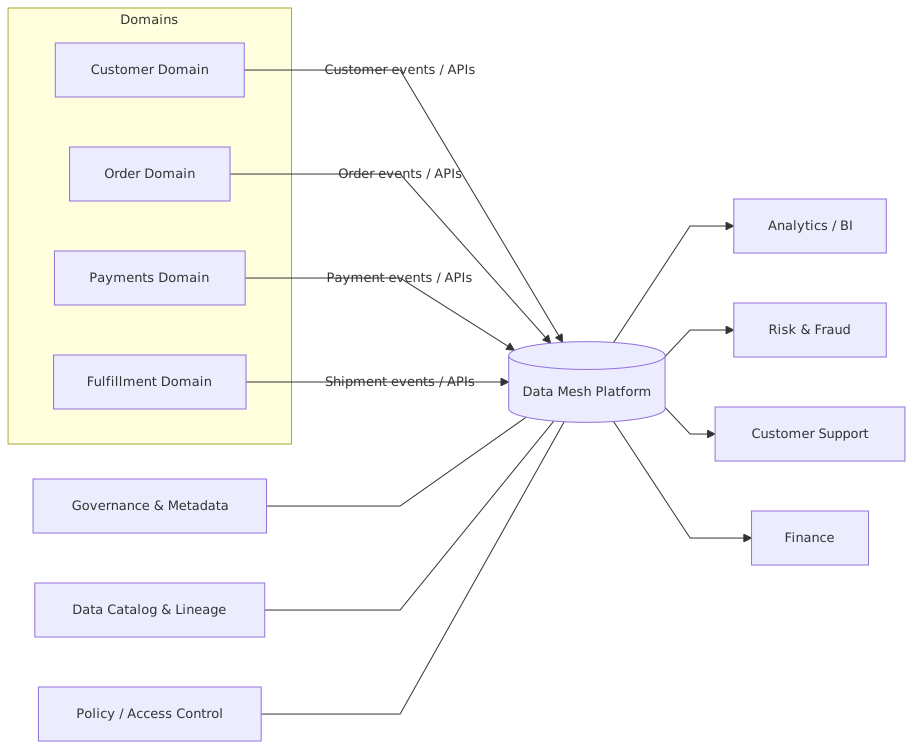
A robust data mesh architecture treats data ownership as a domain concern and data access as a product concern.
Core idea
Each domain publishes one or more data products:
- Operational interfaces for transactional use, often APIs.
- Event streams for state changes and domain events, often Kafka.
- Analytical products for broad read access, often in a warehouse or lakehouse.
- Reference views or query endpoints for low-latency lookups where justified.
The owning domain is responsible for semantics, contract evolution, quality, and metadata. The platform is responsible for discoverability, access control, lineage tooling, schema registry, observability, and standard publishing paths.
Domain semantics come first
This is where domain-driven design is not optional garnish. A data concept belongs to the bounded context that can explain its invariants in business language.
For example:
- The Customer domain owns what constitutes a customer record.
- The Orders domain owns order lifecycle semantics.
- The Payments domain owns authorization, capture, refund, and settlement semantics.
- The Fulfillment domain owns shipment progression and exception states.
The enterprise may want a unified “customer 360.” Fine. But that does not mean one giant platform team owns all customer-related facts. It means multiple domains publish data products that can be composed. The 360 is a consumer-oriented projection, not a transfer of ownership.
That distinction is crucial. Otherwise, the first central team that creates the integrated view quietly becomes the semantic owner of everything, and the old bottleneck returns under a different logo.
Access patterns by use case
Not all reads are equal. A sensible architecture uses different access mechanisms depending on need.
- Transactional reads: use APIs or purpose-built read services. Stronger consistency, lower tolerance for transformation.
- Streaming consumption: use Kafka for domain events and change propagation. Good for reactive workflows and local projections.
- Analytical reads: use curated products in a warehouse or lakehouse. Broad access, historical analysis, lower operational coupling.
- Restricted sensitive access: use controlled APIs, tokenization, or privacy-preserving views.
This variety is healthy. The mistake is forcing every use case into one mechanism.
Canonical ownership with distributed read models
A practical pattern is to keep one canonical owner while allowing many local read models.
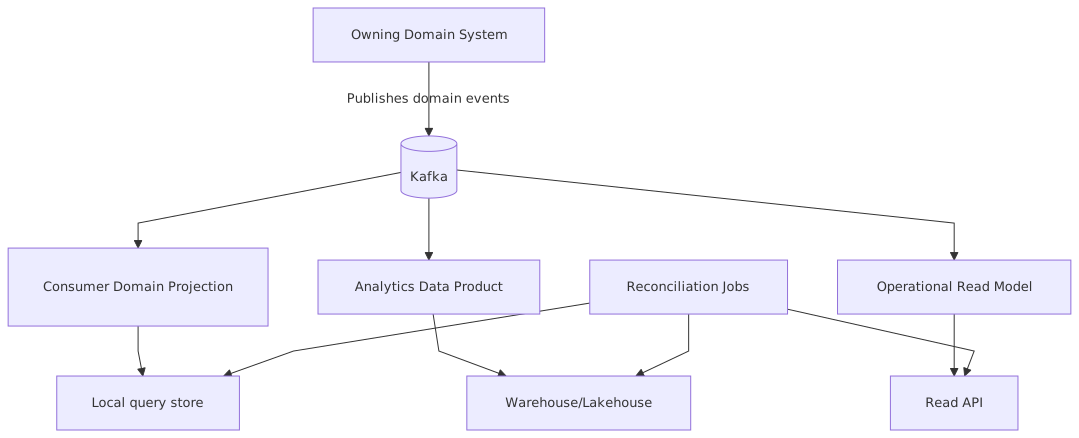
This gives consumers autonomy without write ambiguity. But it also creates a new obligation: reconciliation.
Reconciliation is not a corner case
Event-driven enthusiasts often speak as if a stream is the truth and all else follows automatically. In production, streams are an approximation of change over unreliable networks with imperfect producers and consumers. Reconciliation is therefore not a repair tactic. It is part of the design.
Good architectures define:
- replay mechanisms,
- idempotent consumers,
- periodic re-snapshotting,
- hash or count-based completeness checks,
- correction events,
- and business procedures for disputed records.
If a shipment event is missed, support should not have to guess whether the order or fulfillment system is right. There should be a rule: fulfillment owns shipment status; discrepancies trigger a replay and, if needed, a compensating correction event.
That is architecture. Not wishful messaging.
Migration Strategy
Most enterprises cannot leap into this model. They have shared databases, ETL sprawl, warehouse-defined semantics, and political scars. So the migration needs to be progressive. A strangler pattern works well here.
Step 1: Identify the contested concepts
Find the data concepts that cause repeated confusion or duplicate logic:
- customer,
- order,
- invoice,
- payment status,
- shipment status,
- product availability.
Do not start with everything. Start where semantic ambiguity is expensive.
Step 2: Declare ownership explicitly
Create the first ownership vs read access matrix for those concepts. This can be rough initially. The key is to make the ambiguity discussable.
Expect arguments. Good. Ambiguity that stays polite becomes expensive later.
Step 3: Wrap direct reads
Where consumers read another domain’s database directly, introduce an explicit interface:
- an API,
- a published event stream,
- or a curated read product.
The first goal is not elegance. It is to stop new accidental coupling.
Step 4: Publish authoritative events
For owner domains, publish domain events or change events into Kafka with managed schemas and metadata. Avoid dumping internal tables blindly. Events should reflect domain meaning, not just storage mutations.
Step 5: Build consumer-owned projections
Allow consuming domains to create their own read models from owner-published products. This reduces pressure on owner teams to support every query shape while preserving semantic authority.
Step 6: Introduce reconciliation loops
This is where many migrations fail because they stop at streaming. Add replay, backfill, and drift detection before decommissioning old integration paths.
Step 7: Retire legacy shared paths
Only after access patterns are stable should you cut direct database reads, old ETL jobs, or central semantic transformations that duplicate domain logic.
A simple progressive view looks like this:

Migration reasoning
Why this order? Because semantic ownership without controlled access changes very little, and streaming without reconciliation simply moves inconsistency faster. The progression works because it handles both politics and technology:
- first reduce hidden coupling,
- then establish publication mechanisms,
- then let consumers regain autonomy safely,
- then shut down the old shortcuts.
That is the enterprise sequence. Not the conference talk sequence.
Enterprise Example
Consider a global retailer with e-commerce, stores, customer support, loyalty, and finance systems spread across regions. They have:
- a CRM,
- an order management system,
- a payment gateway integration layer,
- warehouse management,
- a cloud data lake,
- and three generations of reporting marts.
Everyone says the customer data is fragmented. They are right, but not in the way they think.
The real issue is that multiple teams claim authority over different slices of “customer”:
- CRM owns profile and preferences,
- loyalty owns membership tier,
- support owns contactability notes,
- fraud owns risk markers,
- finance owns legal billing identity.
The old architecture tried to solve this with a central master data hub plus nightly ETL into a warehouse. The result was slow, politically fraught, and semantically blurry. Support agents looked at one customer state, marketers saw another, and finance trusted neither.
The new model started differently. They decomposed the problem into concepts:
- Customer Profile owned by Customer domain,
- Loyalty Membership owned by Loyalty,
- Contact Consent owned by Customer with legal constraints,
- Fraud Risk Indicator owned by Fraud,
- Billing Identity owned by Finance.
Then they built an ownership vs read access matrix. Marketing was surprised to learn that broad read access to profile data did not grant them the right to redefine “active customer.” Finance was relieved that invoice identity could remain authoritative in its own domain rather than being overwritten by CRM enrichments.
Kafka became the propagation backbone. Customer, Loyalty, Orders, Payments, and Fulfillment published domain events. A customer 360 analytical product was built in the lakehouse, but explicitly labeled as a derived cross-domain projection. It was valuable, discoverable, and heavily used. It was not allowed to become the operational source of truth.
Support still needed low-latency access. So instead of querying five systems live, they built a support read model populated from owner-published events and corrected nightly via reconciliation jobs. When the projection drifted, ownership rules told them what to trust and how to repair it.
The result was not perfect consistency. That is fantasy. The result was managed inconsistency with clear authority. Which is what scalable enterprises actually need.
Operational Considerations
Good ownership models die quickly without operational discipline.
Metadata and discoverability
A data product nobody can find will be bypassed. Every published product should include:
- owner,
- schema,
- business definition,
- SLA/SLO,
- freshness,
- quality metrics,
- lineage,
- sensitivity,
- and sample usage guidance.
This belongs in a catalog and in team habits.
Schema evolution
If domains own semantics, they must evolve schemas responsibly. Use compatibility rules, versioning policies, and deprecation windows. Kafka with a schema registry helps, but it does not replace product stewardship.
Access control
Read access must be policy-driven, auditable, and proportionate. Do not confuse “mesh” with “open bar.” Sensitive domains like HR, fraud, and finance often need narrower interfaces than broad warehouse exposure.
Data quality ownership
The owning domain is accountable for quality at source. Platform teams may provide observability and scorecards, but they cannot infer meaning. Consumers are responsible for validating assumptions in their own projections too.
Latency expectations
Not every consumer needs real-time data. Forcing real-time propagation everywhere is expensive theater. Classify use cases:
- milliseconds for transactional decisions,
- seconds for operational coordination,
- hours for management reporting,
- days for some regulatory or historical workloads.
Reconciliation cadence
Define it upfront. Streaming plus periodic batch verification is often better than pretending one mode can do everything. Common techniques include:
- row-count checks,
- business-key coverage checks,
- aggregate balancing,
- watermark monitoring,
- dead-letter remediation,
- and snapshot-based repair.
Incident response
When data products disagree, responders need playbooks:
- identify the canonical owner,
- assess whether the issue is publication, transport, projection, or interpretation,
- replay or backfill where needed,
- issue correction events,
- and communicate affected downstream products.
Without this, “data incident” becomes a blame relay.
Tradeoffs
There is no free architecture here. Let’s be honest about the costs.
What you gain
- Clear semantic accountability
- Less accidental cross-domain coupling
- Better scalability of data publishing
- Safer autonomy for consuming teams
- More explicit governance
- Better fit between operational and analytical use cases
What you pay
- More interfaces to manage
- More metadata work
- More need for platform capabilities
- More reconciliation logic
- More upfront decisions about ownership boundaries
- More organizational friction during transition
A central warehouse with one semantic team is simpler to explain. It is just usually less honest about where meaning really lives and less scalable when the business changes quickly.
The ownership vs access split is not cheaper. It is more sustainable.
Failure Modes
This approach fails in predictable ways.
1. Ownership theater
A domain is named “owner” but lacks real authority over upstream processes, schema decisions, or quality investment. They are accountable without power. That is bureaucracy, not architecture.
2. Read access sprawl
Everyone is granted broad access “temporarily.” Soon every product is depended on by dozens of consumers with incompatible expectations. You have recreated the shared database problem one layer higher.
3. Event dumping
Teams publish raw CDC or internal table changes and call it a data product. Consumers then reverse-engineer semantics from implementation detail. This is integration debt in streaming clothing.
4. No reconciliation path
Consumers trust event propagation blindly. After a missed deployment, partition issue, or schema bug, projections diverge and nobody knows how to repair them. Confidence collapses.
5. Derived products become shadow authorities
A customer 360, risk mart, or finance dashboard starts overriding owner domains in operational decisions. The organization drifts back to central semantic control without admitting it.
6. Ownership too granular
If every attribute has a different owner, governance becomes absurd. Domains should own coherent concepts, not atomized fields unless there is a compelling legal or business reason. ArchiMate for governance
7. Platform overreach
The platform team starts defining canonical business models for all domains “for consistency.” That is the old hub-and-spoke disease returning with cloud-native vocabulary. cloud architecture guide
When Not To Use
There are situations where a full ownership vs read access model inside a data mesh is unnecessary or actively unhelpful.
Small organizations with simple domains
If you have one or two product teams, a modest analytical footprint, and low regulatory burden, a simpler centralized model may be entirely sufficient. Do not adopt distributed ownership because it sounds modern.
Stable, low-change data environments
If the business model is stable, data volume is modest, and semantic conflict is rare, the overhead of domain data products and platform governance may outweigh the benefit.
Strongly centralized regulated data functions
In some industries, certain data classes are so tightly controlled that domain autonomy is constrained by law or by internal risk posture. Even then, ownership still matters semantically, but implementation may need a more centralized operating model.
Organizations without domain maturity
If teams cannot articulate bounded contexts, invariants, and product responsibilities, data mesh will amplify confusion. Domain-driven design thinking is a prerequisite, not a decoration.
No appetite for platform investment
Without cataloging, lineage, access control, schema management, and observability, this model degrades quickly. If the enterprise will not fund platform capabilities, do not pretend process alone will save it.
A blunt rule: if your main problem is reporting backlog, do not reach for data mesh first. If your main problem is semantic conflict and ownership ambiguity across many domains, now you are in the right neighborhood.
Related Patterns
Several adjacent patterns matter here.
Bounded Context
From domain-driven design, this is the anchor for semantic ownership. Data ownership should align with bounded contexts wherever possible.
Data Product
The vehicle through which a domain shares data with others. It needs a contract, metadata, quality expectations, and support model.
CQRS Read Models
Useful when many consumers need optimized reads without write access. The owner publishes events; consumers build projections.
Event-Carried State Transfer
Helpful for distributing domain state, but dangerous when consumers mistake transferred state for transferred authority.
API Composition
Still useful for some transactional views. Not every cross-domain read should become a replicated projection.
Change Data Capture
Sometimes valuable as a migration bridge, especially in strangler approaches. But CDC is not a domain model. Treat it as plumbing, not semantics.
Master Data Management
Often overlaps in customer, product, or supplier contexts. In some enterprises, MDM can coexist with data mesh, but only if ownership is explicit and not hidden inside central stewardship dogma.
Summary
The cleanest way to think about data ownership in a data mesh is this:
Ownership answers who has the authority to define and change meaning. Access answers who may consume that meaning.
Those decisions are related, but they are not the same. Treating them as the same creates either silos or chaos.
A practical enterprise approach is to establish an ownership vs read access matrix for critical business concepts, align ownership to bounded contexts, publish data as domain products through APIs, Kafka streams, and analytical views, and support consumer autonomy with local read models. Then do the unglamorous but essential work: schema stewardship, access policies, metadata, reconciliation, and migration through a progressive strangler pattern.
The hard truth is that copied data is inevitable. The important question is not how to avoid copies. It is how to preserve authority when copies spread. That means declaring canonical owners, making read rights explicit, and designing for drift rather than denying it.
Data mesh does not remove enterprise politics. It simply forces them into the open, where architecture can do some good.
And that is the real win. Not perfect consistency. Not magical decentralization.
Just a company that knows, for each important fact, who gets to say what it means, who gets to read it, and what happens when the copies disagree.
Frequently Asked Questions
What is a data mesh?
A data mesh is a decentralised data architecture where domain teams own and serve their data as products. Instead of a central data team, each domain is responsible for data quality, contracts, and discoverability.
What is a data product in architecture terms?
A data product is a self-contained, discoverable, trustworthy dataset exposed by a domain team. It has defined ownership, SLAs, documentation, and versioning — treated like a software product rather than an ETL output.
How does data mesh relate to enterprise architecture?
Data mesh aligns data ownership with business domain boundaries — the same boundaries used in domain-driven design and ArchiMate capability maps. Enterprise architects play a key role in defining the federated governance model that prevents data mesh from becoming data chaos.