Architecture
Anti-Pattern Catalog
16 enterprise architecture anti-patterns across four domains. Each pattern includes symptoms to watch for, root causes, severity rating, and concrete remediation steps.
Download the PDF
3-page printable reference. All 16 anti-patterns with symptoms, severity, and remediation — landscape A4.
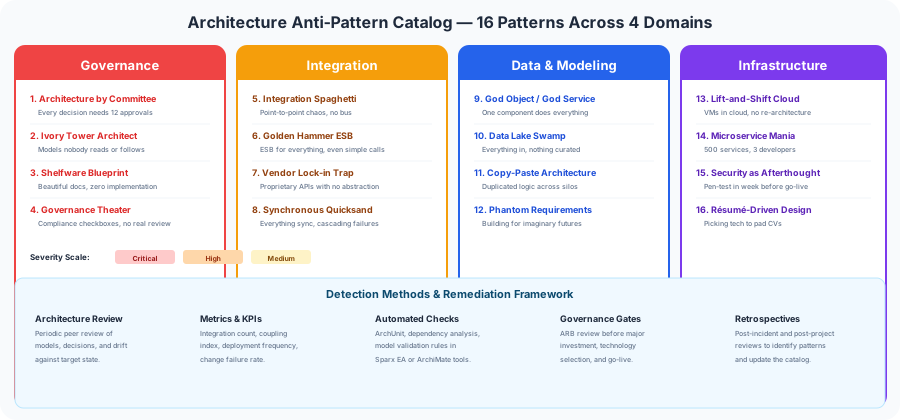
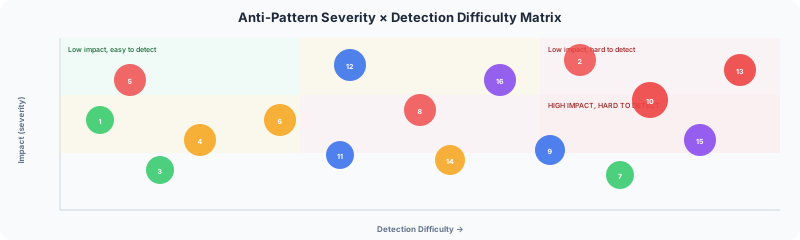
All 16 Anti-Patterns
Governance
#1Architecture by Committee
HighSymptoms: Decision paralysis, 6+ month review cycles, watered-down standards that offend nobody and help nobody.
✓ Remediation: Define clear RACI. Empower domain architects to decide within guardrails. Reserve committee for strategic-level decisions only.
#2Ivory Tower Architect
CriticalSymptoms: Models nobody reads, target states nobody can reach, growing irrelevance of the EA function.
✓ Remediation: Embed architects in delivery teams. Co-create models with implementers. Validate every artifact with implementation feedback.
#3Shelfware Blueprint
MediumSymptoms: Beautiful 200-page document, zero implementation progress, next full rewrite scheduled in 2 years.
✓ Remediation: Publish incrementally. Link every architecture decision to a funded initiative. Kill documents that have no implementation owner.
#4Governance Theater
HighSymptoms: Every proposal approved without challenge, no exceptions ever recorded, compliance is a checkbox exercise.
✓ Remediation: Publish ARB rejection rates. Record Architecture Decision Records (ADRs). Conduct reviews with genuine authority to reject.
Integration
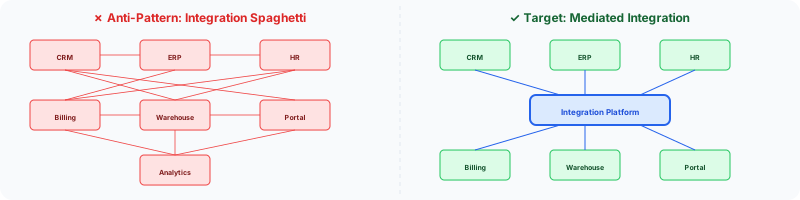
#5Integration Spaghetti
CriticalSymptoms: Any change breaks 5 systems. Nobody knows all the interfaces. End-to-end testing is impossible.
✓ Remediation: Introduce an integration platform. Enforce canonical data models. API-first design with versioning.
#6Golden Hammer ESB
MediumSymptoms: ESB is the bottleneck. Simple REST call routed through 7 ESB transformations and 3 queues.
✓ Remediation: Right-size integration patterns: direct API for simple calls, event bus for pub/sub, ESB only for complex orchestration.
#7Vendor Lock-in Trap
HighSymptoms: Switching vendors requires full rewrite. Vendor controls your roadmap and pricing unilaterally.
✓ Remediation: Anti-corruption layers at every vendor boundary. Standard interfaces (OpenAPI, AsyncAPI). Evaluate exit cost before every contract.
#8Synchronous Quicksand
CriticalSymptoms: Cascading timeouts. 99.9% availability per service means 99% at 10 hops. Peak load causes avalanche failure.
✓ Remediation: Default to async/event-driven. Circuit breakers and bulkheads for sync calls. Synchronous only where latency truly requires it.
Data & Modeling
#9God Object / God Service
HighSymptoms: One service owns 40 database tables. Every change is high-risk. Cannot scale or deploy independently.
✓ Remediation: Decompose along bounded contexts. Apply the single responsibility principle. Use domain-driven design to find natural boundaries.
#10Data Lake Swamp
CriticalSymptoms: Nobody trusts the data. Analysts spend 80% of their time cleaning. No lineage, no catalog, no ownership.
✓ Remediation: Implement data zones (raw → curated → published). Assign data stewards per domain. Enforce metadata and quality standards.
#11Copy-Paste Architecture
MediumSymptoms: Price calculation exists in 4 systems, each slightly different. A bug fix must be applied 4 times.
✓ Remediation: Identify canonical business services. Centralize shared logic into reusable services or libraries with clear ownership.
#12Phantom Requirements
MediumSymptoms: Over-engineered abstractions. 10x complexity built for hypothetical future needs that never materialize.
✓ Remediation: Apply YAGNI. Build for known, validated requirements. Refactor when genuine new needs actually emerge.
Infrastructure
#13Lift-and-Shift Cloud
CriticalSymptoms: Cloud costs exceed on-premises. No elasticity, no managed services, no cloud-native benefits achieved.
✓ Remediation: Cloud-native roadmap. Prioritize workloads for re-platform vs re-architect vs retain. Measure cloud ROI per workload.
#14Microservice Mania
HighSymptoms: Distributed monolith. 500 services maintained by 3 developers. Debugging requires tracing across 12 services.
✓ Remediation: Start with a well-structured modular monolith. Extract services only when team size and scale genuinely justify the overhead.
#15Security as Afterthought
CriticalSymptoms: Critical vulnerabilities discovered in the final sprint. Expensive emergency rework or reluctantly accepted risk.
✓ Remediation: Shift-left security: threat modeling during design, DevSecOps pipeline, security architecture review at project inception.
#16Resume-Driven Design
HighSymptoms: Kubernetes cluster for a 3-page website. Kafka for 10 events per hour. Team cannot maintain the stack.
✓ Remediation: Technology radar (adopt/trial/assess/hold). Match technology to actual scale, team skill, and operational capacity.
Build governance that prevents these anti-patterns
Our architecture training covers governance frameworks, review processes, and modeling practices that help organizations detect and remediate anti-patterns before they cause damage.